
1. Kupu Whakataki
This manual provides essential information for the safe and efficient operation, installation, and maintenance of your Steinbach SPS 100-1 self-priming filter pump. Please read all instructions carefully before installation and use. Keep this manual for future reference.
2. Nga Tohutohu Haumaru
Mōhiohio Haumaru Nui:
- Me momotu te papu i te pūnaha hiko i mua i te mahi i tētahi mahi tiaki, horoi rānei.
- Ensure the electrical installation complies with local regulations and is protected by a Residual Current Device (RCD) with a tripping current not exceeding 30 mA.
- Do not operate the pump if the power cord or plug is damaged. Contact qualified personnel for repairs.
- The pump must be installed on a solid, level surface, protected from direct sunlight and rain.
- Ensure adequate ventilation around the pump motor to prevent overheating.
- Ko tenei taputapu ehara i te mea mo te whakamahi ma te hunga (tae atu ki nga tamariki) he iti te kaha o te tinana, te tairongo, te hinengaro, te kore wheako me te mohiotanga, mena ka tukuna atu ki a raatau te tirotiro, te tohutohu ranei mo te whakamahi i te taputapu e te tangata whai mana mo to raatau haumaru.
- Me mataki nga tamariki kia kore ai ratou e takaro ki te taputapu.
3. Hua Neke Atuview
The Steinbach SPS 100-1 is a self-priming filter pump designed for efficient water circulation in swimming pool filter systems, such as the Speed Clean Comfort 75. It operates without a built-in timer, offering continuous operation when powered.
Waehanga
- Pump body with motor
- Pre-filter basket with transparent lid
- Nga hononga uru me te putanga
- Te taura hiko me te mono

Whakaatu 1: Neke Atuview of the Steinbach SPS 100-1 Self-Priming Filter Pump.
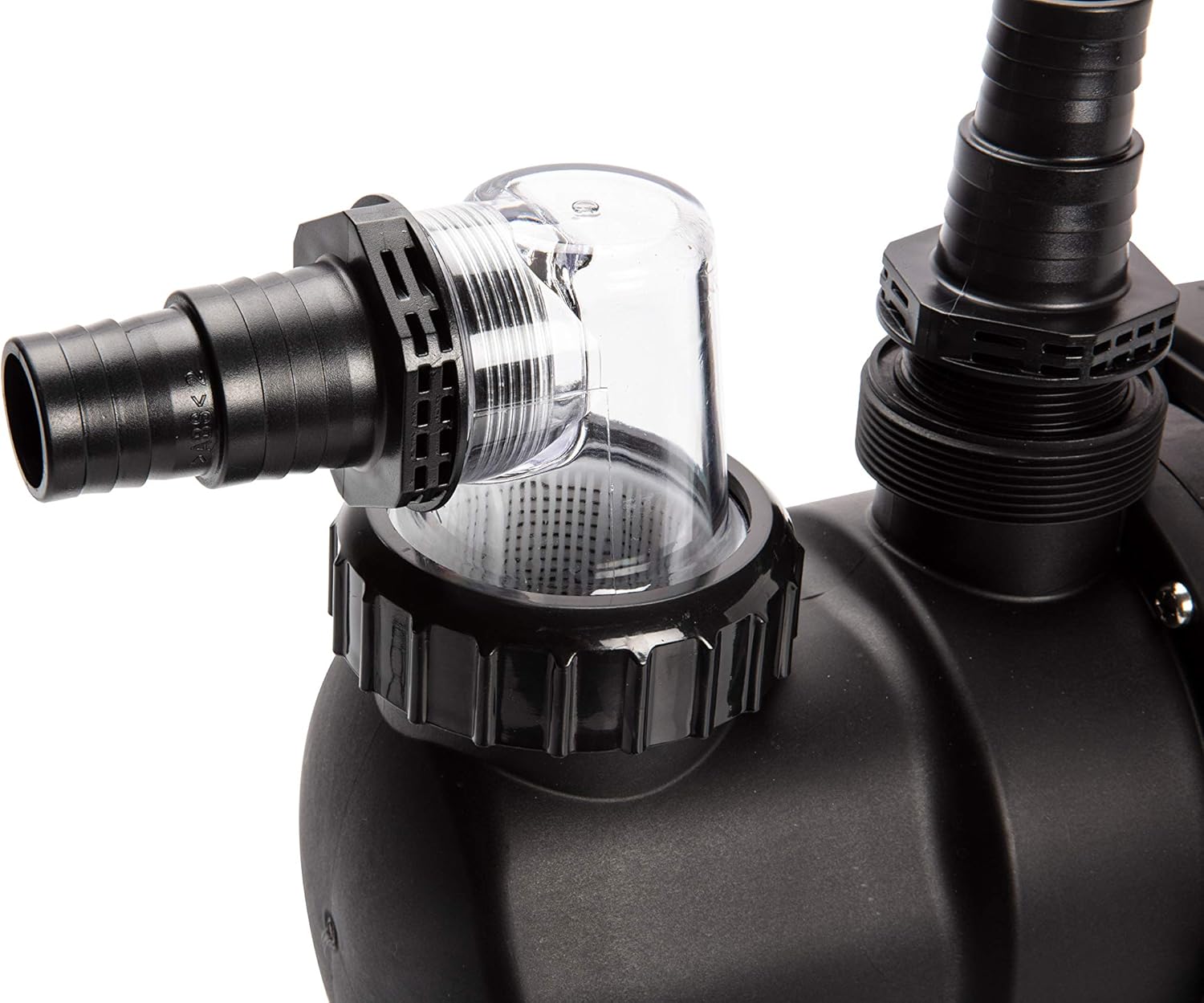
Whakaahua 2: Whakatata view of the pre-filter housing and the inlet connection with a hose attached. The transparent lid allows for easy inspection of the filter basket.

Whakaatu 3: Taipitopito view of the pre-filter and the threaded inlet connection, ready for hose attachment.

Figure 4: Close-up of the pump's outlet connection with a hose securely fastened, directing filtered water.

Whakaatu 5: Taipitopito view of the pump's threaded outlet connection, showing the port where the return hose connects.

Figure 6: Product label displaying technical specifications such as model number, voltage, power, and flow rate.
4. Tatūnga me te Tāuta
Proper installation is crucial for the pump's performance and longevity. Refer to your specific filter system manual for detailed plumbing instructions.
4.1 Whakanoho
- Position the pump as close to the pool as possible, below water level if feasible, to aid in self-priming.
- Ensure the pump is on a stable, level, and dry surface.
- Protect the pump from direct weather exposure (rain, snow, direct sunlight).
- Allow sufficient space around the motor for ventilation and maintenance access.
4.2 Hononga Paipa
- Connect the suction line from the pool skimmer/main drain to the pump's inlet (front connection).
- Connect the discharge line from the pump's outlet (top connection) to the filter system's inlet.
- Use appropriate fittings, clamps, and thread sealant (Teflon tape) to ensure watertight connections.
- Avoid kinks or sharp bends in hoses to maintain optimal flow.
4.3 Hononga Hiko
- Me whakarite kia rite te toha hiko ki te puo o te paputage (230 V).
- Plug the pump into a grounded electrical outlet protected by an RCD.
- Kaua e whakamahi i ngā taura toronga ki te kore e tino tika, ā, kia tino mōhio kei te tika mō te whakamahinga o waho, me te mana hoki e hiahiatia ana e te papu.
5. Nga Tohutohu Whakahaere
5.1 Te Whakapai i te Puma
As a self-priming pump, the SPS 100-1 can draw water, but initial priming is recommended for faster startup:
- Ensure all valves are open, allowing water to flow from the pool to the pump.
- Remove the transparent lid of the pre-filter.
- Fill the pre-filter housing completely with water.
- Replace the lid securely, ensuring the O-ring is properly seated to prevent air leaks.
- Turn on the pump. It should begin to draw water and expel air. If it does not prime within a few minutes, turn it off, re-check connections, and repeat the priming process.
5.2 Te Mahi Noa
- Once primed, the pump will continuously circulate water through your filter system.
- Monitor the pressure gauge on your filter (if applicable) to determine when backwashing or filter cleaning is needed.
- This model does not include a timer, so you will need to manually switch it on and off or connect it to an external timer (not included).
6. Tiaki
6.1 Pre-Filter Basket Cleaning
Regularly inspect and clean the pre-filter basket to prevent debris buildup and maintain pump efficiency.
- Turn off the pump and disconnect it from the power supply.
- Katia ngā takirere e tika ana hei ārai i te rere o te wai mai i te puna kaukau.
- Wetekina te taupoki mārama o te tātari-mua.
- Tangohia te kete ka ringihia ngā paru kua kohia.
- Horoihia te kete ki te wai.
- Tirohia te O-ring i runga i te taupoki mō te pakaru, kia tino ma ai.
- Replace the basket and securely fasten the lid.
6.2 Te whakatotoke
Before freezing temperatures arrive, properly winterize your pump to prevent damage:
- Momotuhia te papu mai i te hiko.
- Drain all water from the pump by removing the drain plug (usually located at the bottom of the pump housing).
- Disconnect all hoses and pipes.
- Clean the pre-filter basket and housing.
- Penapenahia te papu ki te wāhi maroke, kāore he huka.
7. Te Raru
| Raruraru | Take pea | Rongoā |
|---|---|---|
| Kaore e timata te papu | No power; tripped breaker/RCD; motor jammed | Check power connection, reset breaker/RCD; contact service if motor is jammed. |
| Pump runs but does not prime/no water flow | Air leak in suction line; pre-filter basket clogged; insufficient water in pre-filter; low pool water level | Check all connections for air leaks; clean pre-filter basket; fill pre-filter with water; ensure adequate pool water level. |
| He iti te rere o te wai | Clogged pre-filter; clogged main filter; partially closed valves; debris in impeller | Clean pre-filter; backwash/clean main filter; open all valves fully; inspect impeller for debris (disconnect power first). |
| Loud noise/vibration | Air in pump; cavitation; loose mounting; worn bearings | Check for air leaks and prime pump; ensure adequate water supply; tighten mounting bolts; contact service for worn bearings. |
8. Whakatakotoranga
| Āhuahira | Whakatakotoranga |
|---|---|
| Tau tauira | 040922 |
| Momo | Self-Priming Filter Pump |
| Voltage | 230 V |
| Mana | 550 W |
| Rere Rere Morahi | 158 Liters Per Minute (9.400 l/h) |
| Teitei Upoko Morahi | 10 Mita |
| Rauemi | Stainless Steel (motor components), Durable Plastic (pump housing) |
| Taumaha | 5.96 kg |
| Tae | Pango |
| Ngā āhuatanga | Self-priming, No integrated timer, Suitable for Speed Clean Comfort 75 sand filter systems |
9. Pūtāhui me te Tautoko
For warranty information and technical support, please refer to the documentation provided with your purchase or contact Steinbach customer service directly. Keep your proof of purchase for warranty claims.
Mōhiohio Whakapā:
- Manufacturer: Steinbach
- Webpae: www.steinbach.at (Please check for local support details)