
1. Hua Neke Atuview
The BFT P121011 Intro Key Selector is a robust, surface-mounted key switch designed for controlling access systems, such as automatic gates or doors. It features a durable plastic construction and operates with a normally closed contact type, providing a secure and reliable control mechanism.
This device utilizes a key for activation, offering a simple on-off operational mode. It is designed for a single-circuit application and connects via screw terminals for straightforward wiring.
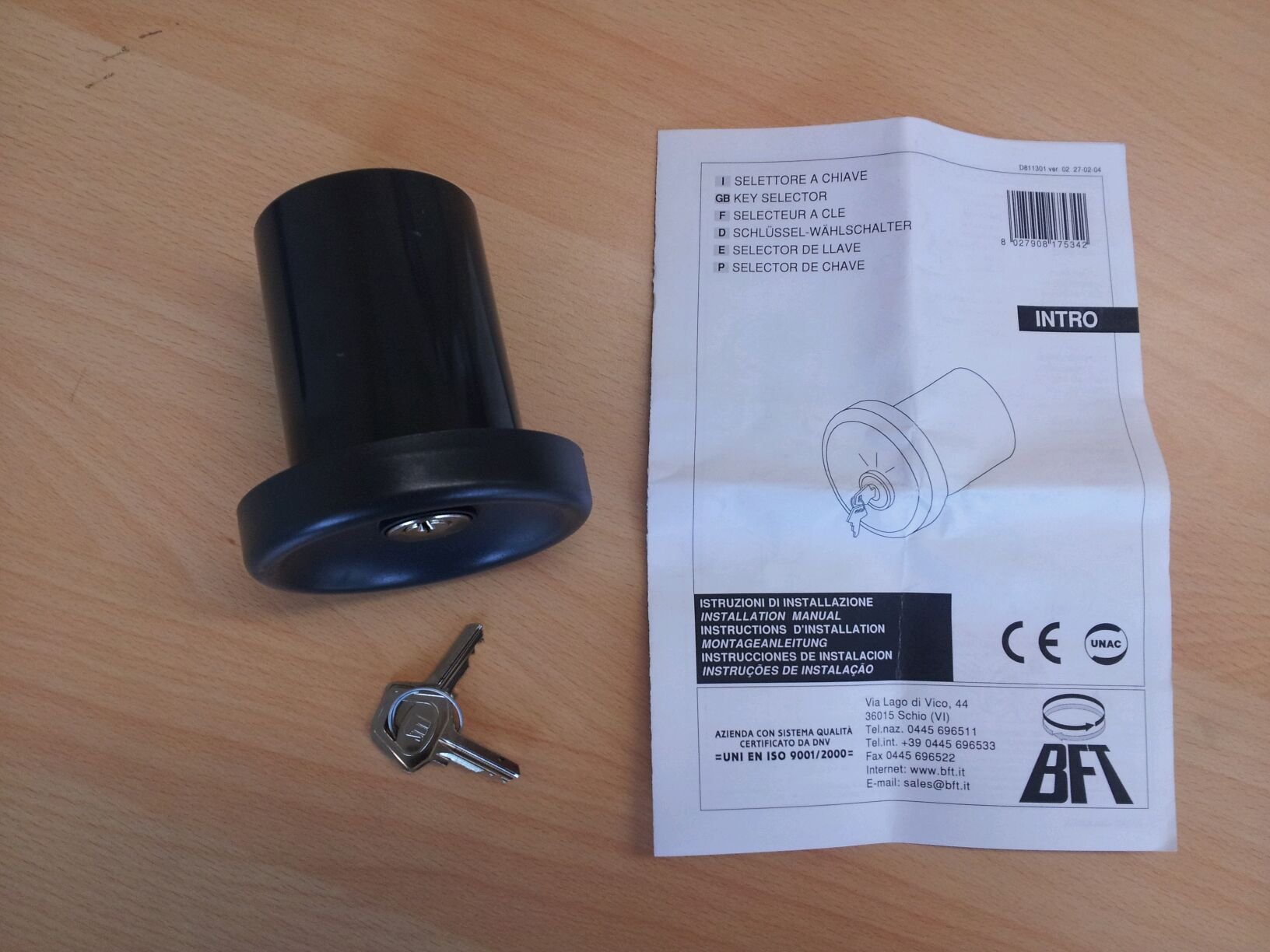
Figure 1: BFT P121011 Intro Key Selector. This image shows the circular key selector unit, dark gray in color, with the BFT logo at the top. Below the logo, the positions 'A', '0', and 'B' are marked around the central keyhole. Two silver keys are visible in the foreground, resting on a wooden surface.
2. Nga korero haumaru
- Me ata panui nga tohutohu katoa i mua i te whakaurunga me te whakamahi.
- Me tāuta e ngā kaimahi whai tohu, kia rite ki ngā ture me ngā whakaritenga hiko ā-rohe.
- Disconnect power to the system before performing any installation, maintenance, or troubleshooting.
- Me whakarite kia mau nga hononga waea katoa, kia tika hoki te kiriweti kia kore ai nga ara iahiko poto.
- Kaua e whakaatuhia te taputapu ki ngā pāmahana tino kino, ki te makuku, ki ngā matū waikura rānei.
- Keep keys out of reach of children and unauthorized personnel.
3. Whakatakotoranga
| Āhuahira | Whakatakotoranga |
|---|---|
| Waitohu | BFT |
| Tauira | P121011 |
| Aratau Mahi | Ki runga-atu |
| Momo Whakapā | Katia te tikanga |
| Momo Whakawhiti | Kī |
| Momo Kapeka | tīwiri |
| Rauemi | Kirihou |
| Ahu (LxWxH) | 30 x 195 x 260 cm (Note: These dimensions seem unusually large for a key selector. Please verify with product packaging.) |
| Momo iahiko | 1 ara |
| Momo Whakaeke | Mata |
| Momo Whakaoho | Button, Knob (Note: This refers to the key as the actuator) |
4. Tāuta me te Tatūnga
4.1. Nga Tirohanga i mua i te whakaurunga
- Manatokohia kei te noho katoa nga waahanga me te kore e pakaru.
- Ensure the mounting surface is flat, stable, and suitable for surface mounting.
- Confirm that the power supply to the gate or access system is disconnected.
4.2. Te Whakamau i te Kōwhiringa Kī
- Choose an appropriate location for the key selector, ensuring it is easily accessible but protected from potential damage.
- Mark the drilling points on the mounting surface using the key selector's base as a template.
- Porohia nga kohao pairati ki nga waahi kua tohua.
- Secure the key selector base to the surface using appropriate screws and fasteners (not included).
4.3. Hononga Waea
- Route the necessary control cables through the designated entry points on the key selector's housing.
- Connect the control wires to the screw terminals inside the key selector. Refer to the wiring diagram provided with your gate or access system control unit for specific connections. The key selector typically acts as a momentary contact switch.
- Me whakarite kia piri, kia mau hoki nga hononga katoa.
- Close the key selector housing, ensuring it is properly sealed.
4.4. I muri i te whakaurunga
- Whakahokia te mana ki te punaha.
- Test the key selector's functionality as described in the Operating Instructions section.
5. Nga Tohutohu Whakahaere
The BFT P121011 Intro Key Selector provides a simple, key-operated control for your access system.
- Whakauruhia te Kī: Insert the provided key into the keyhole on the front of the selector.
- Whakahohe: Turn the key to the desired position (e.g., 'A' or 'B' if multiple functions are supported, or simply to activate the single function). The key selector is designed to provide a momentary contact closure, which signals the connected control unit to perform an action (e.g., open/close gate).
- Kī Whakahoki: After activation, return the key to the '0' (neutral) position and remove it. The key selector will return to its normally closed state.
The specific action triggered by turning the key (e.g., opening, closing, or stopping a gate) depends on how the key selector is wired to the main control unit of your access system.
6. Tiaki
Regular maintenance ensures the longevity and reliable operation of your BFT P121011 Intro Key Selector.
- Te horoi: Periodically clean the exterior of the key selector with a soft, damp kakahu. Kaua e whakamahi i nga kai horoi me nga whakarewa.
- Keyhole Inspection: Ensure the keyhole remains free of debris. If necessary, use a small, soft brush to clear any obstructions. Avoid using lubricants that may attract dust.
- Taki Waea: Annually, or if issues arise, disconnect power and inspect the wiring connections inside the unit for any signs of corrosion or loosening. Re-tighten connections as needed.
- Te Tikanga Matua: Inspect the keys for wear or damage. Worn keys may not operate the selector smoothly or reliably.
7. Te Raru
| Raruraru | Take pea | Rongoā |
|---|---|---|
| Key selector does not activate the system. | Kaore he mana ki te waahanga whakahaere. Waea hape. Faulty key selector contacts. |
Check power supply to the main control unit. Verify wiring connections against the system's diagram. Test the key selector's contacts with a multimeter. Replace if faulty. |
| Key is difficult to turn or remove. | Debris in keyhole. Worn key or lock mechanism. |
Clean keyhole with a soft brush. Try a different key. If issue persists, the lock mechanism may need replacement. |
| Te mahi mokowhiti. | Nga hononga waea korekore. Te wawaotanga o te taiao. |
Tirohia me te whakakaha i nga hononga waea katoa. Ensure the unit is properly sealed and protected from elements. |
8. Pūtāhui me te Tautoko
Specific warranty information for the BFT P121011 Intro Key Selector is typically provided at the point of purchase or within the product packaging. Please refer to your purchase documentation for details regarding warranty coverage and duration.
For technical support, spare parts, or service inquiries, please contact your authorized BFT dealer or the BFT customer service department. Contact information can usually be found on the BFT official webpae, i roto ranei i nga tuhinga taketake o te hua.