
1. Kupu Whakataki
This manual provides essential information for the safe and effective installation, operation, and maintenance of the ABB XT1B 160 TMD 160-1600 4P F F Circuit Breaker. Please read this manual thoroughly before attempting any procedures to ensure proper handling and to prevent potential hazards. This device is designed for electrical protection in various applications.
2. Nga korero haumaru
WHAKATŪPATO: Electrical shock hazard. Only qualified and authorized personnel should perform installation, maintenance, and troubleshooting procedures. Failure to comply with these instructions may result in serious injury or death.
- Always disconnect power before working on the circuit breaker or associated equipment.
- Use appropriate personal protective equipment (PPE) such as insulated gloves and eye protection.
- Ensure all local and national electrical codes and regulations are followed during installation and operation.
- Do not operate the circuit breaker if it appears damaged or if any components are missing.
3. Hua Neke Atuview
The ABB XT1B 160 TMD 160-1600 4P F F is a robust circuit breaker designed for reliable overcurrent protection. It features a Thermal-Magnetic Device (TMD) for both overload and short-circuit protection. This 4-pole fixed-fixed version is rated for 160 Amps, providing essential safety for electrical systems.
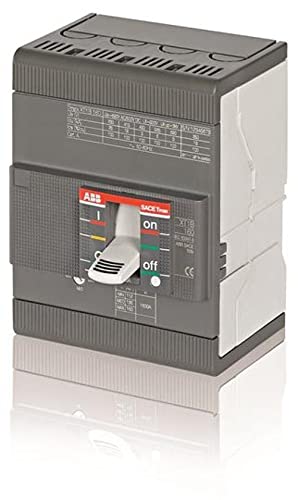
Whakaahua 1: Mua view of the ABB XT1B 160 TMD 160-1600 4P F F Circuit Breaker. This image shows the main body of the circuit breaker, typically white or light-colored, with visible terminals and the trip unit mechanism.
4. Tatūnga me te Tāuta
Installation of the ABB XT1B 160 TMD 160-1600 4P F F Circuit Breaker must be performed by a qualified electrician in accordance with all applicable electrical codes and standards.
4.1 Whakapiki
- Ensure the mounting surface is stable and capable of supporting the breaker's weight (approximately 28.5 pounds).
- Mount the breaker in an enclosure that provides adequate protection from environmental factors and unauthorized access.
- Use appropriate fasteners to secure the breaker firmly in place.
4.2 Waea Whakahoahoa
- Connect the incoming power supply to the designated input terminals and the load to the output terminals.
- Me whakarite kia piri, kia mau nga hononga katoa kia kore ai e wetewete nga hononga me te wera nui.
- Verify correct polarity and phase sequence for multi-phase installations.
- The included components are XT1B 160 TMD 160-1600 4p F F InN=50%.
5. Nga Tohutohu Whakahaere
The circuit breaker is designed for straightforward operation.
5.1 Turning ON the Breaker
- Me whakarite kua reri nga uta katoa o raro ki te whiwhi hiko.
- Move the operating handle to the 'ON' position. The breaker is now closed, and power is supplied to the circuit.
5.2 Turning OFF the Breaker
- Move the operating handle to the 'OFF' position. This opens the circuit, disconnecting power to the load.
5.3 Trip Indication and Reset
- If an overload or short-circuit occurs, the breaker will automatically trip to protect the circuit. The operating handle will move to an intermediate 'TRIPPED' position.
- To reset a tripped breaker, first move the handle fully to the 'OFF' position, then move it to the 'ON' position.
- Investigate and resolve the cause of the trip before resetting the breaker to prevent further issues.
6. Tiaki
Regular maintenance helps ensure the longevity and reliable operation of your circuit breaker. Always disconnect power before performing any maintenance.
- Tirohanga Ia Wa: Visually inspect the breaker and its connections for any signs of damage, discoloration, or loose wiring.
- Te horoi: Keep the breaker free from dust and debris. Use a dry, lint-free cloth for cleaning. Do not use solvents or abrasive cleaners.
- Taki Hononga: Periodically check terminal connections for tightness.
7. Te Raru
This section addresses common issues you might encounter with the circuit breaker.
| Raruraru | Take pea | Rongoā |
|---|---|---|
| He maha nga haerenga a te kaiwhati | Overload, short-circuit, ground fault, or faulty appliance. | Reduce load on the circuit, inspect wiring for short circuits, check appliances for faults. If the problem persists, consult a qualified electrician. |
| Kare a Breaker e tautuhi | Persistent fault on the circuit, internal breaker damage. | Ensure the fault is cleared. If it still does not reset, the breaker may be damaged and require replacement by a qualified professional. |
| He wera te pakaru ki te pa | Te taumaha rawa, te ngoikore o ngā hononga, te kino o roto rānei. | Immediately disconnect power. Check for overload conditions and tighten all connections. If the issue persists, replace the breaker. |
8. Whakatakotoranga
Detailed technical specifications for the ABB XT1B 160 TMD 160-1600 4P F F Circuit Breaker.
| Whakatakotoranga | Uara |
|---|---|
| Kaihanga | FIG |
| Nama Wahi | XT1B160TMD4 |
| Tauira Tuemi | 1SDA066820R1 |
| Taumaha Tūemi | 28.5 pauna |
| Hunga Hua | 6.61 x 28.31 x 13.78 inihi |
| Tae | Mā |
| Amperact Raukaha | 160 Amps |
| Te Rahi Paanui | 1 |
| Nga Waahanga kei roto | XT1B 160 TMD 160-1600 4p F F InN=50% |
| EAN | 8015644694548 |
| Kei roto nga pākahiko? | Kao |
| Pikohiko e hiahiatia ana? | Kao |
| Te Ra Tuatahi Wātea | Hanuere 1, 2025 |
9. Pūtāhui me te Tautoko
This ABB XT1B 160 TMD 160-1600 4P F F Circuit Breaker is covered by a worldwide ABB warranty. For specific warranty terms and conditions, please refer to the official ABB warranty documentation or contact ABB customer support.
For technical assistance, troubleshooting beyond this manual, or warranty claims, please contact ABB customer service or visit the official ABB website. Ensure you have your product model number (XT1B 160 TMD 160-1600 4P F F) and serial number (if applicable) ready when contacting support.