
1. Kupu Whakataki
This manual provides essential instructions for the safe operation and maintenance of your VTech VM333 Safe & Sound Video Baby Monitor. Please read this manual thoroughly before using the product to ensure proper setup and functionality. The VTech VM333 is designed to help you monitor your baby with a high-resolution color LCD screen, automatic night vision, and two-way audio communication.
2. Hua Neke Atuview
The VTech VM333 system includes a Parent Unit (monitor) and a Baby Unit (camera). Familiarize yourself with the components and controls of each unit.
2.1. Parent Unit
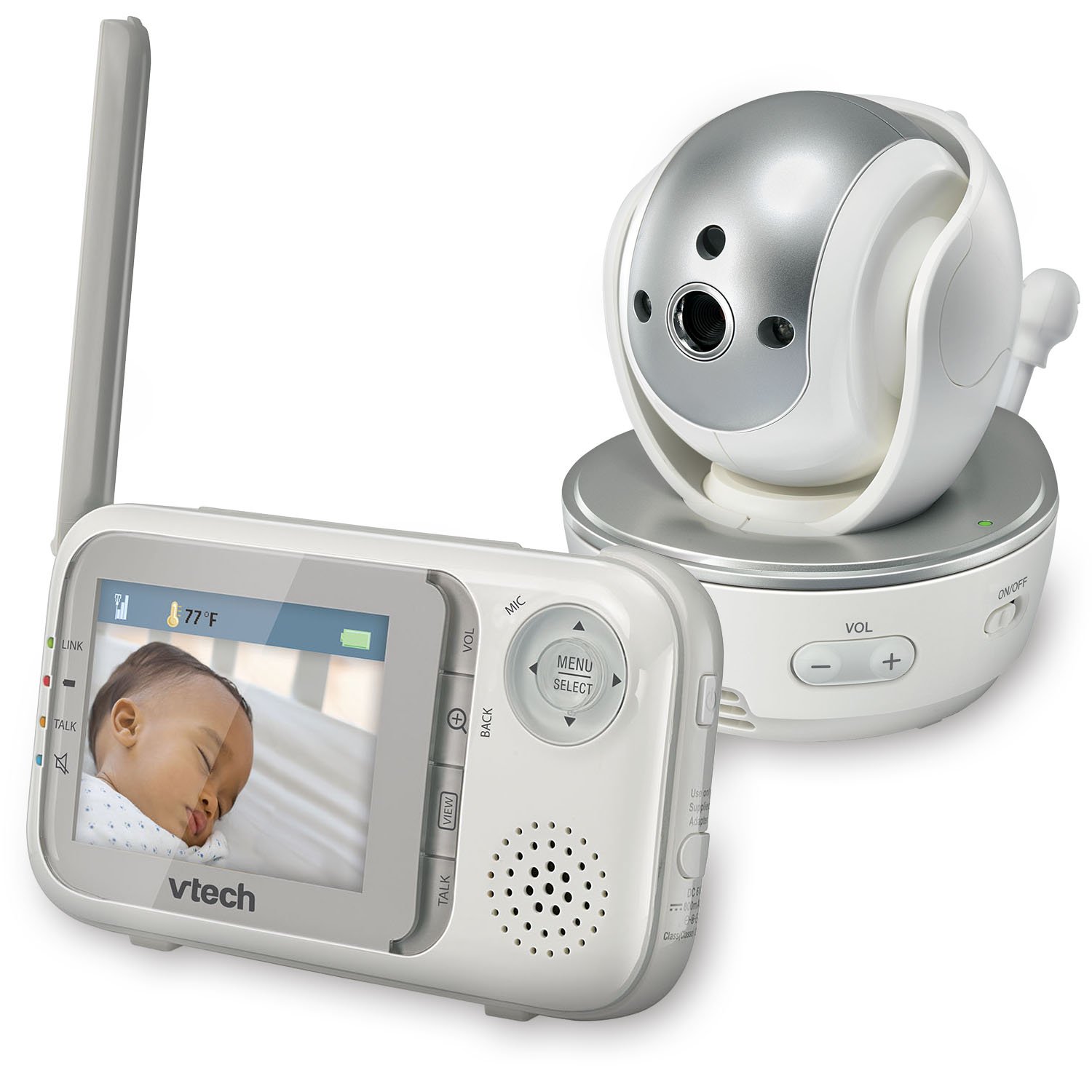
Whakaahua: Mua view of the VTech VM333 Parent Unit.
- 2.8-inihi Tae LCD Mata: Displays live video feed from the Baby Unit.
- MENU/SELECT Button: Accesses menu options and confirms selections.
- Ngā Pere Aronga (Runga/Raro/Mauī/Matau): Navigates menus and controls camera pan/tilt.
- ZOOM Button (+/-): Magnifies the video image.
- Pātene KORERO: Activates two-way audio communication.
- VOLUME Buttons (+/-): Adjusts the Parent Unit speaker volume.
- Tohu Hononga: Shows connection status between units.
- Tohu Pūhiko: Ka whakaatu i te taumata pākahiko o naianei.
- Whakaaturanga Temperature: Shows the temperature detected by the Baby Unit.
2.2. Baby Unit (Camera)

Whakaahua: Mua view of the VTech VM333 Baby Unit camera.
- Arotahi kāmera: Hopu ataata.
- Nga LED Infrared: Provide night vision in low light conditions.
- hopuoro: Detects sound from the baby's room.
- Kaikōrero: Mo te whakawhitiwhiti korero oro-rua.
- Pūoko pāmahana: Monitors room temperature.
- Whakakā HU / Weto: Turns the Baby Unit on or off.
- Jack Hiko: Ka hono ki te urutau hiko.

Whakaahua: Taha view of the VTech VM333 Baby Unit, illustrating the wall-mount bracket.
3. Tatūnga
3.1. Powering On the Units
- Honoa te Waehe Pepe: Plug the small end of the power adapter into the power jack on the back of the Baby Unit. Plug the large end into a wall outlet.
- Connect the Parent Unit: Plug the small end of the power adapter into the power jack on the side of the Parent Unit. Plug the large end into a wall outlet. The Parent Unit battery will begin charging.
- Whakakā: Slide the ON/OFF switch on the Baby Unit to the ON position. Press and hold the POWER button on the Parent Unit until the screen turns on.
The units are pre-linked. If they do not link automatically, refer to the "Troubleshooting" section for re-pairing instructions.
3.2. Positioning the Baby Unit (Camera)
Place the Baby Unit at least 3 feet (1 meter) away from your baby to avoid potential hazards. Ensure the camera is positioned to capture the desired viewing area. Avoid placing the Baby Unit where it can be easily reached by children.
- For optimal performance, place the Baby Unit on a flat surface or mount it to a wall using the included wall-mount bracket.
- Keep the Baby Unit and Parent Unit within range (up to 1,000 feet / 300 meters in open space). Obstacles like walls and furniture can reduce the range.
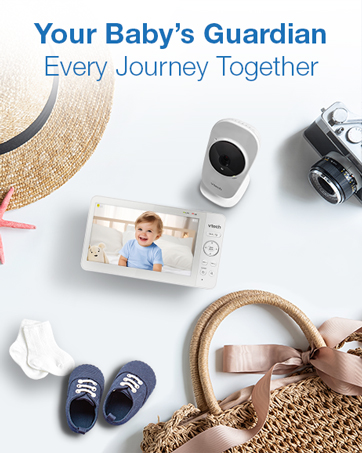
Image: Proper placement of the Baby Unit near a crib.
4. Mahi
4.1. Basic Monitoring
Once both units are powered on and linked, the Parent Unit will display live video from the Baby Unit. Adjust the volume using the VOL+ a VOL - buttons on the Parent Unit.
4.2. Pania, Tītaha, me te Whakanuia
The Baby Unit camera can be remotely controlled from the Parent Unit to adjust its viewing angle and zoom level.
- Pan/Tia: Whakamahia te Pere Arahanga (Up, Down, Left, Right) on the Parent Unit to move the camera lens horizontally (up to 270 degrees) and vertically (up to 124 degrees).
- Topa: Pehia te TONO + button to zoom in (2x magnification) and ZOOM - ki te topa atu.
Video: Demonstration of the VTech VM333's pan, tilt, and zoom features, showing remote camera control from the Parent Unit.
4.3. Korero-rua
You can speak to your baby through the Baby Unit's speaker.
- Patohia me te pupuri i te KORERO button on the Parent Unit.
- Speak clearly into the microphone on the Parent Unit.
- Tukua te KORERO button to stop speaking and hear your baby again.

Image: Using the two-way talk feature on the Parent Unit.
4.4. Automatic IR Night Vision
The Baby Unit is equipped with infrared LEDs that automatically activate in low light conditions, providing a clear black and white video image of your baby in the dark.
Image: The Baby Unit operating in night vision mode.
4.5. Aratau Whakahohe oro
This mode allows the Parent Unit screen to turn off automatically to save power and reduce light disturbance, and then turn back on when sounds are detected from the Baby Unit.
- Pehia te MENU/KORERO button on the Parent Unit.
- Whakatere ki te Maharahara VOX or Whakahohe oro whakatakotoranga.
- Select your desired sound sensitivity level. A higher sensitivity will activate the screen with softer sounds.
Image: Parent Unit displaying the sound activation icon.
4.6. Temperature Monitoring and Alerts
The Baby Unit monitors the room temperature and displays it on the Parent Unit screen. You can set alerts for temperature deviations.
- Pehia te MENU/KORERO pātene.
- Whakatere ki te Matohi Paemahana tautuhinga.
- Set your desired minimum and maximum temperature thresholds. The Parent Unit will beep if the temperature goes outside this range.
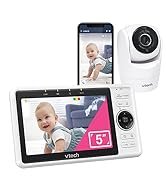
Image: Parent Unit displaying room temperature.
4.7. Multiple Camera Monitoring (Expandable System)
The VM333 system supports up to four cameras (additional cameras sold separately). You can view multiple cameras in different modes.
- Takitahi View: Displays video from one camera at a time. Use the VIEW button to cycle through connected cameras.
- Wehea View: Displays video from multiple cameras simultaneously on a split screen.
- Aratau Tiaki: Automatically cycles through all connected cameras, displaying each for a few seconds.
Video: Demonstration of multi-camera viewing modes, including single view, split view, and patrol mode.
5. Tiaki
- Te horoi: Clean the surfaces of the Parent Unit and Baby Unit with a soft, damp kakahu. Kaua e whakamahia he rehu horoi, he wai horoi rānei.
- Tiaki Pūhiko: The Parent Unit uses a rechargeable Lithium-Ion battery. For optimal battery life, fully charge the unit before first use. Avoid extreme temperatures. If storing the unit for an extended period, remove the battery.
- Tiaki Mata: Keep the camera lens clean to ensure clear video quality. Use a soft, lint-free cloth to gently wipe the lens if needed.
6. Te Raru
| Raruraru | Rongoā |
|---|---|
| No video/audio on Parent Unit. |
|
| Te kounga ataata kino. |
|
| Parent Unit beeps (low battery, out of range, temperature). |
|
| Te pokanoa ki ētahi atu taputapu. |
|
7. Whakatakotoranga
| Āhuahira | Taipitopito |
|---|---|
| Tau tauira | VM333 |
| Rahi Mata | 2.8 inihi (LCD) |
| Hangarau Ahokore | 2.4 GHz FHSS digital transmission |
| Awhe | Tae atu ki te 1,000 putu (300 mita) i te wāhi tuwhera |
| Koki Panui | Up to 270 degrees horizontal |
| Koki Honga | Up to 124 degrees vertical |
| Topa | 2x topa matihiko |
| Matakitenga Po | Automatic infrared (IR) |
| Ororongo Waa-rua | Ae |
| Whakahohe oro | Ae (VOX) |
| Pūoko pāmahana | Yes, with alerts |
| Ka taea te whakawhanui | Up to 4 cameras (additional cameras sold separately) |
| Te Ora o te Pūhiko o te Wāhanga Matua | Tae atu ki te 3.5 hāora (matakitaki ataata) |
| Puna Mana | Rechargeable Lithium-Ion battery (Parent Unit), AC power (Baby Unit) |
| Tae | White / hiriwa |
| Taumaha Tūemi | 2 pauna |
8. Pūtāhui me te Tautoko
For warranty information and technical support, please contact VTech customer service.
- Tau Tautoko Kiritaki: (800) 595-9511
- Webpae: www.vtechbabycare.com
- Īmēra: support@vtechbabycare.com
Tena koa pupuri i to riirii hoko hei tohu mo te hoko mo nga kaupapa whakamana.