
1. Kupu Whakataki
This manual provides essential information for the proper installation, operation, and maintenance of the Furuno FAP7011C Control Unit. The FAP7011C is designed to serve as the primary interface for the Furuno NavPilot 711C autopilot system, enabling precise control and navigation for marine vessels. Please read this manual thoroughly before using the unit to ensure safe and efficient operation.
2. Nga korero haumaru
Observe the following safety precautions to prevent injury, damage to the equipment, or other property. Always prioritize safety when operating marine electronics.
- Tuku Hiko: Whakaritehia te voltage matches the unit's requirements. Incorrect voltagka taea e te kino.
- Tāutatanga: Installation should be performed by qualified personnel to ensure correct wiring and mounting.
- Puranga wai: While designed for marine environments, avoid direct high-pressure water spray on the unit.
- Whakaterenga: The autopilot is an aid to navigation. Always maintain a proper lookout and be prepared to take manual control of the vessel.
- Tiaki: Momotuhia te hiko i mua i te mahi tiaki, horoi ranei.
3. Ihirangi mokete
Manatokona kei te noho nga taonga katoa i roto i te kete i mua i te whakaurunga:
- Furuno FAP7011C Control Unit
- Whakapiki Panui me nga Taputapu
- Waea Hiko
- Data Cable (NMEA2000 or NMEA0183, depending on configuration)
- Pukapuka a te Kaipupuri (tenei tuhinga)
4. Hua Neke Atuview
The Furuno FAP7011C is a dedicated control unit for the NavPilot 711C autopilot system. It features a clear display and intuitive controls for setting course, engaging autopilot modes, and accessing navigation functions. Its robust design is suitable for demanding marine conditions.
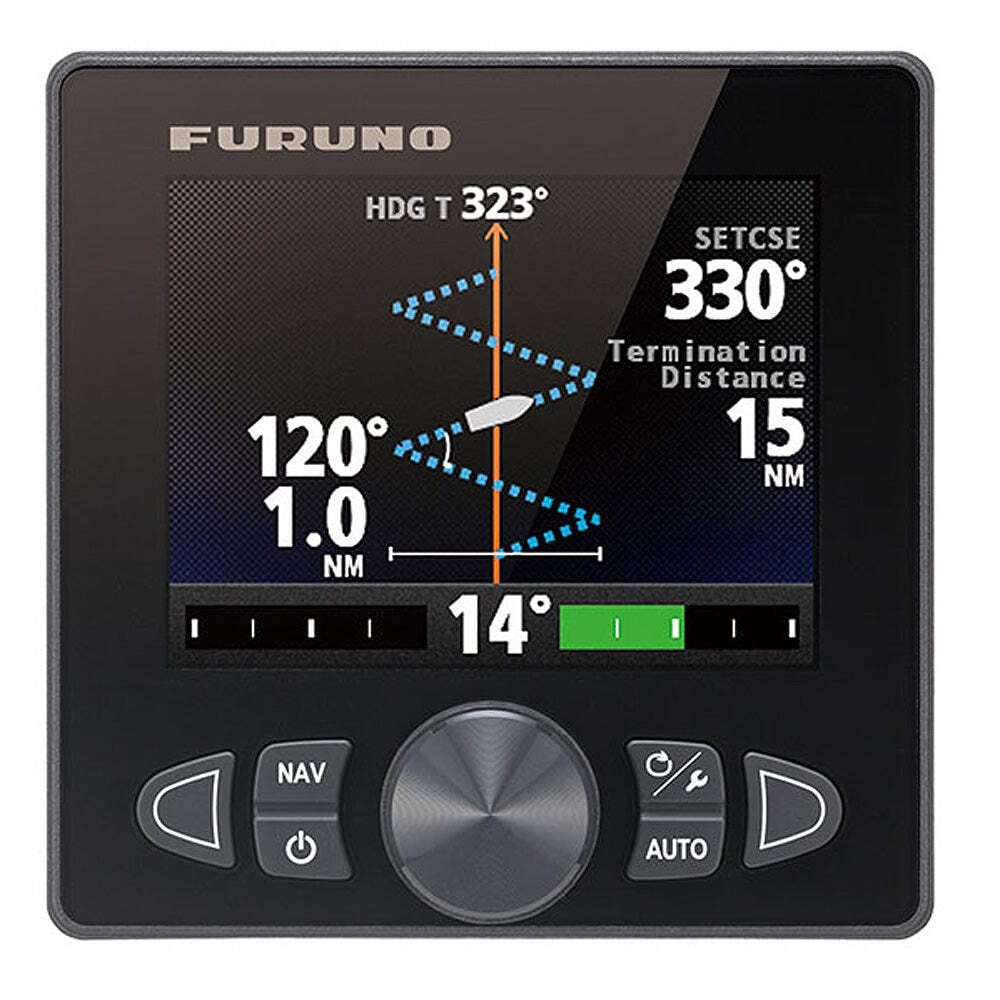
Whakaahua 1: Mua view of the Furuno FAP7011C Control Unit. This image displays the unit's screen, rotary knob, and various control buttons, designed for easy interaction with the NavPilot 711C autopilot system.
5. Tāuta me te Tatūnga
Proper installation is crucial for the performance of your FAP7011C control unit. It is recommended that installation be performed by a certified marine electronics technician.
5.1 Whakapiki
- Kōwhiringa Tauwāhi: Choose a location on the helm that is easily accessible, visible, and protected from direct impact or excessive vibration. Ensure adequate space for wiring connections at the rear.
- Whakamahi Tātauira: Use the provided mounting template to mark drilling locations for the mounting bracket.
- Whakaeke Haumaru: Secure the mounting bracket using the supplied hardware. Ensure a watertight seal if flush mounting.
5.2 Hononga Waea
- Hononga Hiko: Connect the power cable to a suitable 12V or 24V DC power source, ensuring proper polarity. Install an appropriate fuse or circuit breaker as specified in the full NavPilot 711C system manual.
- Hononga Raraunga: Connect the data cable to the NavPilot 711C processor unit. This typically involves a NMEA2000 or NMEA0183 connection, depending on your system configuration. Refer to the NavPilot 711C installation manual for specific wiring diagrams.
- Whakapapa: Ensure the unit is properly grounded to the vessel's common ground system to prevent electrical interference.
6. Nga Tohutohu Whakahaere
The FAP7011C control unit provides intuitive control over your NavPilot 711C autopilot system.
6.1 Kei te Hiko / Weto
- Hei Whakahiko: Patohia me te pupuri i te MANA pēhi i te pātene kia mārama rā anō te mata.
- Hei Whakaweto: Patohia me te pupuri i te MANA pātene kia tutakina te waeine.
6.2 Engaging Autopilot
- Ensure the vessel is on a stable course.
- Pehia te AUTO button. The autopilot will engage and maintain the current heading.
6.3 Course Adjustment
- Whakatikatika pai: Rotate the large rotary knob to adjust the course in 1-degree increments.
- Whakatikatika Papatipu: Whakamahia te tauranga (left arrow) and PAPA WHETU (right arrow) buttons for larger course changes, typically 10-degree increments, or to quickly avoid an obstruction and return to the previous course.
6.4 Navigation Modes
The FAP7011C supports various navigation modes when connected to compatible chartplotters or navigation systems:
- NAV Mode: Engages the autopilot to follow a pre-programmed route or steer to a waypoint. The unit will typically alarm upon approaching waypoints.
- Aratau Aunoa: Maintains a set magnetic or true heading.
- TRK Mode: Maintains a track over ground, compensating for set and drift.
Refer to the comprehensive NavPilot 711C operation manual for detailed instructions on advanced navigation features, including auto route following and specific menu functions.
7. Tiaki
Regular maintenance ensures the longevity and optimal performance of your FAP7011C control unit.
- Te horoi: Horoia te whakaaturanga me casing me te ngohengohe, damp cloth. Do not use abrasive cleaners, solvents, or chemical sprays, as these can damage the screen and plastic components.
- Tirotiro: Periodically check all cables and connections for signs of wear, corrosion, or damage. Ensure connections are secure.
- Rokiroki: If the vessel is stored for an extended period, ensure the unit is powered off and, if possible, protected from extreme temperatures and humidity.
8. Te Raru
This section addresses common issues you might encounter with the FAP7011C control unit.
| Raruraru | Take pea | Rongoā |
|---|---|---|
| Karekau te waeine i te hiko. | No power supply; Blown fuse; Loose connection. | Check power cable connection; Inspect fuse/circuit breaker; Verify battery voltage. |
| He putea, he atarua ranei te whakaaturanga. | Brightness setting too low; Power issue. | Adjust display brightness (refer to NavPilot 711C manual for menu options); Check power supply. |
| Autopilot does not engage. | No valid heading data; System error; NavPilot processor not powered. | Check compass/heading sensor connection; Verify NavPilot 711C processor is powered and functioning; Consult NavPilot 711C manual for error codes. |
| Ko nga mana whakahaere kaore e aro. | Unit frozen; Loose data connection. | Power cycle the unit; Check data cable connection to the NavPilot processor. |
For more complex issues or if troubleshooting steps do not resolve the problem, contact Furuno customer support or a certified service technician.
9. Whakatakotoranga
Key technical specifications for the Furuno FAP7011C Control Unit:
- Ingoa Tauira: FAP7011C
- Tau Wāhanga: FAP7011C
- Waitohu: Furuno
- Rauemi: Kirihou
- Rahi Tūemi (LxWxH): 12 x 8 x 7 inihi
- Taumaha Tūemi: 4 Pauna
- Rahi Mokete (LxWxH): 11.46 x 8.27 x 6.97 inihi
- Taumaha mōkihi: 1.87 Kirokaramu
- Rā Wātea Tuatahi: Pipiri 27, 2014
10. Nga Korero Whakaputanga
The Furuno FAP7011C Control Unit is covered by a manufacturer's warranty. Specific warranty terms and conditions, including duration and coverage details, are provided with the product documentation or can be found on the official Furuno webpae. Tena koa pupurihia to tohu mo te hoko mo nga kereme whakamana.
11. Nga korero tautoko
For technical assistance, service, or further inquiries regarding your Furuno FAP7011C Control Unit or NavPilot 711C system, please contact Furuno customer support. You can find contact details, FAQs, and additional resources on the official Furuno webpae.
Webpae: www.furunousa.com