
1. Nga Tohutohu Haumaru Nui
Read and understand all safety instructions before operating the generator. Failure to follow these instructions can result in serious injury or death.
- Moorearea Waro Monoxide: Generators produce carbon monoxide, an odorless, colorless, poisonous gas. Operate the generator outdoors in a well-ventilated area, far from windows, doors, and vents. Never operate indoors or in partially enclosed spaces.
- Pūmate Rua Hiko: Do not operate the generator in wet conditions. Ensure all electrical connections are dry and properly grounded. Use only approved extension cords that are rated for outdoor use and the generator's power output.
- Pūmate Ahi: Gasoline is highly flammable. Refuel in a well-ventilated area with the engine off and cool. Do not smoke or allow open flames near the generator or fuel. Store gasoline in an approved container in a safe location.
- Mata wera: The generator engine and muffler become very hot during operation and remain hot for a period after shutdown. Avoid contact with hot surfaces to prevent burns.
- Nga tamariki me nga kararehe: Keep children and pets away from the generator, especially during operation.
2. Nga Waahanga Nekeview
Familiarize yourself with the main components of your Husky HKG3000 portable gasoline generator.
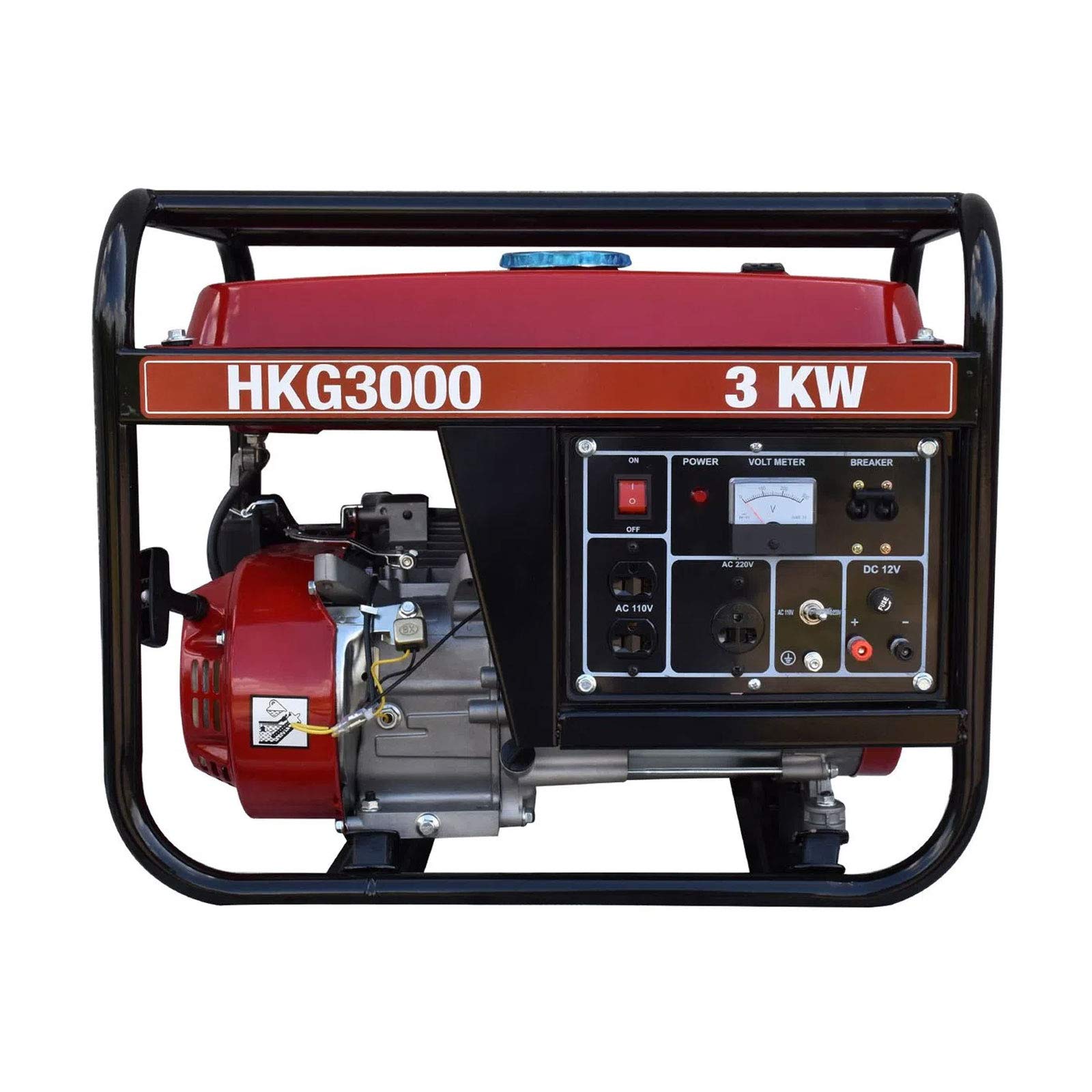
Whakaahua 2.1: Te katoa view of the Husky HKG3000 Portable Gasoline Generator, showcasintōna anga pakari me te papa whakahaere.

Whakaahua 2.2: Mua view of the Husky HKG3000 Portable Gasoline Generator, highlighting the control panel with power outlets, voltmeter, and circuit breakers.

Whakaahua 2.3: Taha view of the Husky HKG3000 Portable Gasoline Generator, showing the 4-stroke engine, air filter housing, and fuel valve.

Figure 2.4: Included accessories for the Husky HKG3000 Portable Gasoline Generator, featuring the user manual, power plugs, and a spark plug wrench.
Wae matua:
- Tane wahie: Stores gasoline.
- Potae hinu: Seals the fuel tank.
- Takiwa wahie: Controls fuel flow to the engine.
- Whakakowaowaotia: Whakamahia hei tīmata i te miihini makariri.
- Recoil Starter: Manual pull-cord for starting the engine.
- Whakawhiti Miihini: Turns the engine ignition ON/OFF.
- Tātari hau: Protects the engine from dust and debris.
- Taupoki Whakakī Hinu/Rākau Whakamātautau: For adding and checking engine oil.
- AC Outlets (110V/220V): For connecting electrical devices.
- Putanga DC 12V: Hei utu i ngā pākahiko 12V.
- Inengaohiko: Ka whakaatu te putanga voltage.
- Kaiwhati iahiko: Ārai i te hikohiko me ngā taputapu hono mai i te taumaha rawa.
- Muffler: Reduces engine noise and directs exhaust gases.
3. Tatūnga
I mua i te whakamahinga tuatahi, me mahi i ngā mahi whakarite e whai ake nei:
3.1 Te Wetewete
- Āta tango i te pūhiko mai i tōna tākai.
- Inspect for any shipping damage. Contact your dealer if damage is found.
- Ensure all included accessories (power plugs, spark plug wrench, manual) are present.
3.2 Te taapiri hinu miihini
Ka tukuna te mīhini whakaputa hiko me te kore hinu. Ka nui te kino o te kino o te mīhini ki te whakamahia me te kore hinu.
- Whakanohoia te kaiwhakanao ki te papa papatairite.
- Unscrew the oil fill cap/dipstick.
- Tāpirihia mārire te hinu miihini kua tūtohutia (hei tauira, SAE 10W-30) ki te pouaka miihini kia tae rā anō ki te tohu o runga i te rākau whakatō. Kaua e whakakī rawa.
- Whakahokia anō te taupoki whakakī hinu/rākau whakatō kia mau.
3.3 Te taapiri wahie
Use only fresh, unleaded gasoline with an octane rating of 87 or higher.
- Me whakarite kua whakawetohia te mīhini whakaputa hiko, ā, kua matao hoki.
- Whakatuwherahia te potae hinu.
- Carefully pour gasoline into the fuel tank, avoiding spills. Do not fill above the red indicator or the bottom of the filler neck.
- Katia kia mau te potae wahie. Horoia tonutia nga wahie kua maringi.
3.4 Te Whakatūnga Whenua o te Pūkaha
Proper grounding is essential to prevent electrical shock.
- Connect a heavy-gauge copper wire from the generator's grounding terminal to an approved ground source, such as a ground rod driven into the earth.
- Consult a qualified electrician for local grounding requirements.
4. Nga Tohutohu Whakahaere
4.1 Ngā Arowhai i mua i te Tīmatanga
- Tirohia te taumata hinu miihini.
- Tirohia te taumata wahie.
- Me mohio kua momotuhia nga kawenga hiko katoa mai i te kaihanga.
- Verify the generator is on a level surface and in a well-ventilated outdoor area.
4.2 Starting the Engine (Manual Start)
- Hurihia te piha wahie ki te ON tūnga.
- Nukuhia te taunga kowaowao ki te KAtia (start) position if the engine is cold. If the engine is warm, set the choke to the TUwhera tūnga.
- Hurihia te miihini ki te ON tūnga.
- Firmly grasp the recoil starter handle and pull it slowly until resistance is felt, then pull quickly and smoothly.
- Once the engine starts, slowly move the choke lever to the TUwhera tūranga (oma).
- Tukua kia whakamahana te miihini mo etahi meneti i mua i te hono i nga uta hiko.
4.3 Te hono i nga Uta Hiko
- Me whakarite kia pai te oma o te mīhini whakaputa hiko.
- Monohia ō taputapu hiko takitahi, tīmata mai i te kaha teitei rawatage taputapu.
- Kaua e neke ake i te wat whakatau a te kaihangatage (2.8 kW nominal, 3 kW maximum). Overloading will trip the circuit breakers.
4.4 Whakamutua te Mihini
- Momotuhia nga kawenga hiko katoa mai i te kaihanga.
- Hurihia te miihini ki te WATE tūnga.
- Hurihia te piha wahie ki te WATE tūnga.
5. Tiaki
Regular maintenance ensures optimal performance and extends the life of your generator. Always perform maintenance with the engine off and cool.
5.1 Huri Hinu Mihini
- Change the engine oil after the first 20 hours of operation, then every 50-100 hours or annually.
- Drain old oil while the engine is warm. Refill with recommended oil type and quantity.
5.2 Te Whakapai i te Matarere
- Tirohia te tātari hau i ia 50 hāora, neke atu rānei i ngā wā katoa mēnā he puehu te puehu.
- Clean the foam element with warm, soapy water, rinse, and allow to dry completely. Lightly oil the foam element before reinstallation.
5.3 Tirohanga Paraka
- Tirohia te mono mura i ia 100 hāora, i ia tau rānei.
- Clean carbon deposits and adjust the gap if necessary. Replace if electrodes are worn or insulation is cracked.
5.4 Tiaki Pūnaha Whara
- If storing the generator for more than 30 days, drain the fuel tank and carburetor, or use a fuel stabilizer.
- Regularly check fuel lines for cracks or leaks.
5.5 Rokiroki
- Horoia te taha o waho o te kaihanga.
- Rokiroki i roto i te waahi ma, maroke, whai hau pai, kei tawhiti atu i te ra me te wera nui.
- Hipokina te kaihanga hei tiaki i te puehu.
6. Te Raru
Ko tenei waahanga e whakarato ana i nga otinga mo nga take whakahaere noa.
6.1 E kore e timata te miihini
- Kore Wahine: Tirohia te taumata wahie, ā, tāpirihia he penehīni hou mēnā e tika ana.
- Wero Waehi: Hurihia te paera wahie ki ON.
- Whakaweto Mihini WEHE: Turn engine switch to ON.
- Improper Choke Position: Adjust choke lever as per starting instructions (Section 4.2).
- Taumata Hinu Iti: Check oil level and add oil if necessary. The generator may have a low-oil shutdown feature.
- Fouled Spark Plug: Tirohia, horoia, whakakapia rānei te mono mura.
6.2 Kaore he Putanga Hiko
- Ka takahia te Kaiwhati iahiko: Reset the AC or DC circuit breaker on the control panel. Reduce load if it trips again.
- Taumaha: Disconnect some electrical devices. Do not exceed the generator's rated capacity.
- Faulty Connection: Check all power cords and connections.
6.3 Kāore i te pai te oma o te mīhini
- Wahie tawhito: Drain old fuel and refill with fresh gasoline.
- Tātari Hau Kua Āraia: Horoi, whakakapihia ranei te tātari hau.
- Fouled Spark Plug: Tirohia, horoia, whakakapia rānei te mono mura.
7. Whakatakotoranga
| Whakatakotoranga | Uara |
|---|---|
| Waitohu | Husky |
| Tauira | HKG3000 |
| Momo Mihini | 4-Puka |
| Mihini Horsepower | 7.5 hp |
| Momo wahie | penehīni |
| Pūnaha Tīmata | Manual (Recoil) |
| Putanga Mana Morahi | 3 kW (3000 Wāti) |
| Putanga Mana Whakatau | 2.8 kW (2800 Wāti) |
| Auautanga | 60 Hz |
| Voltage | 110V / 220V |
| Whakamahi Manakohia | Tauhokohoko |
| Taumaha Tūemi | 70 Kirokaramu |
| Te kawe | Kawe |
8. Pūtāhui me te Tautoko
This Husky generator is covered by a manufacturer's warranty. Please refer to the warranty card included with your product for specific terms and conditions.
For technical assistance, parts, or warranty claims, please contact Husky customer support through their official webpae, nga korero whakapā ranei e whakaratohia ana i roto i to tuhinga hua.
Always provide your model number (HKG3000) and serial number when contacting support to ensure efficient service.


