
CEYOMUR CY70
CEYOMUR Trail Camera CY70 User Manual
Tauira: CY70
1. Kupu Whakataki
The CEYOMUR Trail Camera CY70 is designed for wildlife monitoring, hunting, farm surveillance, and home security. It captures high-resolution photos and videos with advanced features for reliable outdoor performance.
2. He aha kei roto i te Pouaka
Manatokohia kei te noho nga waahanga katoa i roto i te kete:
- 1 x CEYOMUR Trail Camera CY70
- 1 x Tauira USB
- 1 x Here
- 1 x Tripod Mount
- 1 x Pukapuka Kaiwhakamahi

Image: The CEYOMUR Trail Camera CY70 and its included accessories: a strap, tripod mount, USB cable, and user manual.
3. Nga Hua o te Hua
- 2.7K Video Resolution & 24MP Photo Pixels: Captures high-definition videos and crisp images with vivid details, day and night.
- 850nm Low Glow Infrared Night Vision: Equipped with 40 low glow LEDs for clear black and white night vision up to 20 meters.
- Super Wide Detection Angle: Three passive infrared sensors provide up to a 120° detection angle with a 116° ultra-wide lens. Side PIR sensors can be enabled or disabled.
- Ultra-Fast 0.2s Motion Detection: Rapid trigger speed ensures no important moments are missed.
- IP66 Waterproof Performance: Durable construction with a rubber sealing ring in the battery compartment ensures operation in severe weather conditions.
- Clearer Sound Recording: Advanced microphone and speaker for enhanced audio capture.
- Large Memory Storage: Supports memory cards up to 128GB (not included).
- Āhuatanga Maha: Includes password protection, time interval, time lapse, timer, PIR sensitivity adjustment, and more.

Image: Comparison of 1080P and 2.7K video resolution, demonstrating the enhanced clarity of 2.7K for capturing wildlife details.
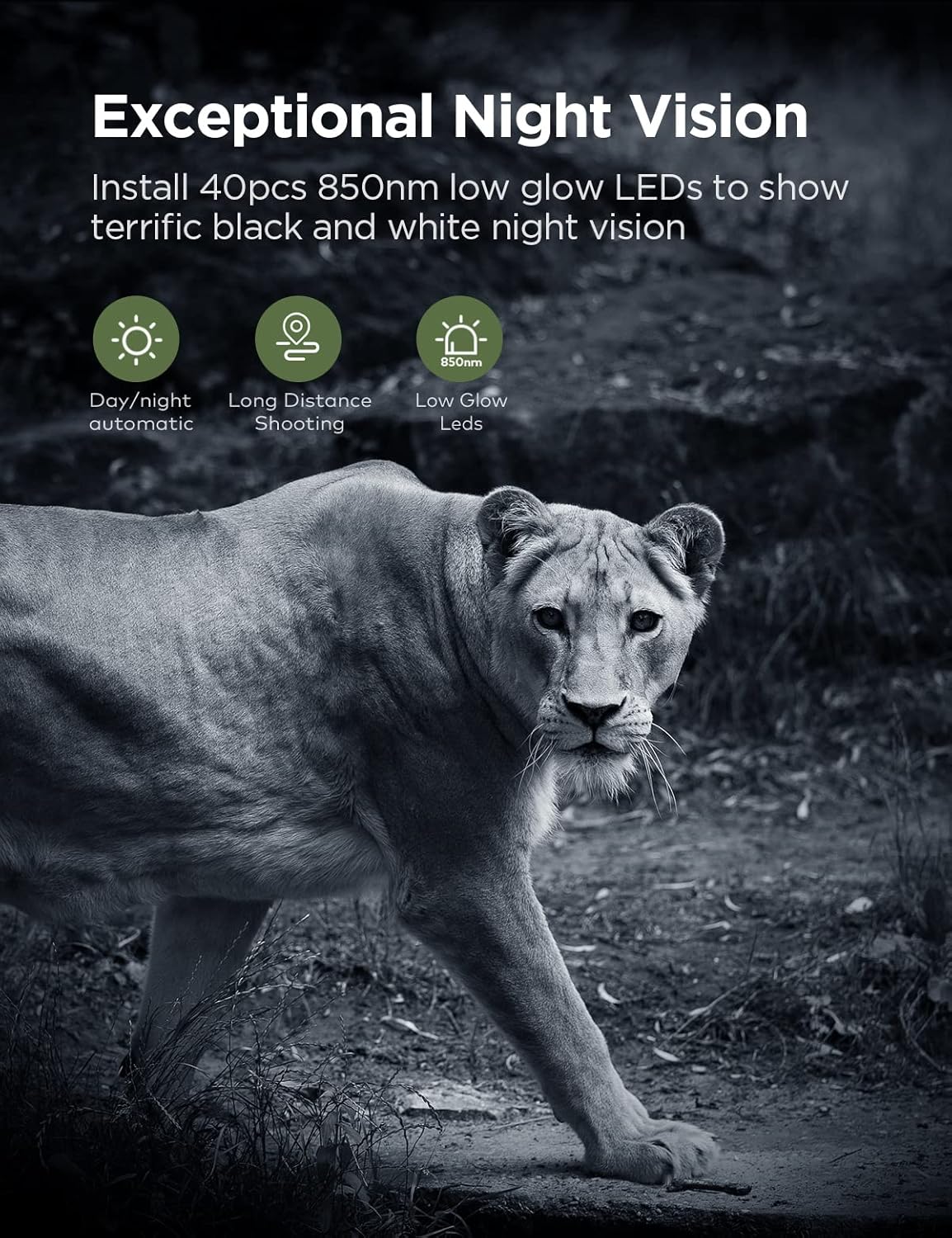
Image: Night vision capabilities of the camera, showing a clear black and white image of a lioness in a dark environment, enabled by 850nm low glow infrared LEDs.

Image: A fawn in motion, demonstrating the camera's 0.2-second trigger speed, capable of capturing fast-moving wildlife.

Image: A wide-angle view of horses grazing in a field, illustrating the camera's broad detection and field of view.

Image: A hummingbird near the camera, symbolizing the clear sound recording capability for capturing ambient wildlife sounds.
4. Tatūnga
4.1 Tāuta Pūhiko
- Whakatuwheratia te whare kamera ma te wetewete i nga riipene taha.
- Locate the battery compartment. The camera requires 8 AA batteries.
- Insert the batteries according to the polarity markings (+/-) inside the compartment.
- Close the battery compartment securely, ensuring the rubber sealing ring is properly seated for water resistance.
4.2 Tāutanga Kāri Pūmahara
- Me mohio kua weto te kamera.
- Insert a Micro SD or SD card (Class 6 or faster, up to 128GB, not included) into the designated memory card slot until it clicks into place.
- Hei tango, pana atahia te kaari kia puta ra ano.
4.3 Whakauru i te Kamera
The camera can be mounted using the included strap or tripod mount:
- Whakamaunga here: Thread the strap through the slots on the back of the camera and secure it around a tree or pole. Adjust for a stable position.
- Maunga Takitoru: Attach the tripod mount to the camera's threaded insert and then secure it to a tripod or other compatible mounting accessory.
5. Nga Tohutohu Whakahaere
5.1 Kei te Hiko / Weto
- To power on, slide the mode switch to the 'ON' position.
- To power off, slide the mode switch to the 'OFF' position.
5.2 Kōwhiringa Aratau
The camera typically features different operating modes:
- WATE: Whakawetohia te kamera.
- PANUI: Access the menu settings and preview images/videos on the 2.4'' LCD screen.
- ON: Camera is active and will capture photos/videos based on configured settings.
5.3 Tautuhinga Tahua
In 'SETUP' mode, use the navigation buttons to access and adjust various settings:
- Aratau: Tīpakohia te Whakaahua, te Ataata, te Whakaahua+Ataata rānei.
- Taumira Whakaahua: Choose from various MP options up to 24MP.
- Taumira Ataata: Select from 2.7K, 2K, 1296P, 1080P, 720P, 480P, 360P.
- PIR mataata: Adjust the motion sensor sensitivity (Low, Medium, High).
- Wā Whakaoho: Tautuhia te whakaroa i waenga i ngā whakaoho karapīpiti.
- Te Waahi: Configure the camera to take photos at set intervals.
- Matawā: Tautuhia ngā wā motuhake mō te kāmera kia whakahohe.
- Parenga Kupuhipa: Enable a password for camera access.
- Rā/Wā: Tautuhia te ra me te wa o naianei.
6. Tiaki
- Te horoi: Whakamahia he kakahu ngohengohe, maroke hei horoi i te arotahi me te whare o te kāmera. Āta karohia ngā kaihoroi whakakoi.
- Tiaki Pūhiko: Replace all batteries at the same time. Remove batteries if the camera will not be used for an extended period.
- Rokiroki: Penapenahia te kāmera ki te wāhi hauhautanga, maroke, kia matara atu i te rā tika ina kore e whakamahia.
- Kāri Pūmahara: Regularly format the memory card to ensure optimal performance and prevent data corruption.
7. Te Raru
- Kāre e kā ana te kāmera: Check battery installation and ensure batteries are fully charged. Verify the mode switch is in the 'SETUP' or 'ON' position.
- Kāore he whakaahua/ataata i hopukina: Ensure the memory card is inserted correctly and has sufficient space. Check PIR sensitivity settings and trigger interval. Verify the camera is in 'ON' mode.
- Kounga ahua/ataata ngoikore: Clean the camera lens. Ensure the camera is mounted securely to prevent movement. Check resolution settings.
- Night vision issues: Ensure there are no obstructions in front of the infrared LEDs. Check battery level, as low power can affect IR performance.
- Te whakauru wai: Ensure all latches are securely closed and the battery compartment's rubber seal is intact.
8. Whakatakotoranga
| Āhuahira | Whakatakotoranga |
|---|---|
| Ingoa Tauira | CY70 |
| Whakataunga Tonu Whaihua | 24 MP |
| Whakataunga Hopu Ataata | 2.7K, 2K, 1296P, 1080P, 720P, 480P, 360P |
| Te wa whakaoho | 0.2s |
| Awhe Tirohanga Po | 20 Mita |
| Momo Puna Maama | 40pcs Infrared LEDs (850nm Low Glow) |
| Viewing Koki | 116 Waeine |
| Koki Rapu | Up to 120 Degrees (with 3 PIR sensors) |
| Taumata Atete Wai | IP66 parewai |
| Puna Mana | 8 pākahiko AA (kaore i whakauruhia) |
| Momo Mahara Kohiko | Micro SD, SD (up to 128GB) |
| Rahi Mata | 2.4 Inihi |
| Ahu (L x W x H) | 5.31 x 3.94 x 2.99 inihi |
| Taumaha Tūemi | 1.3 pauna |
9. Pūtāhui me te Tautoko
CEYOMUR products are designed for reliability and performance. For warranty information, technical support, or service inquiries, please refer to the contact details provided in your product packaging or visit the official CEYOMUR webpae. Puritia to rihiti hoko mo nga kereme whakamana.
10. Taiwhanga Media
10.1 Ataata Hua Whaimana
Video: Interesting Moments Captured by CEYOMUR CY70 Trail Camera. This video showcases various wildlife captured by the camera, demonstrating its motion detection and recording capabilities.
Video: CEYOMUR Trail Camera CY70 - Day and Night Image & Video. This video provides examples of both daytime color footage and nighttime infrared footage from the CY70 camera.
Video: Day & Night Video Examples of CEYOMUR Trail Camera CY70. A collection of short video clips demonstrating the camera's performance in different lighting conditions.
Video: CEYOMUR Trail Camera CY70 - Common Snipes & Eurasian Teals. This video captures specific bird species, highlighting the camera's ability to record smaller wildlife.
Video: Welcome to the World of Birds. A compilation of various bird species recorded by the CEYOMUR CY70, showcasing its use for birdwatching and monitoring.
Video: CEYOMUR Trail Camera CY70 - Examples of Various Animals. This video features diverse animal captures, illustrating the camera's versatility for different wildlife monitoring scenarios.
Video: CEYOMUR CY70 Trail Camera: Great Picture and Video Quality. This video highlights the overall quality of images and videos produced by the CY70 trail camera.
Video: Time Lapse Function of CEYOMUR CY70 Trail Camera. This video demonstrates the time-lapse feature, showing environmental changes or slow-moving subjects over time.
Ask a question about this manual
Ask about setup, troubleshooting, compatibility, parts, safety, or missing instructions. Manuals+ will review the question and use this page’s manual context to help answer it.