
OOYCYOO P 60A
OOYCYOO MPPT 60A Solar Charge Controller User Manual
Model: P 60A
1. Kupu Whakataki
This manual provides detailed instructions for the installation, operation, and maintenance of your OOYCYOO MPPT 60A Solar Charge Controller. This device is designed to efficiently manage power flow from your solar panels to your battery bank, ensuring optimal charging and system protection. It supports automatic 12V/24V system voltage identification and is compatible with various battery types.
Key features include a backlit LCD display, a 4-stage battery charging algorithm, and comprehensive protection functions.
2. Nga Tohutohu Haumaru
- Me hono tonu te pākahiko i te tuatahi, kātahi te panera rā, ā, ko te kawenga i te mutunga. Momotuhia i te raupapa whakamuri.
- Ensure all wiring is correctly polarized to prevent damage.
- Do not connect inverters or inductive loads directly to the controller's load terminals.
- Tāutahia te pūmana ki tētahi wāhi whai hā pai, kei tawhiti atu i ngā rawa muramura.
- The controller generates heat during operation; ensure adequate airflow. The integrated cooling fan activates when the temperature exceeds 45°C and turns off below 40°C.
- Use appropriate circuit breakers and fuses for all connections.
- This device is for indoor use only. Protect it from water and moisture.
3. Hua Neke Atuview
The OOYCYOO MPPT 60A Solar Charge Controller is designed for efficient solar power management. It features an LCD display for real-time data, multiple protection functions, and support for various battery types.
3.1 Ihirangi mokete
- 1 x OOYCYOO MPPT 60A Solar Charge Controller
- 1 x Pūoko Temperature
- 1 x Pukapuka Kaiwhakamahi (Ingarihi)
3.2 Tautuhinga Wae

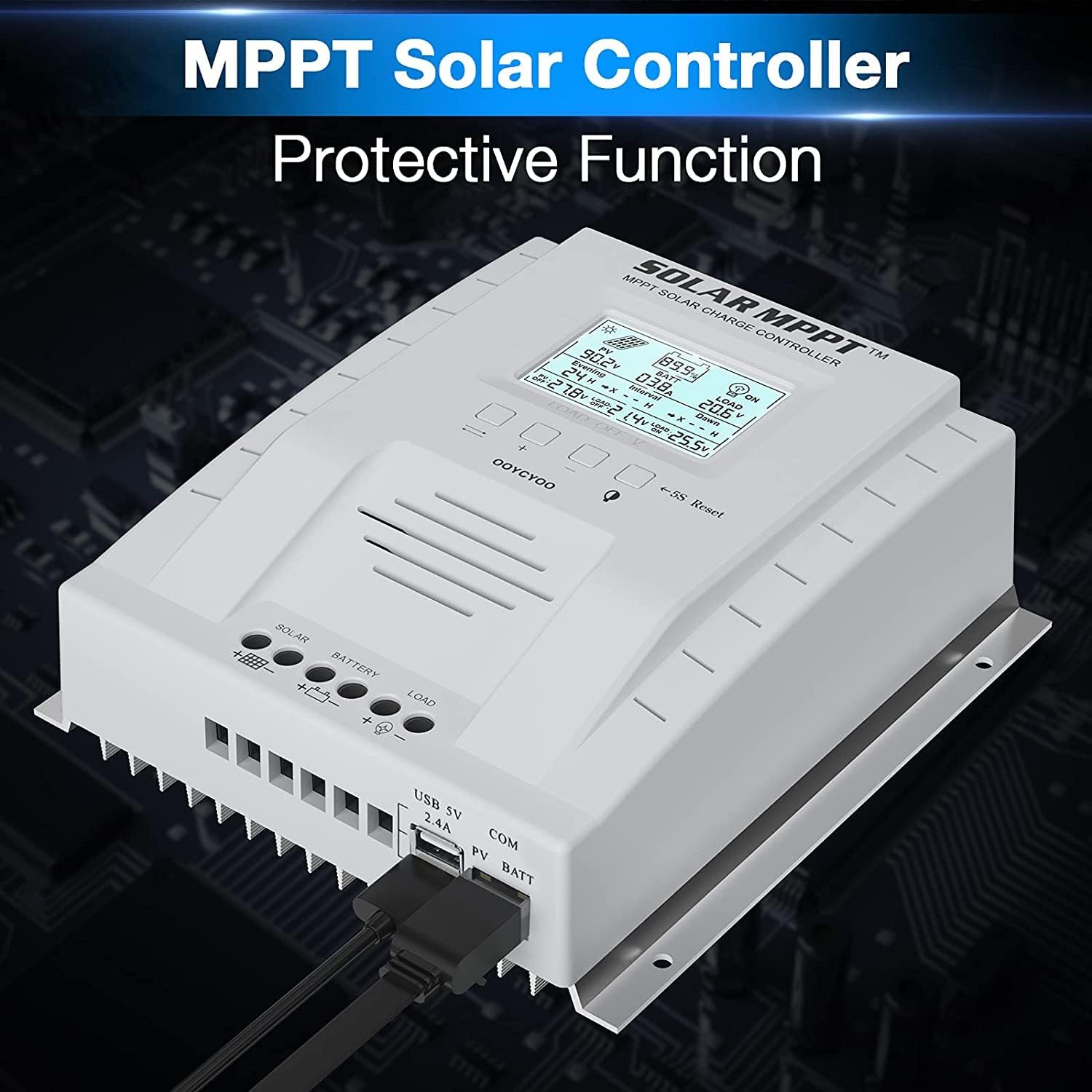
The controller features a clear LCD display on the front for monitoring system status. Below the display are control buttons for navigation and settings. Connection terminals for solar panels, battery, and load are located at the bottom. USB ports and an RS485 communication port are on the side.
4. Tatūnga me te Tāuta
He mea nui te tāutanga tika mō te mahi haumaru me te whai hua o tō pūmana hiko pūngao rā. Me āta whai i ēnei mahi.
4.1 Whakapiki i te Kaiwhakahaere
- Choose a dry, well-ventilated location, protected from direct sunlight, high temperatures, and water.
- Ensure there is sufficient space around the controller for heat dissipation.
- Mount the controller vertically on a wall or stable surface using the provided mounting holes.
4.2 Hononga Waea
Follow the connection order precisely to avoid damage to the controller or other components.
- Tūhono te Pūhiko: Connect the positive and negative terminals of the battery to the corresponding battery terminals on the controller. Ensure correct polarity. The controller will automatically detect the system voltage (12V, 24V ranei).
- Honoa ngā Paewhiri Rā: Connect the positive and negative leads from your solar panel array to the corresponding PV terminals on the controller. Ensure correct polarity. Do not exceed the maximum PV input voltagTuhinga o mua.
- Tūhono te Uta (Kōwhiringa): Connect your DC loads to the load terminals on the controller. Note that the load output is for DC loads only. Do not connect inverters or inductive loads directly to these terminals.
- Connect the Remote Temperature Sensor: Plug the temperature sensor into its dedicated port. This sensor helps the controller optimize charging based on battery temperature.

Tuhipoka Nui: Always connect the battery first and disconnect the solar panel last. Incorrect connection order can damage the controller.
5. Nga Tohutohu Whakahaere
Once installed, the controller will begin operation automatically. The LCD display provides real-time system information.
5.1 Whakaaturanga LCD me nga Patene

The backlit LCD displays critical system parameters such as PV voltage, pūhiko voltage, charging current, load current, and accumulated energy (KWH). The four buttons below the display are used for navigation and settings adjustment:
- Takahuri Kī: Used to cycle through display screens or confirm selections.
- '+' (Plus) Key: Increases values or moves forward in menus.
- '-' (Minus) Key: Decreases values or moves backward in menus.
- Manual Switch Load Key: Toggles the load output on/off manually.
- 5S Reset: Patohia me te pupuri mo te 5 hēkona hei whakaora i nga tautuhinga wheketere.
5.2 Battery Charging Algorithm
The controller utilizes a 4-stage charging algorithm to optimize battery life and performance:
- Akona Ake: Ka utu te pākahiko i te naianei teitei tae noa ki te voltage tae ki te whakanui voltage.
- Whakarei Ake: Nga utu i te puia tonutage for a set period to ensure full charge.
- Ake Whakatika: Maintains the battery at a lower voltaghei ārai i te tukunga aunoa me te utu nui rawa.
- Equalization (for specific battery types): Periodically overcharges the battery to balance cell voltages me te aukati i te sulfate.
5.3 Momo Pūhiko Tautokohia
The controller is compatible with various battery types, including:
- Lead-Acid (Sealed, Gel, Flooded)
- Lithium (LFP)
- User-defined parameters for other battery types.
Pre-set charging parameters are available for Sealed, Gel, Flooded, and LI (LFP) batteries. Users can customize parameters for other battery types as needed.
6. Nga Mahi Tiaki
The OOYCYOO MPPT 60A Solar Charge Controller incorporates multiple protection mechanisms to ensure system safety and longevity:
- PV Overcurrent/Overpower Protection
- Te Parenga Porowhita Poto PV
- PV Whakamuri Polarity Parenga
- Reverse Charging at Night Protection
- Pūhiko Whakamuri Polarity Parenga
- Pūhiko Overvoltage Tiaki
- Battery Over-discharge Protection
- Battery Overtemperature Protection
- Controller Overtemperature Protection
- Lithium Battery Low Temperature Protection
- Utahia te Tiaki Whakawhiti Poto
- Utu Whakahaumaru Whakahaumaru
- TVS High Voltage Parenga Puta
7. Tiaki
Regular maintenance ensures optimal performance and extends the lifespan of your solar charge controller.
- Taki Hononga: Periodically inspect all wiring connections for tightness and corrosion. Tighten any loose connections.
- Horoia te Kaiwhakahaere: Keep the controller clean and free of dust. Use a dry cloth to wipe the exterior. Ensure ventilation openings are not obstructed.
- Tirotiro mo te kino: Check for any signs of physical damage, overheating, or unusual odors.
- Tirohanga Pūhiko: Follow the manufacturer's maintenance guidelines for your specific battery type.
8. Te Raru
Ko tenei waahanga e aro ana ki nga take noa ka pa ki a koe me to kaiwhakahaere utu solar.
| Raruraru | Take pea | Rongoā |
|---|---|---|
| Controller not powering on / LCD blank | Kāore he pākahiko i honoa, kāore hoki he kaha o te pākahikotage too low. Reverse polarity connection. | Me mohio kei te hono te pākahiko i te tuatahi me te rawaka te voltage. Check battery polarity. |
| Kāore he utu mai i ngā panera rā | Solar panels not connected or reverse polarity. Insufficient sunlight. PV voltage iti rawa, teitei rawa ranei. | Check solar panel connections and polarity. Ensure adequate sunlight. Verify PV voltage is within operating range (e.g., 18V-96V for 12V system, 36V-96V for 24V system). |
| Kare e mahi ana te uta | Load output disabled. Load short circuit or overload. Battery voltage iti rawa. | Check load output status on LCD. Disconnect load and check for short circuit. Ensure battery is sufficiently charged. |
| Te whakamahana o te kaiwhakahaere | Poor ventilation. Excessive load or charging current. | Ensure adequate airflow around the controller. Reduce load or charging current if possible. |
| Kore i tika voltage panui | Loose connections. Faulty temperature sensor. | Check all wiring connections. Ensure temperature sensor is properly connected. |
9. Whakatakotoranga
Technical specifications for the OOYCYOO MPPT 60A Solar Charge Controller.
| Tawhā | Uara |
|---|---|
| Utu Whakataunga o naianei | 60A |
| Pūnaha Voltage | 12V/24V Auto Identification |
| Max. PV Open Circuit Voltage | 100V DC |
| Mana Whakauru PV Mōrahi (Pūnaha 12V) | 750W |
| Mana Whakauru PV Mōrahi (Pūnaha 24V) | 1500W |
| DC/DC Transfer Efficiency | Tae atu ki te 98.7% |
| Te Waahi Mahi | -20 ℃ ki te +55 ℃ |
| Rahinga Kāpeka | 10 AWG |
| Ahu (L*W*H) | 8.3 x 8.4 x 3.4 inihi (21.2 x 20.8 x 8.4 cm) |
| Taumaha | 3 lbs (1.28 kg) |
| Momo Whakaatu | LCD Whakamuri |
| UPC | 768461886785 |
| Tau tauira | P 60A |


10. Pūtāhui me te Tautoko
For warranty information or technical support, please contact your retailer or the manufacturer directly. Refer to the product packaging or purchase documentation for specific contact details.
Ask a question about this manual
Ask about setup, troubleshooting, compatibility, parts, safety, or missing instructions. Manuals+ will review the question and use this page’s manual context to help answer it.