1. Kupu Whakataki
The MFY-03 Vacuum Seal Tester is a precision instrument designed to evaluate the sealing performance and integrity of various packaging materials. This device is crucial for quality control in industries where package sealing is critical, such as food, pharmaceutical, and chemical packaging. It operates by creating a vacuum environment to detect leaks and assess the strength of seals, ensuring product safety and shelf life.
2. Nga korero haumaru
- Always ensure the device is connected to a stable power source (AC220V 50Hz) with proper grounding.
- Kaua e whakahaere i te taputapu ki te makuku ringa, ki te damp nga taiao hei aukati i te ru hiko.
- Ensure the vacuum chamber lid is securely closed before applying vacuum.
- Use appropriate personal protective equipment (PPE) such as safety glasses when operating the device.
- Maintain a clear workspace around the tester to prevent accidents.
- Only use the specified air pressure (0.7 MPa) and connection tubes (8mm or 6mm polyurethane) to avoid damage to the system.
3. Hua Neke Atuview
The MFY-03 Vacuum Seal Tester utilizes a vacuum chamber to simulate pressure differences, allowing for the detection of leaks in sealed packages. Samples are typically immersed in water within the chamber. When a vacuum is applied, any gas escaping from a faulty seal will manifest as bubbles, indicating a leak. The device can also assess seal characteristics by observing sample expansion and subsequent release under external pressure differences.
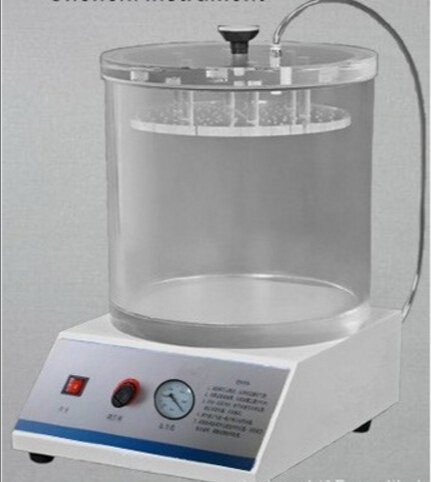
The image illustrates the MFY-03 Vacuum Seal Tester. On the left, a sealed package is shown submerged in water. The center and right panels show the package inside the transparent vacuum chamber, submerged in water, as vacuum is applied to test the seal integrity.
4. Whakatakotoranga
| Tawhā | Uara |
|---|---|
| Tau tauira | MFY-03 |
| Taumata Korehau | 0 ~ -90 kPa |
| Tika | 1 |
| Effective Vacuum Chamber Size | 270mm (Diameter) x 210mm (Height) (Standard) |
| Air Pressure Requirement | 0.7 MPa (User-provided gas source) |
| Air Connection Tube | 8mm Polyurethane tube (Machine connection: 6mm polyurethane tubes) |
| Ahu (L x W x H) | 420mm x 380mm x 450mm |
| Puna Mana | AC220V 50Hz |
| Paerewa e tika ana | GB/T 15171, ASTM D3078 |
5. Tatūnga
- Wewete ana: Carefully remove the MFY-03 Vacuum Seal Tester from its packaging. Inspect for any visible damage during transit.
- Turanga: Place the unit on a stable, level, and vibration-free surface in a well-ventilated area. Ensure there is sufficient space around the device for operation and maintenance.
- Hononga Tukunga Hau: Connect a clean, dry air supply with a pressure of 0.7 MPa to the device's air inlet. The device is designed for an 8mm polyurethane tube connection, but the internal system uses 6mm tubes. Ensure a secure, leak-free connection. The gas source must be provided by the user.
- Hononga Hiko: Connect the power cord to the device and then to a grounded AC220V 50Hz power outlet.
- Taki Tuatahi: Before first use, ensure all connections are tight and the vacuum chamber is clean and free of debris.
6. Nga Tohutohu Whakahaere
- Whakaritea Sample: Obtain the sealed package sample kia whakamatautauria.
- Fill Chamber: Fill the vacuum chamber with water to a level that will fully immerse the sample.
- Wahi Sample: Whakanohoia te sample into the water within the vacuum chamber, ensuring it is fully submerged.
- Close Chamber: Securely close the vacuum chamber lid. Ensure a proper seal is formed between the lid and the chamber.
- Apply Vacuum: Activate the vacuum pump and gradually apply vacuum to the desired level, typically between 0 and -90 kPa, as per testing standards (e.g., GB/T 15171, ASTM D3078).
- Observe for Leaks: Maintain the vacuum for the specified duration. Carefully observe the submerged sample for any streams of bubbles emanating from the package. Bubbles indicate a leak in the seal.
- Alternative Test (Expansion/Release): For certain tests, the vacuum can be applied to observe the expansion of the package due to the external pressure difference. After the vacuum is released, observe the package's recovery to assess seal characteristics.
- Tukunga Korehau: Once the test is complete, slowly release the vacuum to atmospheric pressure.
- Tango Sample: Open the chamber lid and carefully remove the tested sample.
- Tuhia nga Hua: Document all observations and test results according to your quality control procedures.
7. Tiaki
- Te horoi: Regularly clean the vacuum chamber and lid with a soft cloth and mild detergent. Rinse thoroughly and dry completely. Avoid abrasive cleaners that could scratch the chamber.
- Tirohanga Hiri: Periodically inspect the rubber seals and gaskets on the vacuum chamber lid for wear, cracks, or damage. Replace them if necessary to ensure a proper vacuum seal.
- Hononga Air: Check all air connections and tubing for signs of wear, kinks, or leaks. Ensure connections are secure.
- Waea Hiko: Inspect the power cord for any damage. Do not use if the cord is frayed or damaged.
- Rokiroki: When not in use, store the device in a clean, dry environment, away from direct sunlight and extreme temperatures.
8. Te Raru
| Raruraru | Take pea | Rongoā |
|---|---|---|
| No vacuum or insufficient vacuum |
|
|
| Inaccurate vacuum readings |
|
|
| Chamber lid not sealing properly |
|
|
9. Pūtāhui me te Tautoko
This product is designed for reliable performance. While specific warranty details are not provided, the manufacturer aims to ensure customer satisfaction and offers after-sales service. If you encounter any issues, have questions, or require assistance with your MFY-03 Vacuum Seal Tester, please do not hesitate to contact the seller or manufacturer's support team. They are committed to providing a satisfactory solution.


