
1. Kupu Whakataki
This manual provides comprehensive instructions for the installation, operation, and maintenance of your Vivotek ND9426P Network Video Recorder (NVR). The ND9426P is a 16-channel, 2-bay embedded NVR with Power over Ethernet (PoE) capabilities and integrated Artificial Intelligence (AI) features, designed for robust surveillance applications. Please read this manual thoroughly before using the device to ensure proper setup and functionality.
2. Nga korero haumaru
- Ensure the NVR is installed in a well-ventilated area to prevent overheating.
- Whakamahia te urutau hiko anake me te taputapu.
- Do not expose the NVR to water, moisture, or extreme temperatures.
- Avoid placing heavy objects on top of the NVR.
- Momotuhia te hiko i mua i te whakahaere i tētahi tikanga tiaki, tāutanga rānei.
- Tukuna atu nga ratonga katoa ki nga kaimahi whai tohu.
3. Ihirangi mokete
Verify that all items listed below are included in your package. If any items are missing or damaged, contact your vendor immediately.
- Vivotek ND9426P NVR Unit
- Pūurutau Hiko
- Kiore USB
- Aratohu Tāuta Tere
- HDD Mounting Screws
4. Tino Tinoview
Familiarize yourself with the front and rear panels of the Vivotek ND9426P NVR.
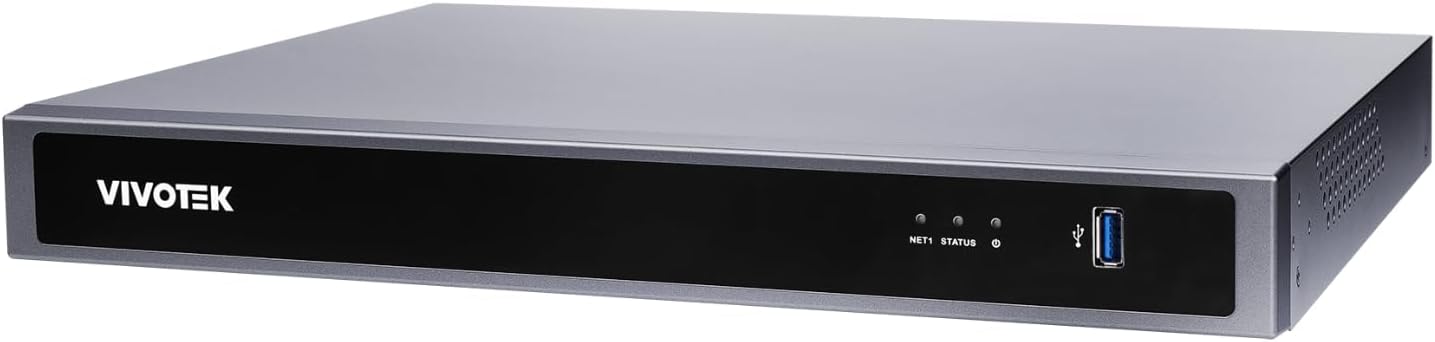
Figure 1: Front Panel of Vivotek ND9426P NVR. This image displays the front of the NVR unit, featuring the VIVOTEK brand logo on the left, two small indicator LEDs labeled "NET1" and "STATUS" in the center, and a blue USB 3.0 port on the right. The overall casing is a dark gray metallic finish.
4.1 Paewhiri Mua
- VIVOTEK Logo: Indicates the brand.
- NET1 LED: Network activity indicator for LAN port 1.
- KAUPAPA KAUPAPA: Tohu mana o te punaha.
- Tauranga USB 3.0: For connecting a USB mouse, keyboard, or external storage devices.
4.2 Paewhiri Whakamuri (Whakaritenga Tikanga)
While not pictured, the rear panel typically includes the following ports:
- PoE Ports (x16): RJ-45 ports for connecting IP cameras and providing power.
- Tauranga LAN: RJ-45 port for connecting the NVR to your local network.
- Huaputa HDMI: Hei hono atu ki tētahi mata, ki tētahi whakaaturanga rānei.
- Putanga VGA: Hei hono atu ki tētahi mata, ki tētahi whakaaturanga rānei.
- Ororongo ki roto/waho: Mo te hono i nga taputapu oro o waho.
- Tauranga USB 2.0: Ngā tauranga USB tāpiri mō ngā taputapu taapiri.
- Whakauru Hiko: Mo te hono i te urutau hiko.
- Tapeke Papaa: Mo te waahi haumaru.
5. Tatūnga
5.1 Tāuta Pūmārō
- Tāuta Puku Mārō:
Unscrew the NVR casing to access the internal bays. Mount up to two 3.5-inch SATA hard drives using the provided screws. Reattach the casing haumaru.
- Honoa ngā Kāmera IP:
Connect your PoE-enabled IP cameras to the NVR's PoE ports using Ethernet cables. The NVR will provide power and data connectivity.
- Connect Display and Mouse:
Connect a monitor to the NVR's HDMI or VGA output port. Connect the USB mouse to one of the NVR's USB ports.
- Hononga Whatunga:
Connect the NVR's LAN port to your network router or switch using an Ethernet cable.
- Whakahiko:
Honoa te urutau hiko ki te tāuru hiko o te NVR, kātahi ka mono ki te putanga hiko. Ka whakakā aunoa te NVR.
5.2 Whirihoranga Tuatahi
- Upon first boot, the NVR will guide you through a setup wizard. Follow the on-screen instructions.
- Set a strong password for the administrator account. This is crucial for security.
- Whirihorahia ngā tautuhinga whatunga (DHCP, IP tūmau rānei).
- Scan for and add connected IP cameras.
- Tautuhia te ra, te wa, me te rohe waahi.
6. Te whakahaere i te NVR
6.1 Whakaterenga Atanga Kaiwhakamahi
- Ora View: Access real-time video feeds from all connected cameras. Use the mouse to select camera views and layouts.
- Purei: Review tuhia footage. Navigate through timelines, search by date/time, and export video clips.
- Tautuhinga Hopu: Configure recording schedules (continuous, motion-triggered, event-based) and video quality for each camera.
- Whakahaere Kaupapa: Set up alerts for motion detection, tampering, or AI-triggered events. Configure notification methods (e.g., email, push notifications).
- Tautuhinga Pūnaha: Manage user accounts, network configurations, storage, and system logs.
6.2 Āhuatanga AI
The Vivotek ND9426P integrates advanced AI capabilities to enhance surveillance efficiency. These features may include:
- Rapu Motini Ataata: Differentiates between human/vehicle movement and environmental factors to reduce false alarms.
- Te Tangohanga Rawa: Defines specific areas for monitoring and triggers alerts upon unauthorized entry.
- Te Kitenga Whakawhiti Raina: Detects when an object crosses a predefined virtual line.
- Refer to the NVR's on-screen interface or the detailed software manual for specific AI feature configuration.
7. Tiaki
- Whakahōu Firmware: Regularly check the VIVOTEK website for firmware updates to ensure optimal performance and security. Follow the provided instructions carefully for updating.
- Pūrua Raraunga: Periodically back up important recorded footage to external storage devices (e.g., USB drive, network storage) to prevent data loss.
- Rangitaki Pūnaha: Review system logs regularly for any error messages or unusual activity that may indicate a problem.
- Te horoi: Keep the NVR unit clean and free from dust. Use a soft, dry cloth. Do not use liquid cleaners or aerosols. Ensure ventilation openings are not obstructed.
8. Te Raru
| Raruraru | Take pea | Rongoā |
|---|---|---|
| Kāore he putanga ataata i runga i te mata | He koretake te hononga taura, he hē te pūtake tāuru o te mata, kāore te NVR i te whakakā. | Check HDMI/VGA cable connections. Ensure monitor is set to correct input. Verify NVR power. |
| Kāore ngā kāmera e whakaatu ana | Camera not powered, network issue, incorrect camera settings. | Check camera power and Ethernet cables. Verify network connectivity. Ensure cameras are added and configured correctly in NVR settings. |
| Cannot access NVR over network | Network cable disconnected, incorrect IP address, firewall blocking access. | Check LAN cable. Verify NVR's IP address and network settings. Adjust firewall rules if necessary. |
| Kaore i te mahi te tuhi | Hard drive not installed/initialized, recording schedule not set, insufficient storage. | Ensure HDD is installed and formatted. Check recording schedules. Verify available storage space. |
9. Whakatakotoranga
| Tauira | ND9426P |
| Waitohu | VIVOTEK |
| Te maha o nga hongere | 16 |
| Nga whanga HDD | 2 (3.5" SATA) |
| Tauranga PoE | 16 |
| Hangarau Hononga | Itarangi, USB |
| Taumaha Tūemi | 1 Kirokaramu (2.2 pauna) |
| Ahu mōkihi | 0.39 x 0.39 x 0.39 inihi (L x W x H) |
Note: Specifications are subject to change without notice. For the most current information, please refer to the official VIVOTEK product page.
10. Pūtāhui me te Tautoko
VIVOTEK products are covered by a limited warranty. For detailed warranty terms and conditions, please refer to the warranty card included with your product or visit the official VIVOTEK webpae.
For technical support, product inquiries, or service requests, please contact your local VIVOTEK dealer or visit the VIVOTEK support portal online. Have your product model and serial number ready when contacting support.
- VIVOTEK Official Webpae: www.vivotek.com
- Pouaka Tautoko: Tirohia te webpae tukutuku mō ngā hoapā tautoko ā-rohe.