
1. Kupu Whakataki
This manual provides essential information for the installation, operation, and maintenance of the JOCCOS FX3U-24MR and FX3U-24MT series Programmable Logic Controllers (PLCs). These devices are designed for industrial control applications, offering robust performance and versatile connectivity. Please read this manual thoroughly before using the product to ensure safe and correct operation.
2. Nga korero haumaru
Me whai tonu i ngā mahi ārai haumaru e whai ake nei hei ārai i ngā whara whaiaro, i ngā kino rānei o ngā taputapu:
- Ensure power is disconnected before performing any wiring or maintenance.
- Ko nga kaimahi whai mana anake te whakauru, te whakahaere me te pupuri i enei taputapu.
- Do not operate the PLC in environments exceeding its specified temperature, humidity, or vibration limits.
- Ground the PLC properly to prevent electrical shock and ensure stable operation.
- Manatokohia he haumaru, he tika hoki nga hononga waea i mua i te tono hiko.
3. Hua Neke Atuview
The JOCCOS FX3U-24MR and FX3U-24MT PLCs are compact industrial control boards featuring a range of digital and analog I/O, along with communication interfaces.
3.1. Nga waahanga matua
- Mamati I/O: 14 Digital Inputs (DI) / 10 Digital Outputs (DO)
- Analog I/O: 6 Analog Inputs (AI) / 2 Analog Outputs (AO)
- Whakawhitiwhiti: RS232 and RS485 ports
- Tauira: FX3U-24MR (Relay Output), FX3U-24MT (Transistor Output)
3.2. Component Identification (FX3U-24MR)
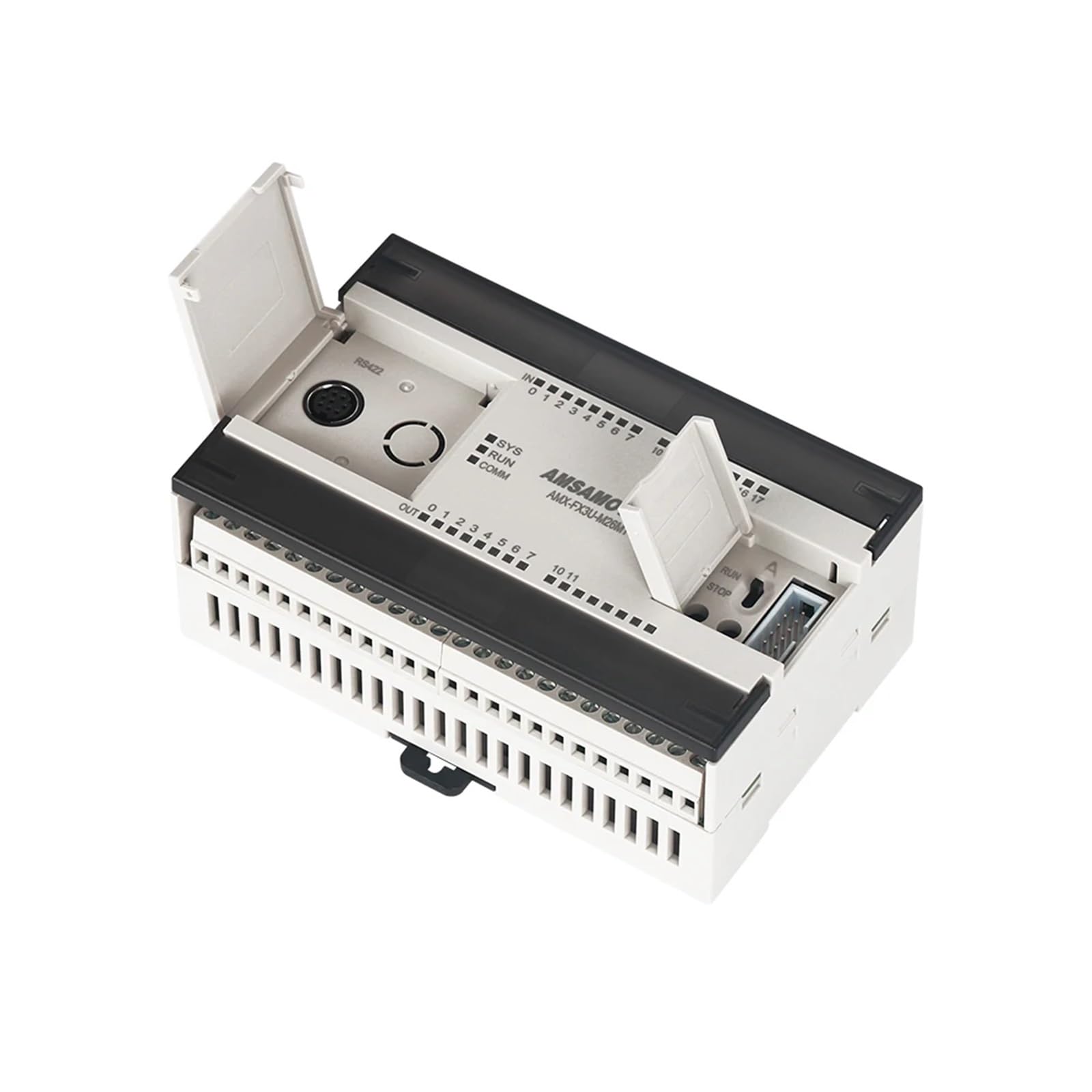
Whakaahua 1: Runga view of the JOCCOS FX3U-24MR PLC. This image displays the green terminal blocks for digital inputs (top) and digital outputs (bottom right), the blue DB9 RS232 serial port (bottom left), and the internal circuit board with various electronic components visible through the transparent casing.
3.3. Component Identification (FX3U-24MT)
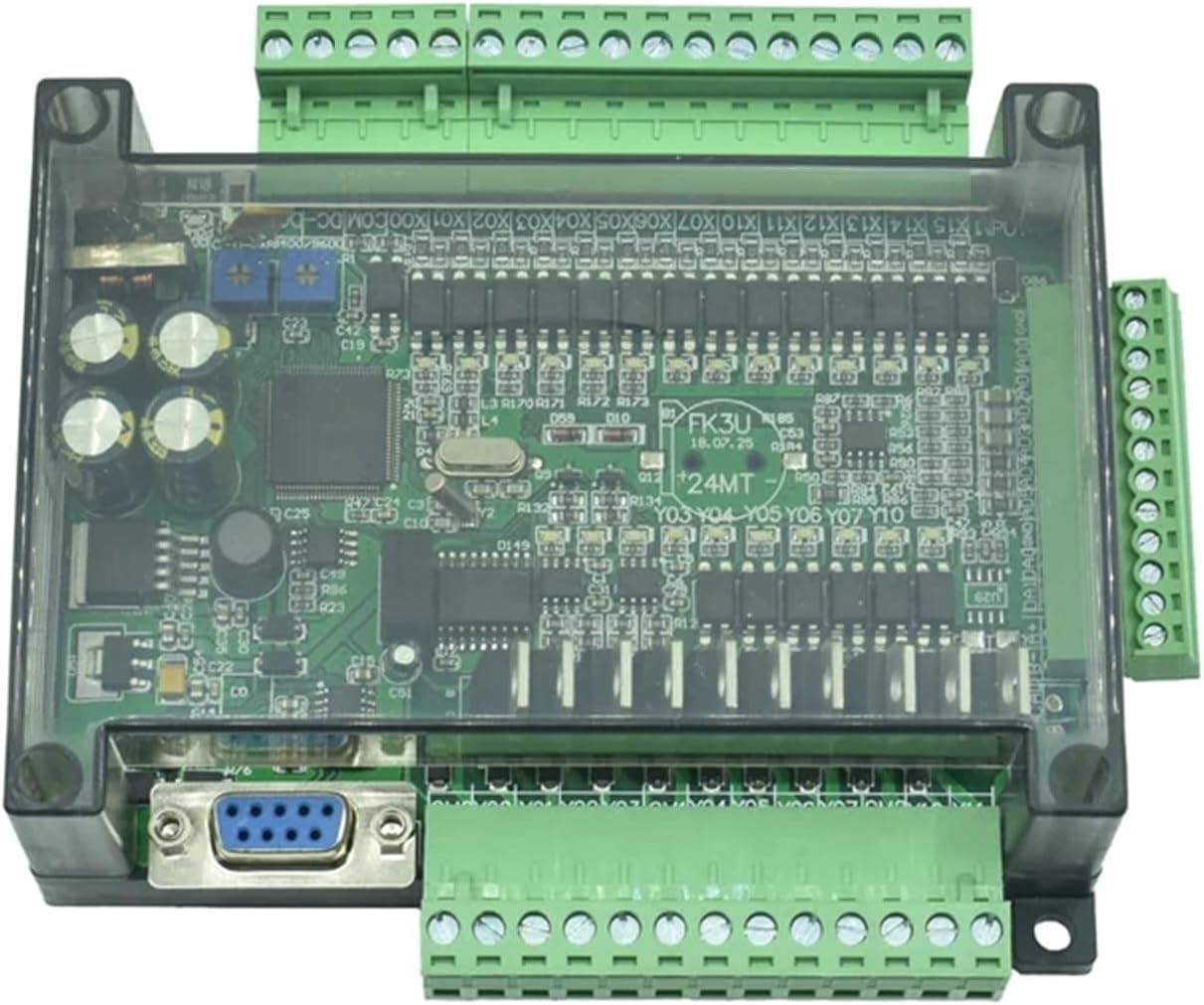
Whakaahua 2: Runga view of the JOCCOS FX3U-24MT PLC. Similar to the MR model, this image highlights the green terminal blocks for digital inputs and outputs, the DB9 RS232 port, and the internal components, specifically indicating the transistor output type.
4. Whakatakotoranga
| Āhuahira | Whakatakotoranga |
|---|---|
| Tāuru Mamati (DI) | 14 |
| Putanga Mamati (DO) | 10 (MR: Relay, MT: Transistor) |
| Tāuru tairitenga (AI) | 6 |
| Putanga Anarite (AO) | 2 |
| Tauranga Whakawhitiwhiti | RS232, RS485 |
| Tuku Hiko | DC 24V (typical) |
| Taumaha Tūemi | 50 Karamu (1.76 hekere) |
| Ahu mōkihi | 1.18 x 0.79 x 0.39 inihi |
| Kaihanga | JOCCOS |
| Tau tauira | JOCCOS (Generic, refer to FX3U-24MR/MT for specific model) |
5. Tatūnga
5.1. Whakapiki
The PLC is designed for panel mounting. Use appropriate screws to secure the unit to a stable surface. Ensure adequate ventilation around the unit to prevent overheating.
5.2. Waaho
All wiring should be performed with power disconnected. Use appropriate wire gauges for power and signal connections. Refer to the terminal labels on the PLC for correct connections.
- Tuku Hiko: Connect a stable DC 24V power source to the designated power terminals. Observe polarity.
- Whakauru Mamati: Connect sensors, switches, or other input devices to the DI terminals (X0-X13).
- Putanga Mamati: Connect actuators, relays, or other output devices to the DO terminals (Y0-Y9). Ensure the load current does not exceed the specified limits for relay (MR) or transistor (MT) outputs.
- Tāuru tairitenga: Connect analog sensors (e.g., 0-10V, 4-20mA) to the AI terminals.
- Putanga tairitenga: Connect analog actuators or drives to the AO terminals.
- Tauranga Whakawhitiwhiti: Use standard RS232 or RS485 cables to connect to programming devices or other communication modules.

Whakaahua 3: Koki view of the JOCCOS FX3U-24MR PLC, illustrating the accessible terminal blocks for wiring. This perspective helps in identifying the connection points for power, digital inputs, digital outputs, analog signals, and communication interfaces.
6. Nga Tohutohu Whakahaere
6.1. Pūmanawa Papatono
The JOCCOS FX3U series PLCs are compatible with standard Mitsubishi FX series programming software, such as GX Works2 or GX Developer. Install the software on your computer and ensure proper communication drivers are installed.
6.2. Establishing Communication
Connect the PLC to your computer using an RS232 or RS485 programming cable. Configure the communication settings in the programming software to match the PLC's default or configured settings (e.g., baud rate, data bits, stop bits, parity).
6.3. Program Download and Upload
- Tikiake: After creating your ladder logic program, compile it and download it to the PLC's memory. Ensure the PLC is in STOP mode before downloading.
- Tukuake: You can upload the existing program from the PLC to your computer for backup or modification.
6.4. Run/Stop Mode
The PLC can be switched between RUN and STOP modes via the programming software. In RUN mode, the PLC executes the loaded program. In STOP mode, the program execution is halted, allowing for program changes or debugging.
7. Tiaki
7.1. Te horoi
Periodically clean the PLC's exterior with a soft, dry cloth. Do not use solvents or abrasive cleaners. Ensure no dust or debris accumulates in the ventilation openings.
7.2. Whakahoutanga Firmware
Tirohia te kaihanga website for any available firmware updates. Follow the provided instructions carefully when performing updates to avoid damaging the unit.
7.3. Whakakapinga Pūhiko (mehemea e tika ana)
Some PLC models may include a battery for retaining program data or real-time clock settings. If your model has a battery, refer to specific instructions for replacement to avoid data loss.
8. Te Raru
Ko tenei waahanga e aro ana ki nga take noa ka pa ki a koe.
| Raruraru | Take pea | Rongoā |
|---|---|---|
| PLC not powering on | No power supply, incorrect wiring, faulty power supply | Check power connections, verify DC 24V supply, test power supply unit. |
| Cannot establish communication with PC | Incorrect cable, wrong communication settings, driver issues | Ensure correct RS232/RS485 cable, match baud rate/settings in software, reinstall communication drivers. |
| Digital input not responding | Sensor faulty, incorrect wiring, input not configured in program | Check sensor operation, verify input wiring, confirm input address in PLC program. |
| Digital output not activating | Actuator faulty, incorrect wiring, output not configured in program, overload | Check actuator, verify output wiring, confirm output address in PLC program, check for overcurrent. |
| Analog input reading incorrect | Sensor faulty, incorrect wiring, scaling issues in program | Verify sensor output, check analog input wiring, review scaling parameters in PLC program. |
9. Pūtāhui me te Tautoko
JOCCOS products are manufactured to high-quality standards. For warranty information, please refer to the terms and conditions provided at the time of purchase or contact your vendor. For technical support, please reach out to your supplier or the JOCCOS customer service department with your product model and purchase details.