1. Kupu Whakataki
This manual provides essential information for the safe and effective use of your OPTIMA D34 YellowTop Dual Purpose Sealed AGM Battery. The OPTIMA YellowTop battery is designed for high-performance applications, offering both strong cranking power and deep-cycle capabilities. It is suitable for vehicles with significant accessory loads, such as cars, trucks, and SUVs.
2. Hua Neke Atuview
The OPTIMA D34 YellowTop battery features advanced AGM (Absorbed Glass Mat) technology, providing a sealed, maintenance-free power source. Its unique SpiralCell Technology enhances power delivery and vibration resistance.
Āhuatanga matua:
- Dual Purpose Design: Functions as both a starting battery and a deep-cycle battery.
- Tiaki-Kore: Sealed design eliminates the need for water additions.
- Spillproof: Can be mounted in various positions without leakage.
- Ātete Wiri: Up to 15 times more resistant to vibration compared to standard flooded batteries.
- Faster Recharging: Designed for efficient recharging.
- Roa ake te Ora: Offers up to three times longer life than standard flooded batteries.
Wae Hua:

Whakaahua 2.1: Mua view of the OPTIMA D34 YellowTop battery, showing the yellow top cover and gray casing with positive (red) and negative (black) terminals.

Whakaahua 2.2: Koki view of the OPTIMA D34 YellowTop battery, highlighting the compact design and terminal placement.

Whakaahua 2.3: Te taha view of the OPTIMA D34 YellowTop battery, showing the cylindrical cells within the casing.
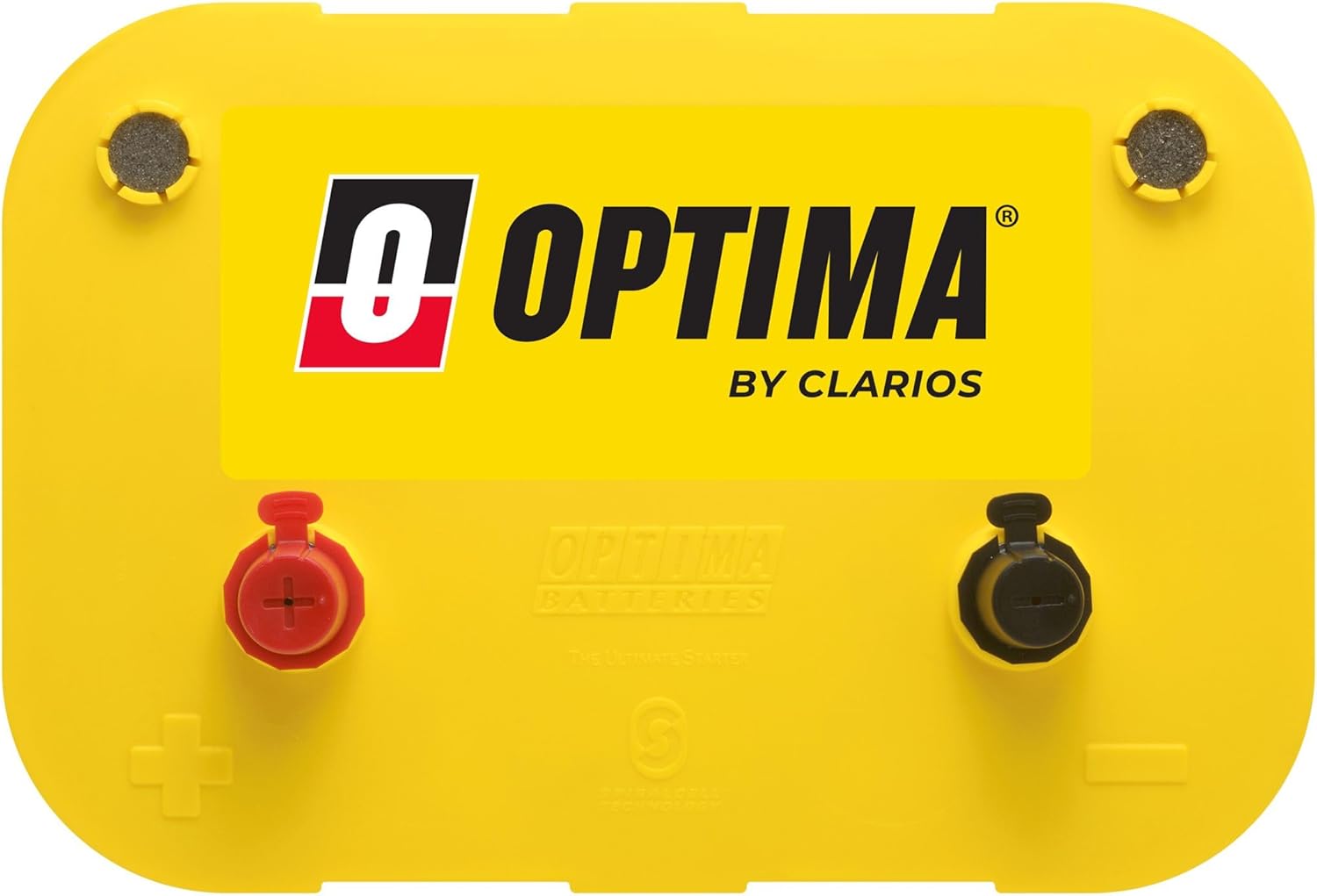
Whakaahua 2.4: Runga view of the OPTIMA D34 YellowTop battery, illustrating its dimensions: 10 1/16" (254 mm) length, 6 7/8" (175 mm) width, and 7 7/8" (200 mm) height.
3. Nga korero haumaru
WARNING: Batteries contain sulfuric acid and produce explosive gases. Improper handling can cause severe injury or death. Always wear eye protection and gloves when working with batteries.
- Puritia nga pākahiko kei taea e nga tamariki.
- Do not smoke or allow open flames near batteries.
- Ensure adequate ventilation when charging or working with batteries.
- Avoid contact with battery acid. In case of contact, flush immediately with water and seek medical attention.
- Kaua e taiawhiowhio nga putu pākahiko.
- Always disconnect the negative (-) terminal first and connect it last during installation or removal.
- Refer to your vehicle's owner's manual for specific battery handling and installation procedures.
4. Tatūnga me te Tāuta
Proper installation is crucial for battery performance and safety. If you are unsure about any step, consult a qualified technician.
- Whakaritenga:
- Me mohio kua weto te mura o te waka, kua momotuhia nga taputapu katoa.
- Wear appropriate safety gear: eye protection and gloves.
- Gather necessary tools: wrench, battery terminal cleaner, anti-corrosion spray.
- Removing the Old Battery:
- Kimihia te pākahiko i roto i to waka.
- Momotuhia te tauranga toraro (-) i te tuatahi, katahi te tauranga pai (+).
- Tangohia te pupuri i te pākahiko clampngā whitiki rānei.
- Carefully lift and remove the old battery, noting its orientation. Batteries are heavy; use proper lifting techniques or seek assistance.
- Installing the OPTIMA D34 YellowTop Battery:
- Horoia te paepae pākahiko me te cl taurangaamps thoroughly to ensure good electrical contact.
- Place the new OPTIMA D34 YellowTop battery into the battery tray, ensuring it is securely seated and oriented correctly (positive to positive, negative to negative).
- Secure the battery with hold-down clampngā whitiki rānei.
- Connect the positive (+) terminal first, then the negative (-) terminal. Ensure connections are tight.
- Apply anti-corrosion spray to the terminals to prevent corrosion.
- Taki i muri-Tāutatanga:
- Manatoko he haumaru nga hononga katoa.
- Start the vehicle to confirm proper operation.
- Tirohia mēnā he rama whakatūpato kei runga i te papatohu.
Note: Due to variations in vehicle designs, some modifications to battery cables or trays may be necessary for proper fitment in certain models. Always ensure secure connections and proper clearance.
5. Nga Tohutohu Whakahaere
The OPTIMA D34 YellowTop is a dual-purpose battery, meaning it is designed to provide both starting power and sustained power for accessories. It is suitable for vehicles with high electrical demands.
- Te Mana Timata: The battery delivers high cold cranking amps (CCA) for reliable engine starting, even in challenging weather conditions.
- Deep Cycle Use: It can withstand repeated discharge and recharge cycles, making it ideal for powering vehicle accessories, audio systems, winches, or other high-demand electronics without compromising starting ability.
- Kei te utu: For optimal performance and longevity, use a battery charger compatible with AGM batteries. Avoid overcharging or undercharging.
6. Tiaki
The OPTIMA D34 YellowTop battery is designed to be maintenance-free, meaning it does not require water additions. However, periodic checks can help ensure its longevity and performance.
- Tirohanga Kapeka: Periodically inspect battery terminals for corrosion or loose connections. Clean terminals with a battery brush and baking soda solution if corrosion is present, then rinse with water and dry. Ensure connections are tight.
- Tirotiro i te Pouaka Pūhiko: Check the battery case for any signs of damage, cracks, or bulging. If damage is observed, the battery should be replaced.
- Taumata Utu: If the vehicle is stored for extended periods or used infrequently, consider using a trickle charger or battery maintainer specifically designed for AGM batteries to keep the charge level optimal.
- Te horoi: Keep the top of the battery clean and dry to prevent dirt and moisture from creating conductive paths.
7. Te Raru
If you encounter issues with your OPTIMA D34 YellowTop battery, consider the following common troubleshooting steps:
- Vehicle Not Starting / Slow Cranking:
- Check battery terminals for tightness and corrosion. Loose or corroded connections can impede current flow.
- Ensure the battery is fully charged. A low charge can result in slow cranking or failure to start.
- Have the vehicle's charging system (alternator) checked by a professional to ensure it is properly charging the battery.
- If the battery is old, its capacity may have diminished.
- Kaore te Puhiko e mau ana i te utu:
- Verify there are no parasitic drains on the vehicle's electrical system (e.g., lights left on, faulty accessories).
- Ensure the charging system is functioning correctly.
- The battery may have been deeply discharged multiple times, which can reduce its overall lifespan if not properly recharged.
- Physical Fitment Issues:
- The OPTIMA D34 has specific dimensions (10" x 6 7/8" x 7 13/16"). Compare these to your vehicle's battery tray and available space.
- Terminal orientation and cable length can vary by vehicle. Minor adjustments or specialized terminals may be required in some cases.
If problems persist after performing these checks, it is recommended to consult a professional automotive technician or contact OPTIMA customer support.
8. Whakatakotoranga
| Āhuahira | Whakatakotoranga |
|---|---|
| Tau tauira | D34 (OEM Part Number: 8012-021) |
| Voltage | 12-Volt |
| Makariri Cranking Amps (CCA) | 750 CCA |
| C20 Capacity | 55 AH |
| Rahui Rahui | meneti 120 |
| Ahu (L x W x H) | 10" x 6 7/8" x 7 13/16" (254mm x 175mm x 200mm) |
| Taumaha | 42.9 pauna |
| Momo Kapeka | SAE Terminal |
| Hangarau | Sealed AGM, SpiralCell Technology |
| UPC | 811405000218 |
9. Pūtāhui me te Tautoko
For warranty information and customer support, please refer to the official OPTIMA Batteries website or contact their customer service directly. Warranty terms and conditions may vary based on purchase location and retailer.
E taunaki ana kia mau tonu to tohu hoko mo nga kereme whakamana.


