1. Kupu Whakataki
This manual provides instructions for the safe and effective use of the Sealey MM19 Digital Multimeter. The MM19 is a general-purpose multimeter designed for measuring various electrical parameters, including AC and DC voltage, DC current, resistance, audible continuity, and diode/transistor verification. Please read this manual thoroughly before operation and retain it for future reference.
2. Nga korero haumaru
Always observe basic safety precautions when using electrical test equipment to reduce the risk of fire, electric shock, or personal injury. This device complies with IEC 1010 and CE CAT II safety standards.
- Kaua e neke atu i ngā rohe whakauru mōrahi mō tētahi mahi. Tirohia te wāhanga whakatakotoranga mō ētahi atu kōrero.
- Kaua rawa e tono voltage to the meter when the rotary switch is set to Resistance (Ω), Diode, Continuity, or Current (A) functions.
- Kia tupato ki te mahi tahi me te voltagkei runga ake i te 30V AC RMS, te 42V tihi, te 60V DC rānei. Ko enei voltaghe morearea ohorere.
- Ensure the test leads are in good condition, without cracked or broken insulation.
- Always connect the common (COM) test lead first and disconnect it last.
- Disconnect power to the circuit under test before measuring resistance or continuity.
- Whakakapia tonutia te pākahiko ina puta te tohu pākahiko iti hei whakarite i ngā pānui tika.
3. Hua Neke Atuview
The Sealey MM19 Digital Multimeter features a clear LCD display, a central rotary switch for function selection, and input jacks for test leads.
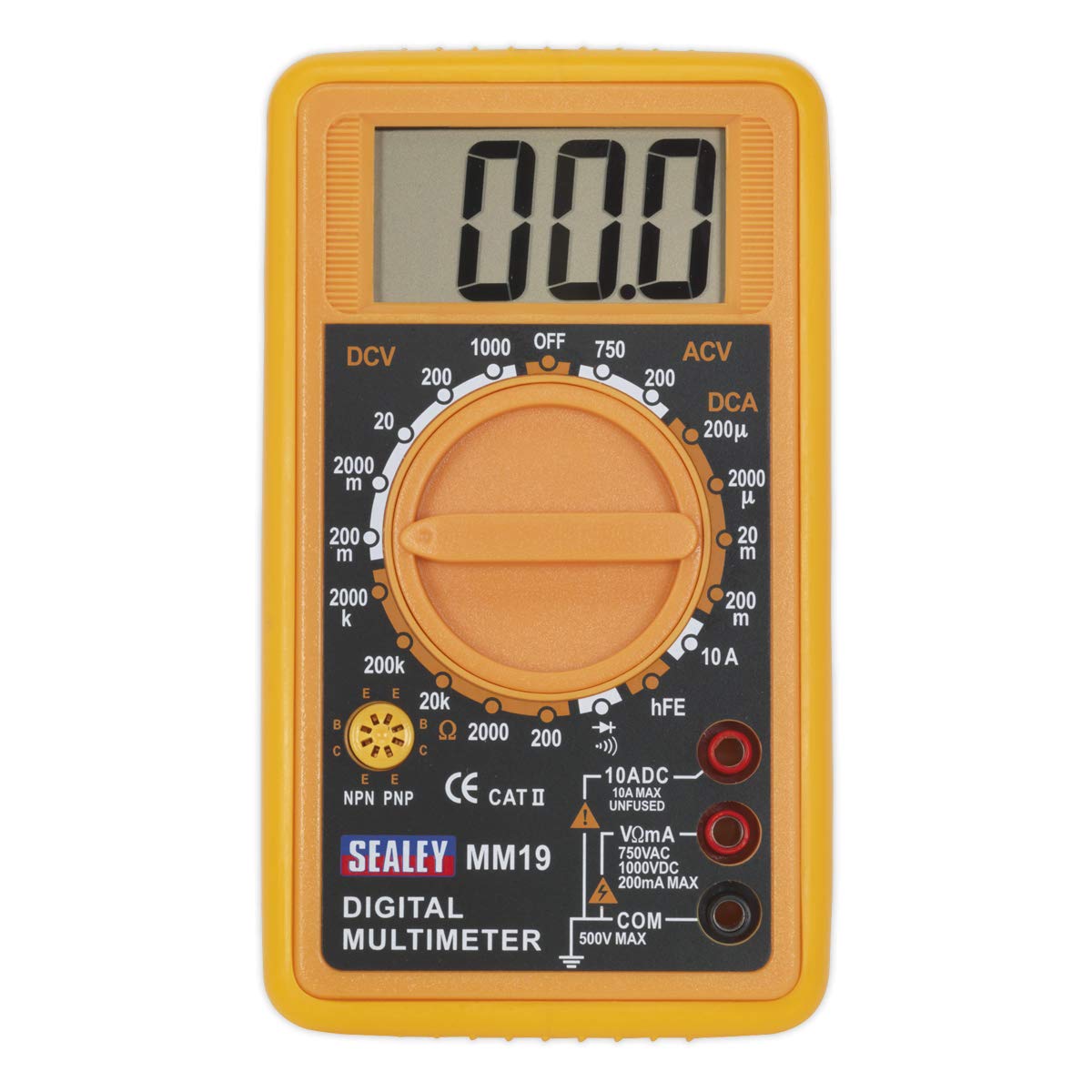
The Sealey MM19 Digital Multimeter, shown with its yellow casing, large LCD display, rotary function switch, and red and black test leads connected to the input jacks.
Waehanga:
- Whakaaturanga LCD: Large (46 x 25mm) digital display for reading measurements.
- Whakawhiti Rotary: Whakamahia hei tīpako i te mahi ine me te awhe e hiahiatia ana.
- VΩmA Input Jack: Mo te voltage, resistance, and current measurements up to 200mA.
- 10ADC Input Jack: For high current measurements up to 10A DC (unfused).
- Jack Tāuru COM: Whakauru noa (kino) mo nga inenga katoa.
- hFE turanga: For transistor (NPN/PNP) testing.
- Nga Tohu Whakamatau: Ngā taura whero (pai) me te mangu (kino) hei hono atu ki ngā ara iahiko.
4. Tatūnga
4.1. Tāuta Pūhiko
The Sealey MM19 Multimeter requires a 9V battery for operation. If the display does not illuminate or shows a low battery indicator, the battery needs to be installed or replaced.
- Me whakaweto te mita maha.
- Kimihia te uhi o te wahanga pākahiko kei muri o te waeine.
- Tangohia te tīwiri e mau ana i te taupoki, ka ata hiki ake.
- Connect a new 9V battery to the battery clips, observing correct polarity.
- Place the battery inside the compartment and replace the cover, securing it with the screw(s).
4.2. Te hono i nga Kaitohu Whakamatau
The multimeter is supplied with a pair of test leads (red and black).
- Whakauruhia te mata whakamātautau pango ki roto i te COM Hononga tāuru (noa).
- Mo te nuinga o nga inenga (voltage, resistance, low current), insert the mata whakamātautau whero ki roto i te VΩmA Jack tāuru.
- For high DC current measurements (up to 10A), insert the mata whakamātautau whero ki roto i te 10ADC Jack tāuru.
5. Nga Tohutohu Whakahaere
To operate the multimeter, select the desired function and range using the rotary switch.
5.1. Measuring DC Voltage (DCV)
- Insert the red lead into the VΩmA jack and the black lead into the COM jack.
- Set the rotary switch to the desired DCV range (e.g., 200m, 2000m, 20, 200, 1000). Start with the highest range if the voltage kore e mohiotia.
- Honoa nga arataki whakamatautau puta noa i te waahanga, iahiko ranei hei ine.
- Pānuihia te voltage uara i runga i te whakaaturanga LCD.
5.2. Te Ine AC Voltage (ACV)
- Insert the red lead into the VΩmA jack and the black lead into the COM jack.
- Set the rotary switch to the desired ACV range (e.g., 200, 750). Start with the highest range if the voltage kore e mohiotia.
- Honoa nga arataki whakamatautau puta noa i te waahanga, iahiko ranei hei ine.
- Pānuihia te voltage uara i runga i te whakaaturanga LCD.
5.3. Measuring DC Current (DCA)
- Mō ngā iahiko tae atu ki te 200mA: Insert the red lead into the VΩmA jack and the black lead into the COM jack.
- Mō ngā iahiko tae atu ki te 10A: Insert the red lead into the 10ADC jack and the black lead into the COM jack.
- Set the rotary switch to the desired DCA range (e.g., 200μ, 2000μ, 20m, 200m, 10A). Start with the highest range if the current is unknown.
- Whakawetohia te hiko ki te ara iahiko. Open the circuit where the current is to be measured.
- Honoa te mita maha ki te ara iahiko mā te raupapa.
- Tāpirihia te hiko ki te ara iahiko, ka pānui i te uara o nāianei kei runga i te mata LCD.
5.4. Measuring Resistance (Ω)
- Insert the red lead into the VΩmA jack and the black lead into the COM jack.
- Set the rotary switch to the desired Resistance (Ω) range (e.g., 200, 2000, 20k, 200k, 2000k).
- Me whakarite kua whakakorea te hiko o te ara iahiko e whakamatautauria ana.
- Honoa nga arataki whakamatautau puta noa i te waahanga hei ine.
- Pānuihia te uara ātete i runga i te mata LCD.
5.5. Whakamātautau Tonu Audible
- Insert the red lead into the VΩmA jack and the black lead into the COM jack.
- Tautuhia te pana hurihuri ki te tohu haere tonu (ata o te kaikorero).
- Me whakarite kua whakakorea te hiko o te ara iahiko e whakamatautauria ana.
- Connect the test leads across the component or wire.
- If continuity exists (low resistance), the meter will emit an audible tone. The display will show the resistance value.
5.6. Diode/Transistor Verification Mode (hFE)
- Insert the red lead into the VΩmA jack and the black lead into the COM jack for diode testing.
- Set the rotary switch to the diode symbol.
- Connect the red lead to the anode and the black lead to the cathode of the diode. The display will show the forward voltage drop. Reverse the leads; the display should show 'OL' (open loop) for a good diode.
- For transistor hFE measurement, insert the transistor leads (Emitter, Base, Collector) into the appropriate sockets (E, B, C) in the hFE test socket, ensuring correct NPN or PNP type selection.
- Read the hFE value on the LCD display.
6. Tiaki
6.1. Te horoi
Horoia te mita casing me te panuiamp he kakahu me te horoi ngawari. Kaua e whakamahi i te abrasive me te whakarewa. Me whakarite kua maroke katoa te mita i mua i te whakamahi.
6.2. Whakakapinga Pūhiko
Refer to Section 4.1 for battery installation instructions. Replace the 9V battery when the low battery indicator appears on the display to maintain measurement accuracy.
7. Te Raru
- Kore Whakaatu: Check battery installation and ensure the battery has sufficient charge.
- 'OL' or '1' on Display: This usually indicates an over-range condition or an open circuit. Select a higher range or check connections.
- Pānui hē: Ensure the correct function and range are selected. Check test lead connections and battery condition.
- No Continuity Tone: Verify the circuit is de-energized and the leads are making good contact.
8. Whakatakotoranga
| Tawhā | Uara |
|---|---|
| Waitohu | Sealey |
| Tau tauira | MM19 |
| Puna Mana | Whakahikohia te Pūhiko (9V) |
| Whakaatu | Digital LCD (46 x 25mm) |
| DC Voltage (DCV) | 200mV, 2000mV, 20V, 200V, 1000V |
| AC Voltage (ACV) | 200V, 750V |
| DC Naianei (DCA) | 200µA, 2000µA, 20mA, 200mA, 10A |
| Ātete (Ω) | 200Ω, 2000Ω, 20kΩ, 200kΩ, 2000kΩ |
| Tonu | Audible tone below approx. 30Ω |
| Whakamatau Diode | Whakamua Voltagwhakaaturanga e-maturuturu |
| Whakamātautau Transistor | hFE (NPN/PNP) |
| Whakatauranga Haumaru | CE CAT II, IEC 1010 |
| Ahu (L x W x H) | 1.93 x 4.21 x 6.06 inihi |
| Taumaha Tūemi | 9.5 hekere (0.27 Kirokaramu) |
9. Pūtāhui me te Tautoko
For warranty information or technical support, please refer to the documentation provided with your purchase or contact Sealey customer service directly. Keep your proof of purchase for any warranty claims.


