1. Kupu Whakataki
This manual provides essential information for the safe and efficient installation, operation, and maintenance of your Goobay 30003 LED Transformer. This device is designed to convert AC power to 12V DC, suitable for powering LED lighting systems with a total load of up to 30 watts.
Tena koa panuihia enei tohutohu i mua i te whakamahi me te pupuri i a raatau hei tohutoro a meake nei.
2. Nga Tohutohu Haumaru
- Haumaru Hiko: Installation and connection must be performed by a qualified electrician or competent person in accordance with local electrical codes and regulations.
- Momotu Hiko: Always disconnect the power supply before performing any installation, maintenance, or troubleshooting.
- Raukaha Uta: Do not exceed the maximum load of 30 watts. Overloading can damage the transformer and connected LEDs, and poses a fire risk.
- Whakahau: Ensure adequate ventilation around the transformer to prevent overheating. Do not cover the unit.
- Taiao: This transformer is designed for indoor use. Avoid exposure to moisture, direct sunlight, and extreme temperatures.
- Kohanga Tiaki II: The transformer features safe electronic separation as per protection class II, meaning it has reinforced insulation and does not require a protective earth connection.
- Furniture Installation: This unit is approved for installation in furniture, provided proper ventilation and safety clearances are maintained.
3. Hua Neke Atuview
The Goobay 30003 LED Transformer is a compact and efficient power supply for 12V DC LED applications. Key features include:
- DC current source for LEDs with electronic ballast unit.
- Flat design for space-saving installation.
- Approved for installation in furniture.
- Safe electronic separation as per protection class II.
- Putanga putanga tonutage for parallel circuits.

Whakaahua 1: Goobay 30003 LED Transformer. This image displays the top view of the white rectangular transformer, showing the input terminals (PRI: 200-240V~) on the left and output terminals (SEC: 12V===) on the right, with clear labeling for N, L, + and - connections.
4. Tatūnga me te Tāuta
A pee i enei taahiraa mo te whakauru tika:
- Momotu Hiko: Ensure the main power supply is switched off before beginning any installation work.
- Whakapiki: Select a suitable location for the transformer, ensuring it is dry, well-ventilated, and within the specified operating temperature range. The flat design allows for space-saving installation, including within furniture.
- Input Connection (PRI): Connect the AC mains supply (200-240V~, 50/60 Hz) to the input terminals labeled 'N' (Neutral) and 'L' (Live) on the transformer. Use appropriate wiring and ensure secure connections.
- Output Connection (SEC): Connect your 12V DC LED lighting system to the output terminals labeled '+' and '-' on the transformer. Ensure correct polarity (+ to + and - to -) for your LED devices. The transformer provides a constant 12V DC output suitable for parallel circuits.
- Load Check: Manatokohia te tapeke wattage of all connected LED devices does not exceed 30 watts.
- Hononga Haumaru: Double-check all wiring connections to ensure they are tight and correctly insulated.
- Whakahiko: Kia mau nga hononga katoa me te manatoko, whakahokia te hiko ki te ara iahiko.
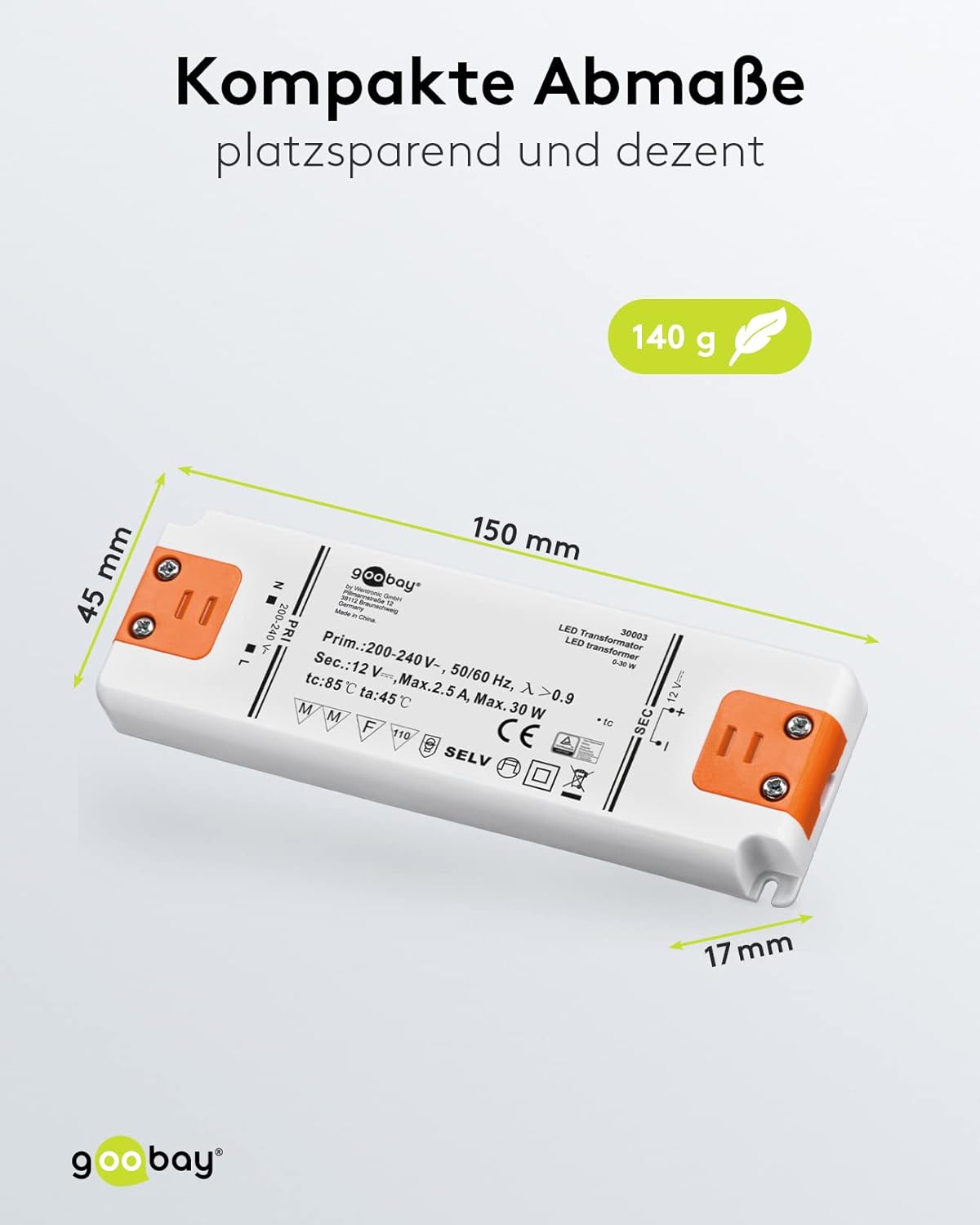
Whakaahua 2: Goobay 30003 LED Transformer with dimensions. This image shows the transformer with its length (150 mm), width (45 mm), and height (17 mm) clearly indicated, alongside its weight (140 g).
5. Nga Tohutohu Whakahaere
The Goobay 30003 LED Transformer operates automatically once correctly installed and powered. It provides a stable 12V DC output for your connected LED devices.
- Ensure the total load of connected LEDs does not exceed 30W.
- The transformer is designed for continuous operation within its specified parameters.
6. Tiaki
The Goobay 30003 LED Transformer requires minimal maintenance.
- Te horoi: Disconnect power before cleaning. Use a dry, soft cloth to wipe the exterior. Do not use liquid cleaners or solvents.
- Tirotiro: Periodically check the wiring for any signs of damage or loose connections.
- Whakahau: Ensure that ventilation openings are not obstructed.
7. Te Raru
If you encounter issues with your transformer, refer to the following table:
| Raruraru | Take pea | Rongoā |
|---|---|---|
| Kare e marama nga rama | Karekau he hiko waea hē Faulty LED(s) Kua whakahohehia te parenga taumaha | Tirohia te hiko hiko me te ara iahiko. Verify input and output connections and polarity. Test LEDs with a known working power source. Reduce the total load; disconnect power, wait a few minutes, then reconnect. |
| Ko nga rama rama e korikori ana, kua atarua ranei | Hononga wewete Insufficient power (near max load) Faulty LED(s) | Tirohia nga hononga waea waea katoa. Ensure total load is well within the 30W limit. Test individual LEDs. |
| Transformer makes buzzing noise | Nga waahanga wetekina Incompatible LED load (rare for constant voltage) Te taumahatanga | Ensure secure mounting. If noise persists and performance is affected, discontinue use. Verify total load is within specifications. |
| Transformer is hot | He kino te hau Te taumahatanga | Ensure adequate airflow around the unit. Do not cover. Reduce the total load of connected LEDs. |
If the problem persists after following these steps, disconnect the power and contact customer support or a qualified electrician.
8. Whakatakotoranga
- Tau tauira: 30003
- Waitohu: Goobay
- Whakauru Voltage (Primary): 200-240V~, 50/60 Hz
- Putanga Voltage (Secondary): 12V DC
- Morahi Putanga o nāianei: 2.5 Amps
- Uta Tapeke Morahi: 30 Watts
- Puna Hiko: Electricity, Male Plug
- Karaehe Tiaki: II (Safe electronic separation)
- Tiwhikete: CE
- Momo Whakapuru: Bodenmontage (Floor Mounting - typically refers to surface mounting)
- Rahi Hua: 1.77 x 0.67 x 5.91 inihi (45 x 17 x 150 mm)
- Taumaha: Tata ki te 5.59 auneke (140 karamu)
- Operating Temperature (ta): 45 °C
- Case Temperature (tc): 85 °C
9. Pūtāhui me te Tautoko
Mō ngā mōhiohio pūtāhui, mō te tautoko hangarau rānei, tirohia ngā tuhinga i whakaratohia me tō hoko, whakapā atu rānei ki tō kaihokohoko. Puritia tō taunakitanga hoko mō ngā kereme pūtāhui.


