1. Kupu Whakataki
This manual provides essential information for the safe and efficient operation of your VOLTCRAFT GOS-632 FG Oscilloscope with Frequency Generator. Please read this manual thoroughly before using the device and keep it for future reference. The GOS-632 FG is a 30 MHz dual-channel analog oscilloscope integrated with a frequency generator, designed for various electronic measurement and testing applications.
2. Nga Tohutohu Haumaru
Always observe the following safety precautions to prevent electric shock, injury, or damage to the instrument:
- Puna Hiko: Connect the instrument only to a power source with the specified voltage me te auau.
- Whakapapa: Ensure the instrument is properly grounded to prevent electric shock.
- Whakahau: Do not block ventilation openings. Ensure adequate airflow to prevent overheating.
- Taiao: Operate the oscilloscope in a dry, clean environment, away from direct sunlight, high temperatures, and excessive dust or humidity.
- Nga tirotiro: Use only probes rated for the voltage and frequency being measured. Ensure probes are in good condition.
- Ratonga: Refer all servicing to qualified service personnel. Do not attempt to open or repair the instrument yourself.
- Wai Whakapā: Avoid contact with liquids. If liquid enters the device, disconnect power immediately and have it inspected by a qualified technician.
3. Ihirangi mokete
Please check the package contents upon receipt. If any items are missing or damaged, contact your dealer immediately.
- VOLTCRAFT GOS-632 FG Oscilloscope with Frequency Generator
- Waea hiko
- Two (2) Oscilloscope Probes (1x/10x switchable)
- Pukapuka Kaiwhakamahi (tenei tuhinga)
4. Hua Neke Atuview
The VOLTCRAFT GOS-632 FG is a robust analog oscilloscope designed for reliable waveform analysis. Below is a general view o te taputapu.
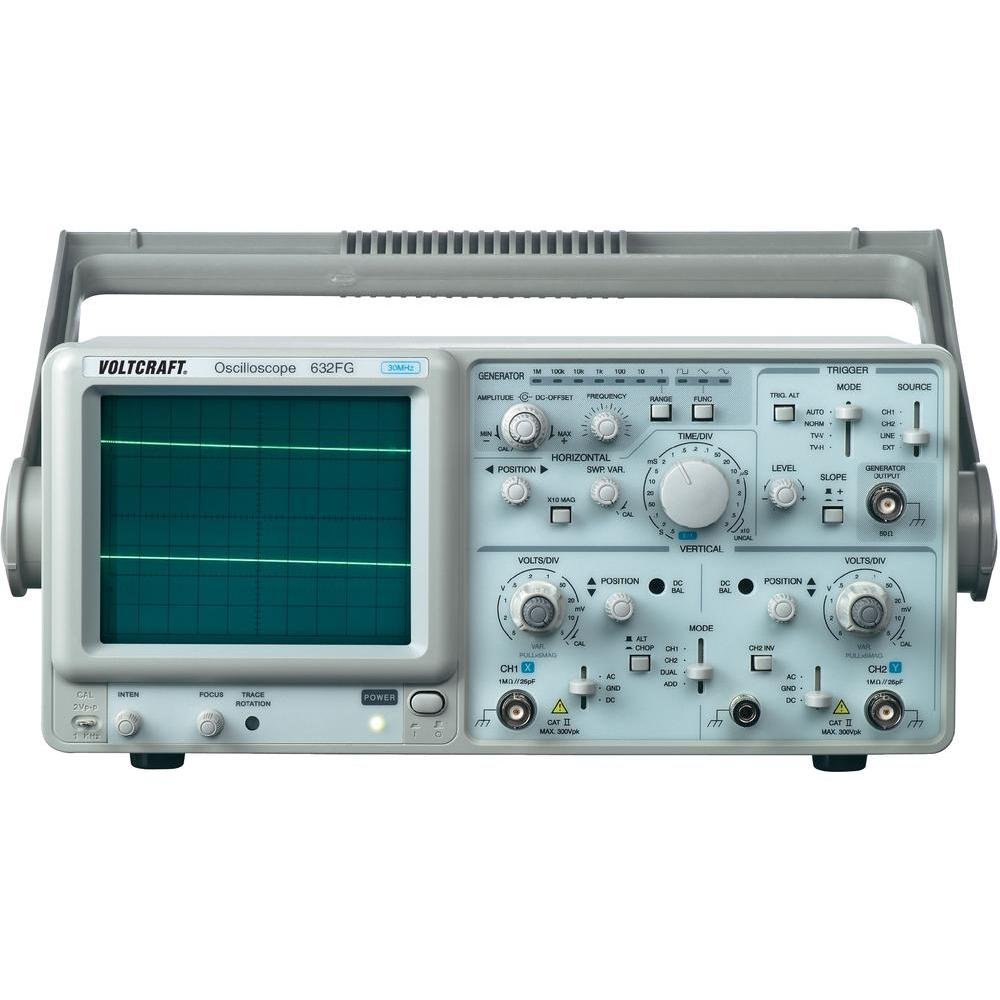
Whakaahua 4.1: Mua view of the VOLTCRAFT GOS-632 FG Oscilloscope. This image shows the main display, control knobs, and input connectors for the two channels and the frequency generator output.
4.1. Mana Paewhiri Mua
- CRT Display: Shows the waveform.
- CH1/CH2 Input: BNC connectors for connecting oscilloscope probes.
- VOLTS/DIV: Adjusts the vertical sensitivity for each channel.
- TUNGA: Adjusts the vertical position of the waveform.
- TIME/DIV: Adjusts the horizontal sweep speed.
- TRIGGER LEVEL: Ka tautuhia te voltage level at which the sweep starts.
- AHUNGA: Selects trigger source (CH1, CH2, EXT, LINE).
- FREQUENCY GENERATOR OUTPUT: BNC connector for the integrated signal generator.
- FREQUENCY/AMPLITUDE: Controls for the frequency generator output.
- Whakawhiti POWER: Ka whakakā, whakaweto rānei i te taputapu.
4.2. Hononga Paewhiri Whakamuri
- Whakauru Hiko AC: Tuhono mo te taura hiko.
- Kāpeka Whenua: For additional grounding if required.
5. Tatūnga
- Wewete ana: Carefully remove the oscilloscope from its packaging. Retain the packaging for future transport.
- Turanga: Place the oscilloscope on a stable, level surface with adequate ventilation around the unit.
- Hononga Hiko: Connect the supplied power cord to the AC power input on the rear panel and then to a grounded electrical outlet.
- Hononga tirotiro: Connect the oscilloscope probes to the CH1 and/or CH2 BNC input connectors on the front panel. Ensure a secure connection.
- Utu Whakamātautau: Before taking measurements, compensate your probes. Connect the probe tip to the probe compensation output (usually a square wave signal on the front panel) and adjust the probe's compensation trimmer until a flat-top square wave is displayed.
6. Te Whakahaere i te Oscilloscope
6.1. Te Ine Taketake
- Whakahiko: Press the POWER switch to turn on the oscilloscope. Allow a few minutes for the display to stabilize.
- Tohu Input: Connect the probe to the circuit point you wish to measure.
- Vertical Adjustment (VOLTS/DIV & POSITION):
- Select the appropriate VOLTS/DIV setting to display the waveform within the screen.
- Use the POSITION knob to center the waveform vertically.
- Horizontal Adjustment (TIME/DIV & POSITION):
- Select the appropriate TIME/DIV setting to display several cycles of the waveform horizontally.
- Use the horizontal POSITION knob to move the waveform left or right.
- Tatūnga Whakaoho:
- Set the TRIGGER MODE (e.g., AUTO, NORM).
- Adjust the TRIGGER LEVEL knob until a stable waveform is displayed.
- Select the TRIGGER SOURCE (e.g., CH1, CH2).
6.2. Using the Frequency Generator
- Tūhono Huaputa: Connect a BNC cable from the FREQUENCY GENERATOR OUTPUT to the circuit or device under test.
- Tautuhi Auautanga: Use the FREQUENCY control to select the desired output frequency.
- Tautuhi Ampahuru: Whakamahia te AMPLITUDE control to adjust the output signal strength.
- Tīpakonga Ngaru: If available, select the desired waveform type (e.g., sine, square, triangle).
7. Tiaki
- Te horoi: Momotuhia te taura hiko i mua i te horoinga. Whakamahia he taura ngohengohe, he tauraamp cloth with a mild detergent to clean the exterior. Do not use abrasive cleaners or solvents.
- Rokiroki: When not in use for extended periods, store the oscilloscope in a dry, dust-free environment.
- Whakatikatika: For accurate measurements, periodic calibration by qualified personnel is recommended.
8. Te Raru
| Raruraru | Take pea | Rongoā |
|---|---|---|
| Kaore he whakaaturanga i muri o te hiko | No power, brightness/focus too low | Check power cord, outlet. Adjust INTENSITY and FOCUS knobs. |
| Ngaru kore pumau | Incorrect trigger settings, signal too noisy | Adjust TRIGGER LEVEL, TRIGGER MODE, and TRIGGER SOURCE. Check signal integrity. |
| Karekau he tohu i whakaatuhia | Probe not connected, incorrect VOLTS/DIV, signal outside range | Ensure probe is connected and making contact. Adjust VOLTS/DIV and POSITION. Check probe compensation. |
| Frequency generator output not working | Output cable not connected, amplitude set to zero | Check output cable connection. Increase AMPRITI. |
9. Whakatakotoranga
| Āhuahira | Taipitopito |
|---|---|
| Tau tauira | GOS-632 FG |
| Kaihanga | PUKAPUKA |
| Aratuku | 30 MHz (DC) |
| Nga hongere | 2 Waerenga Analog |
| Integrated Function | Kaihanga Hiko |
| Taumaha Hua | 9.07 g (Note: This weight seems unusually low for an oscilloscope and might be a data entry error. Refer to product packaging for accurate weight.) |
| ASIN | B003IDBEYM |
| Tuatahi Wātea | Maehe 31, 2015 |
10. Pūtāhui me te Tautoko
VOLTCRAFT products are designed for quality and reliability. For information regarding warranty terms, technical support, or service, please refer to the warranty card included with your product or visit the official VOLTCRAFT webpae. Kaua e ngana ki te whakatika i te taputapu i a koe ano, na te mea ka kore to whakamana.
For further assistance, please contact your local VOLTCRAFT distributor or customer service center.


