1. Kupu Whakataki
Mauruuru koe mo te hokoasing the Lanzar Max Pro 1800 Watt Mono Block Amplifier, Model MAXP1200. This manual provides essential information for the proper installation, operation, and maintenance of your amplifier. To ensure optimal performance and safety, please read this manual thoroughly before attempting to install or operate the unit. Keep this manual for future reference.
2. Nga korero haumaru
Kia mau ki nga whakaritenga haumaru e whai ake nei hei aukati i te whara, i te kino ranei o te amplifier and connected components.
- Haumaru Hiko: Ensure all power connections are made correctly and securely. Disconnect the vehicle's battery before making any power connections to avoid electrical shorts. Use appropriate gauge wiring for power and ground connections as specified in the installation section.
- Whakahau: Tāutahia te amplifier in a location that allows for adequate air circulation. Do not cover the amplifier or install it in an enclosed space where heat cannot dissipate. Overheating can lead to amplifier shutdown or damage.
- Tāuta Ngaio: If you are unsure about any aspect of the installation, it is recommended to seek assistance from a qualified car audio professional.
- Makuku Makuku: Kaua e hurahia te amplifier to moisture or water. This can cause electrical shock or damage to the unit.
- Whakaeke Haumaru: Maunga te ampwhakapūmau kia kore ai e waiho hei pere ina tū ohorere, ina puta he aituā rānei.
3. Hua Neke Atuview
The Lanzar MAXP1200 is a high-performance mono block amplifier designed to deliver powerful and clear bass to your car audio system. Featuring 1800 watts of peak power, this amplifier is optimized for driving subwoofers.
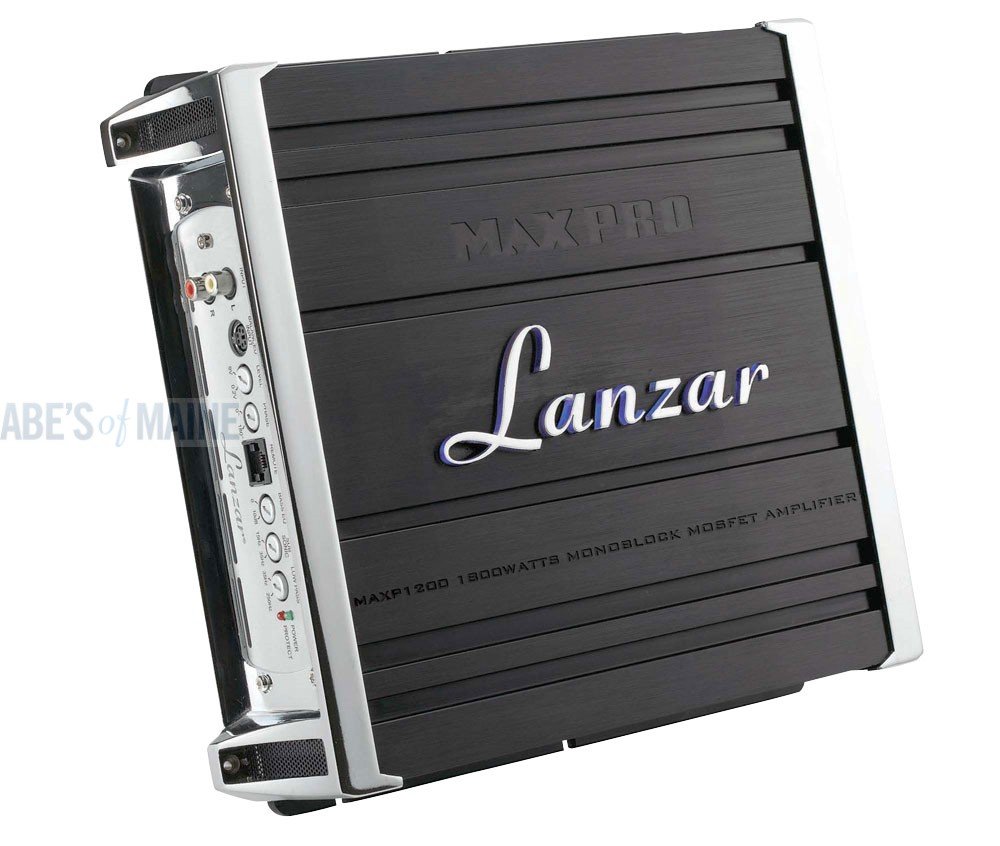
Figure 3.1: Lanzar Max Pro 1800 Watt Mono Block Amplifier (Model MAXP1200). This image shows the amplifier's main body with its black ribbed heatsink design and the silver-colored side panel where the input and control terminals are located. The "Lanzar" logo is prominently displayed on the top surface.
Āhuatanga matua:
- Mono Block Design for dedicated subwoofer power.
- High Power Output: Up to 1800 Watts.
- MOSFET Power Supply for efficient operation.
- Variable Low Pass Crossover.
- Variable Bass Boost.
- Thermal, Overload, and Short Protection Circuitry.
Tautuhi Wae:
Tirohia te Whakaahua 3.1 mo te whakaaturanga ataata o te ampngā wāhanga o te kaiwhakaora.
- Nga Whakauru RCA: For connecting the audio signal from your head unit.
- Mana Whiwhi: Adjusts the input sensitivity to match the output of your head unit.
- Low Pass Filter (LPF) Control: Sets the upper frequency limit for the ampputanga a liifier.
- Mana Whakanui Panguru: Increases the output level at a specific bass frequency.
- Power/Protect Indicators: LEDs that show the amplifier's operational status.
- Kaihoko Hiko: Connections for +12V, Ground, and Remote Turn-On.
- Kaihoko korero: Output connections for your subwoofer(s).
4. Tatūnga me te Tāuta
He mea nui te whakaurunga tika mo te mahi me te roa o to oranga ampkaikawe
4.1 Ngā Arowhai i mua i te Tāutanga:
- Me whakarite kia taea e te pūnaha hiko o te waka te tautoko i te ampnga whakaritenga mana o te liifier.
- Disconnect the negative terminal of the vehicle's battery before starting any wiring.
- Gather all necessary tools and wiring accessories (power wire, ground wire, remote wire, RCA cables, speaker wire, fuse holder, fuse).
4.2 Whakapiki i te AmpKaiwhakaora:
Ko te amplifier is designed for surface mount installation. Choose a mounting location that is:
- Secure and stable, preventing movement during vehicle operation.
- Well-ventilated, allowing heat to dissipate effectively. Avoid enclosed spaces like under carpets or in tight compartments.
- Away from direct sunlight or heat sources.
- Protected from moisture and excessive dust.
Use appropriate screws to secure the amplifier to the chosen surface. Ensure no existing wiring or fuel lines are damaged during drilling.
4.3 Hononga Waea:
- Hiko (+12V) Hononga: Run a power cable (e.g., 4-gauge or larger) directly from the positive terminal of the vehicle's battery to the amplifier's +12V terminal. Install an in-line fuse holder with an appropriate fuse (refer to specifications for fuse rating) within 18 inches (45 cm) of the battery.
- Hononga Whenua (GND): Connect a ground cable of the same gauge as the power cable from the amplifier's GND terminal to a clean, unpainted metal surface of the vehicle's chassis. Ensure a solid electrical connection by scraping away any paint or rust. The ground point should be as short as possible, ideally less than 3 feet (1 meter).
- Hononga Mamao (REM): Connect a remote turn-on wire (e.g., 18-gauge) from the ampte pūrua REM a te kaiwhakaoho ki te putanga mamao o tō waeine upoko. Ka hurihia e tēnei waea te ampwhakakoi me te whakaweto me to wae upoko.
- Hononga Whakauru RCA: Honoa ngā taura RCA mai i te mua-amp outputs of your head unit to the RCA inputs on the ampkaikawe
- Hononga Putanga Puoro: Honoa ō subwoofer ki te amplifier's speaker terminals. Pay close attention to polarity (+ to + and - to -). For multiple subwoofers, ensure proper wiring for the desired impedance load.
5. Te whakahaere i te Ampkaikawe
5.1 Hiko-Whakaoho Tuatahi:
Once all connections are made and double-checked, reconnect the vehicle's battery. Turn on your head unit. The amplifier's "Power" indicator light should illuminate, indicating it is receiving power and is operational. If the "Protect" light illuminates, refer to the Troubleshooting section.
5.2 Adjusting Controls:
- Mana Whiwhi: This is not a volume control. It matches the amptairongo tāuru o lifier ki te putanga voltage of your head unit. Start with the gain set to minimum. Play a familiar track with a strong bass signal at about 75% of your head unit's maximum volume. Slowly increase the ampkia rongo koe i te korikoritanga, ka hoki whakamuri paku.
- Tātari Tuku Iti (LPF): Adjust this control to filter out frequencies above the desired range for your subwoofer. A common starting point is between 80Hz and 120Hz, depending on your subwoofer and other speakers.
- Whakarei i te Bass: Use this control sparingly. Excessive bass boost can lead to distortion and potential damage to your subwoofer. Start at minimum and increase only if more bass impact is desired, ensuring the sound remains clean.
6. Tiaki
Ko te tiaki i nga wa katoa ka awhina i te roa me te mahi o to mahi ampkaikawe
- Te horoi: Ia wā horoia te amplifier's exterior with a soft, dry cloth to remove dust and dirt. Do not use harsh chemicals or abrasive cleaners. Ensure the cooling fins are free of obstructions.
- Taki Hononga: Occasionally inspect all wiring connections (power, ground, remote, RCA, speaker) to ensure they are secure and free from corrosion. Loose connections can cause performance issues or damage.
- Whakahau: Me whakarite te amplifier's mounting location remains well-ventilated. Clear any objects that might obstruct airflow around the unit.
7. Te Raru
Mena ka raru koe ki to amplifier, consult the following table before contacting technical support.
| Raruraru | Take pea | Rongoā |
|---|---|---|
| Karekau he Hiko (Whakaweto Hiko) | Blown fuse; Loose power/ground/remote connection; Faulty wiring. | Takina amplifier fuse and in-line battery fuse. Verify all power, ground, and remote connections are secure and have proper voltage. |
| Tiakina te LED | Overheating; Speaker short circuit; Low impedance load; DC offset. | Whakaae amplifier to cool down. Check speaker wiring for shorts. Verify speaker impedance matches amplifier's minimum rating. Disconnect RCA inputs to check for DC offset. |
| Kore Putanga oro | No input signal; Gain set too low; Speaker wires disconnected/shorted; Head unit settings. | Check RCA connections from head unit. Increase gain. Inspect speaker wiring. Ensure head unit's subwoofer output is enabled and volume is up. |
| Oro Kopikopiko | Gain set too high; Improper LPF setting; Poor ground connection; Damaged speaker. | Reduce gain. Adjust LPF. Check ground connection for cleanliness and security. Inspect speaker for damage. |
8. Whakatakotoranga
The following are the general specifications for the Lanzar Max Pro 1800 Watt Mono Block Amplifier (Model MAXP1200):
| Āhuahira | Taipitopito |
|---|---|
| Waitohu | TAKA |
| Tau tauira | MAXP1200 |
| Rahi Hua (L x W x H) | 38.1 x 32.2 x 11.1 henimita (15 x 12.67 x 4.38 inihi) |
| Taumaha Tūemi | 3.98 kg (8.77 lbs) |
| Momo Whakaeke | Maunga Mata |
| Kaihanga | Xtensive Car Audio |
| ASIN | B003OUI5VO |
| UPC | 068888899864 |
Tuhipoka: Ko nga korero ka whakarereke me te kore panui mo te whakapai ake i nga hua.
9. Pūtāhui me te Tautoko
Lanzar products are designed and manufactured to the highest quality standards. For information regarding warranty coverage, terms, and conditions, please refer to the warranty card included with your product or visit the official Lanzar webpae.
For technical assistance, troubleshooting beyond this manual, or service inquiries, please contact Lanzar customer support. Contact information can typically be found on the product packaging or the official Lanzar website. Please have your model number (MAXP1200) and purchase details ready when contacting support.


