Kupu Whakataki
This manual provides comprehensive instructions for the safe and effective operation, maintenance, and troubleshooting of the Testo 400563 4354 IAQ Kit. This device is designed for simple and intuitive operation for reading, saving, and analyzing ventilation and indoor air quality parameters, including Relative Humidity (RH), Temperature, Carbon Dioxide (CO2), and Barometric Pressure.
Nga korero haumaru
Please read this section carefully before operating the device. Failure to comply with these instructions may result in injury or damage to the instrument.
- Always operate the device within its specified operating temperature and humidity ranges.
- Do not expose the device to extreme temperatures, direct sunlight, or corrosive environments.
- A ape i te tuku, te tuku ranei i te taputapu ki nga paanga kaha.
- Only use specified batteries and dispose of them properly.
- Kaua e ngana ki te whakatuwhera, ki te whakatika ranei i te taputapu. Tukuna atu nga ratonga katoa ki nga kaimahi whai tohu.
- Puritia te taputapu kia ma, kia kore he puehu me te para.
Ka mutu te huaview
The Testo 400563 4354 IAQ Kit is a versatile instrument for environmental measurements. Familiarize yourself with its components:
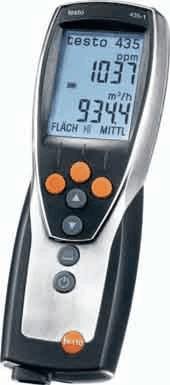
Whakaahua 1: Testo 435-4 IAQ Meter. This image displays the handheld meter, featuring a large digital display at the top showing readings like "1037 ppm" and "934.4 m³/h". Below the screen are several control buttons: three orange circular buttons at the top, followed by two grey arrow buttons (up and down), another grey circular button, and finally a power button with a power symbol. The device has a sleek, ergonomic design with a black body and silver-colored accents.
Wae matua:
- Whakaatu: Large LCD for clear reading of measurement values and menu navigation.
- Patene Mana: Intuitive buttons for power, navigation, selection, and function activation.
- Whakauru Whakauru: Port for connecting various probes (e.g., CO2, humidity, temperature).
- Wāhanga Pūhiko: Located at the rear for power supply.
Tatūnga
1. Tāuta Pūhiko:
- Kimihia te uhi o te wahanga pākahiko kei muri o te taputapu.
- Open the cover by sliding or unscrewing it (refer to specific model instructions if screws are present).
- Insert the required batteries (e.g., AA or AAA, typically 3 or 4) ensuring correct polarity (+/-).
- Katia kia mau te uhi o te wahanga pākahiko.
2. Tūhononga Probe:
- Connect the desired measurement probe (e.g., CO2 probe, humidity/temperature probe) to the designated input port on the device.
- Ensure the connection is firm and secure to prevent inaccurate readings.
Nga Tohutohu Whakahaere
1. Whakawera/Weto:
- Kia kaha tonu, paatohia kia mau te Mana button (usually marked with Ⓢ) kia tiaho rā anō te mata.
- Ki te whakaweto, patohia kia mau te Mana patene ano kia weto te whakaaturanga.
2. Te Inenga:
- Once powered on and a probe is connected, the device will typically display real-time measurements for the connected parameters (e.g., CO2 in ppm, Temperature in °C/°F, RH in %).
- Position the probe in the environment you wish to measure. Ensure proper air circulation around the sensor for accurate readings.
- Allow a few moments for readings to stabilize, especially for CO2 and humidity.
3. Navigating Menus and Saving Data:
- Whakamahia te Runga/Raro arrow buttons to navigate through different measurement modes or menu options.
- Pehia te Tomo/OK button (often a central circular button) to select an option or confirm a setting.
- To save a measurement, look for a Tiaki or Maharahara button/option. Follow the on-screen prompts to store data.
- To recall saved data, navigate to the Maharahara or Maharahara kōwhiringa tahua.
Te tiaki
1. Te horoi:
- Horoia te pūrere casing me te ngohengohe, damp kakahu. Kaua e whakamahi i nga kai horoi me nga whakarewa.
- Ensure no liquid enters the sensor openings or electrical connections.
- For probes, follow specific cleaning instructions provided with the probe itself.
2. Whakakapinga Pūhiko:
- Whakakapihia nga pākahiko ina puta te tohu pākahiko iti ki te whakaaturanga.
- Whakamahia i nga wa katoa nga pākahiko hou o te momo kua tohua.
- Whakakorehia nga pākahiko tawhito i runga i nga ture o te rohe.
3. Whakariterite:
- Regular calibration is essential for maintaining measurement accuracy.
- Refer to the device's on-screen calibration menu or consult Testo's official support for recommended calibration intervals and procedures.
- Some probes may require specific calibration gases or humidity standards.
Raparongoā
| Raruraru | Take pea | Rongoā |
|---|---|---|
| Kaore te taputapu i te hiko. | Nga pākahiko kua mate, kua he ranei te whakaurunga. | Tirohia te āhua o te pākahiko; whakakapia ki ētahi atu pākahiko. |
| Ko nga panui kore tika. | Sensor dirty, damaged, or out of calibration; improper probe connection. | Clean sensor; ensure probe is securely connected; perform calibration. |
| Display shows "Error" or "---". | Sensor malfunction; out of measurement range; internal error. | Check probe connection; move to an environment within measurement range; restart device; contact support if persistent. |
| Cannot save data. | Kua kī te mahara; he hē te tukanga tiaki. | Delete old data; refer to operating instructions for saving data. |
Whakatakotoranga
The following specifications are for the Testo 400563 4354 IAQ Kit:
- Momo Hua: CO2/Temp/RH/Barometric Meter
- Tauira: 400563 4354
- Waitohu: Testo
- Tau Wāhanga: AO-10382-23
- Rahi Mōkī: Ia
- Ahu mōkihi: 16.3 x 13 x 4.3 inihi; 8.2 Pauna
- ASIN: B00481RUUA
- Wātea Tuatahi: Hōngongoi 18, 2012
Note: Specific measurement ranges and accuracies depend on the probes used with the device. Refer to individual probe documentation for detailed specifications.
Pūtāhui me te Tautoko
For warranty information, technical support, or service inquiries, please contact Testo customer service or visit their official webpae.
Ka kitea e koe etahi atu korero me nga korero whakapā i runga i te Testo Store on Amazon.


