1. Kupu Whakataki
This manual provides detailed instructions for the installation, operation, and maintenance of your Gewiss GW10701 Programmable Thermostat. This device is designed to control heating and air conditioning systems, allowing you to manage room temperature efficiently and comfortably. Please read this manual thoroughly before installation and use to ensure proper functionality and safety.
2. Nga korero haumaru
Always observe the following safety precautions to prevent personal injury or damage to the device:
- Me mahi anake te tāutanga e ngā kaimahi whai tohu, i runga anō i ngā ture me ngā whakaritenga hiko ā-rohe.
- Disconnect power to the heating/cooling system at the main circuit breaker before installing or servicing the thermostat.
- Kaua e tukuna te whakamaarama ki te wai, ki te makuku nui ranei.
- Whakamahia te momo pākahiko kua tohua anake, ā, kia tika te polarity i te wā e tāuta ana.
- Keep batteries out of reach of children. Do not dispose of batteries in fire.
- Do not attempt to open or repair the thermostat yourself. Contact qualified service personnel.
3. Hua Neke Atuview
The Gewiss GW10701 is a wall-mounted programmable thermostat featuring an LCD display and intuitive controls for temperature management.
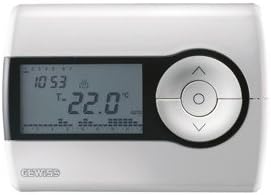
Whakaahua 1: Mua view of the Gewiss GW10701 Thermostat. It features a clear LCD screen displaying time and temperature, alongside a circular control panel with directional buttons and a central confirmation button for easy navigation and setting adjustments.
3.1. Nga Taonga
- Whakaaturanga LCD: Shows current time, temperature, operating mode, and programming settings.
- Patene Mana: Typically include UP/DOWN arrows for temperature adjustment, MODE button for selecting operating modes (e.g., Heat, Cool, Auto, Off), and a SET/PROG button for accessing programming menus. (Note: Specific button functions may vary slightly; refer to on-screen prompts.)
- Wāhanga Pūhiko: Located on the rear or side, houses the power supply batteries.
- Maunga Pahi: Mō te tāutanga pakitara haumaru.
4. Tāutanga
4.1. Te Kōwhiri Tauwāhi
Select a central location on an interior wall, approximately 1.5 meters (5 feet) above the floor. Avoid locations near heat sources (lamps, direct sunlight, fireplaces), drafts (windows, doors), or areas with poor air circulation.
4.2. Te Whakaeke i te Thermostat
- Momotu Mana: Turn off the power to your heating/cooling system at the main circuit breaker.
- Pereti Turanga Motuhake: Carefully detach the front cover of the thermostat from its base plate.
- Tohua me te Wiri: Hold the base plate against the wall at your chosen location. Mark the drilling points. Drill holes and insert wall anchors if necessary.
- Pereti Turanga Haumaru: Fasten the base plate to the wall using the provided screws.
- Waea (mēnā e tika ana): Connect the system wires to the appropriate terminals on the base plate. Refer to the wiring diagram provided with your heating/cooling system or consult a qualified electrician. Note: While the thermostat is battery-powered, it controls a 230V system. Ensure correct wiring.
- Whakauruhia nga Pataha: Insert the required batteries into the battery compartment, observing correct polarity (+/-).
- Āpiti Thermostat: Carefully reattach the thermostat front cover to the base plate, ensuring it clicks securely into place.
- Whakaora i te Mana: Turn on the power to your heating/cooling system at the main circuit breaker.
5. Mahi
5.1. Tatūnga Tuatahi
Upon first power-up or after battery replacement, you may need to set the current time and date. Follow the on-screen prompts or refer to the programming section.
5.2. Te Tautuhinga i te Pawera
Whakamahia te UP a RARO arrow buttons to adjust the desired temperature. The display will show the set temperature temporarily, then revert to the current room temperature.
5.3. Aratau Mahi
Pehia te MODE button (or similar) to cycle through available operating modes:
- TE wera: Ka whakahohehia e te thermostat te punaha whakamahana ina taka te pāmahana rūma ki raro i te pāmahana kua whakaritea.
- Matao: The thermostat will activate the air conditioning system when the room temperature rises above the set temperature.
- MOTO: The thermostat automatically switches between heating and cooling to maintain the set temperature range.
- WATE: Ka wetohia nga punaha whakamahana me te whakamatao.
6. Papatonotanga
The Gewiss GW10701 allows you to create custom heating/cooling schedules for different times of the day and days of the week. This feature helps optimize energy consumption and comfort.
6.1. Tautuhi Wā me te Rā
- Pehia te SET or MAUI pātene ki te tomo i te tahua tautuhinga.
- Navigate using the arrow buttons to find "Time" or "Date" settings.
- Use the arrow buttons to adjust the values (hour, minute, day, month, year).
- Confirm each setting with the SET or central button.
6.2. Creating a Program Schedule
The thermostat typically offers daily or weekly programming options. You can set different temperatures for various periods (e.g., Wake, Day, Evening, Sleep).
- Pehia te MAUI pātene ki te tomo aratau hōtaka.
- Select the day or group of days you wish to program (e.g., Mon-Fri, Sat-Sun, or individual days).
- For each period (e.g., "Wake"), set the desired start time and temperature using the arrow buttons.
- Advance to the next period and repeat the process.
- Save your program and exit programming mode.
Consult the on-screen menu and specific button labels on your device for precise programming steps, as interfaces can vary.
7. Tiaki
7.1. Whakakapinga Pūhiko
The thermostat is powered by batteries. When the battery indicator appears on the display, replace the batteries promptly to ensure continuous operation. Typically, 2x AA or AAA alkaline batteries are required.
- Tangohia marietia te taupoki o mua o te whakamahana wera.
- Tangohia nga pākahiko tawhito me te tuku tika.
- Whakauruhia nga pākahiko hou, kia tika te polarity.
- Whakauruhia te taupoki o mua.
7.2. Te horoi
Clean the thermostat's exterior with a soft, dry cloth. Do not use abrasive cleaners, solvents, or spray cleaners directly onto the device, as this can damage the display or internal components.
8. Te Raru
| Raruraru | Take pea | Rongoā |
|---|---|---|
| He putea, he atarua ranei te whakaaturanga. | Nga pākahiko iti, mate ranei. | Whakakapihia nga pākahiko ki nga mea hou. |
| Ko te punaha whakamahana/Matao kaore i te urupare. |
|
|
| Ko te ahua o nga panui o te pāmahana kaore i te tika. | Te waahi whakamaarama e pa ana ki nga tauira me nga puna wera. | Kia tino mohio kei pā te thermostat ki te rā tika, ki ngā hauhautanga, ki ngā taputapu whakaputa wera rānei. |
9. Whakatakotoranga
- Kaihanga: Gewiss
- Tau tauira: GW10701 (Chorus)
- Ahu (L x W x H): 13 x 2.3 x 9.2 cm
- Taumaha: 9.07 g
- Tae: Mā
- Rauemi: Kirihou
- Tuku Hiko: Ma te pākahiko
- Whakawhiti Voltage: 230 Volt (for controlled system)
- Momo Whakaatu: LCD ranei LED
- Momo Whakapuru: Whakanohoia ki te pakitara
- Āhuatanga Mana: Programmable, Button control
- Whakamahinga: Heating systems, Air conditioning systems
10. Pūtāhui me te Tautoko
For warranty information, technical support, or service inquiries regarding your Gewiss GW10701 Thermostat, please refer to the warranty card included with your product or visit the official Gewiss website. You may also contact your local Gewiss distributor or retailer for assistance.
Gewiss Official Webpae: www.gewiss.com


