1. Kupu Whakataki
This manual provides detailed instructions for the setup, operation, maintenance, and troubleshooting of your ASUS RT-AC66U Dual-Band AC1750 Gigabit Router. Please read this manual thoroughly to ensure proper use and optimal performance of your device.
The ASUS RT-AC66U Gigabit wireless dual-band router features Broadcom’s 5th generation Wi-Fi (5G WiFi) technology. It operates on both 2.4GHz and 5GHz bands, delivering data rates up to 1.75Gbps, which is three times faster than 802.11n speeds. Equipped with ASUS AiRadar technology, it amplifies transmissions for optimized signals, enhancing network coverage. The router supports ASUSWRT setup, Quality of Service (QoS) standards, multiple SSIDs, and includes two USB ports for file, DLNA, and printer server capabilities. It also features three detachable R-SMA type antennas for wider coverage and supports VPN Server functionality and IPv6.
2. Hua Neke Atuview
The ASUS RT-AC66U router is designed to provide high-speed and reliable wireless connectivity for your home or office network. Below are key features and a visual representation of the device.
Āhuatanga matua:
- Dual-Band AC1750 WiFi: Utilizes 5th generation 802.11ac chipset for concurrent 2.4GHz/5GHz operation, offering speeds up to 1.75Gbps.
- ASUS AiCloud Service: Enables access, streaming, sharing, and syncing of files on the go with unlimited storage expansion.
- Tauranga Itarangi Gigabit: Provides fast and reliable wired internet performance.
- AiRadar Technology: Optimizes wireless coverage through high-powered amplification and beam-forming with detachable antennas.
- ASUSWRT Dashboard UI: Offers a user-friendly interface for 3-step easy setup, signal monitoring, and network application control.
- Download Master: Facilitates wireless data storage and access to USB storage devices connected to the router.
- Multi-functional USB Ports: Two built-in USB ports support file sharing, printer sharing, and 3G sharing.
- Tūmau VPN: Integrated VPN server functionality for secure remote access.
- Tautoko IPv6: Ready for the next generation of internet protocol.
Hua Views:

Whakaahua 1: Mua view of the ASUS RT-AC66U router, showcasing its design and external antennas.

Figure 2: Top-front perspective of the ASUS RT-AC66U router, highlighting the ventilation and LED indicators.
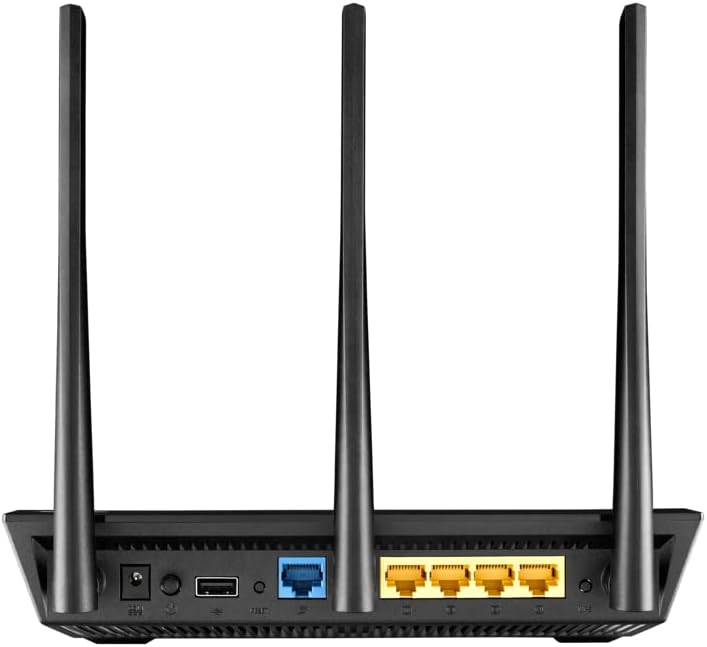
Whakaahua 3: Whakamuri view of the ASUS RT-AC66U router, showing the WAN, LAN, USB ports, and power input.
3. Tatūnga
Follow these steps to set up your ASUS RT-AC66U router and establish an internet connection.
3.1 Hononga Miihini
- Whakanohoia te Pouara: Place the router in a central location for optimal Wi-Fi coverage. Ensure antennas are oriented vertically for best signal.
- Honoa te Pouwhanga: Whakawetohia to pouwhanga. Mēnā he pūhiko pūrua, tangohia.
- Tūhono Tauranga WAN: Connect one end of an Ethernet cable to your modem's LAN port and the other end to the blue WAN port on the ASUS RT-AC66U router.
- Hono Hono: Plug the power adapter into the router's power input and then into a power outlet.
- Whakahiko: Turn on your modem, then turn on the ASUS RT-AC66U router. Wait for the LED indicators to stabilize.
Video: How to set up ASUS WiFi Router via Quick Internet Setup. This video demonstrates the physical connections and initial configuration steps for your ASUS router.
3.2 Initial Configuration (ASUSWRT)
- Hono ki te Pouara: Connect your computer to the router either wirelessly (using the default Wi-Fi name and password found on the router's label) or via an Ethernet cable to one of the yellow LAN ports.
- Uru Tatūnga Whārangi: Tuwhera a web pūtirotiro me te tomo pouara.asus.com or 192.168.1.1 i te pae wāhitau.
- Whaia nga Tohutohu I-Mata: The ASUSWRT dashboard UI will guide you through a 3-step setup process to configure your internet connection, Wi-Fi network name (SSID), and password.
- Confirm Internet Status: After completing the setup, check the "Network Map" section to ensure the Internet status shows "Connected".
Video: How to enter the ASUS Router Setting page. This video guides you on accessing the router's web atanga mo te whirihoranga.
4. Te whakahaere i te Pouara
Once your router is set up, you can manage its various functions through the ASUSWRT interface or the ASUS Router app.
4.1 Wireless Network Management
- Mahinga Takirua-Taua: The RT-AC66U operates on both 2.4GHz and 5GHz frequencies. You can configure separate SSIDs for each band or use Smart Connect to allow devices to automatically choose the best band.
- Whatunga Manuhiri: Create up to three separate guest networks for visitors, providing internet access while isolating your main network for security.
- AiRadar Beamforming: This technology automatically detects the location of Wi-Fi devices and directs stronger signals towards them, improving range and stability.
4.2 USB Applications
The two USB 2.0 ports on the router offer versatile functionalities:
- AiDisk (File Tiritahi): Connect a USB storage device to create a personal cloud server for file sharing and streaming.
- Tūmau Pūreretā: Connect a USB printer to share it across your network.
- 3G/4G Sharing: Connect a compatible 3G/4G USB dongle to use as a primary or backup internet connection.
4.3 Network Security and Control
- AiProtection: Provides network security features, including malicious site blocking, vulnerability protection, and infected device prevention and blocking.
- Adaptive QoS: Prioritizes network traffic for specific applications (e.g., gaming, streaming) to ensure smooth performance.
- Mana Mātua: Manage and schedule internet access for connected devices.
- Tūmau VPN: Set up a Virtual Private Network (VPN) server to securely access your home network from anywhere.
5. Tiaki
Regular maintenance ensures your router operates efficiently and securely.
5.1 Whakahōu Firmware
Keeping your router's firmware up to date is crucial for performance, security, and new features. You can update the firmware via the ASUSWRT interface.
- Access ASUSWRT: Takiuru ki te pouara web interface (router.asus.com).
- Navigate to Firmware Upgrade: Haere ki Administration > Firmware Upgrade.
- Tirohia mo nga Whakahoutanga: Click "Check" to see if a new firmware version is available.
- Perform Update: If an update is available, follow the on-screen instructions to download and install it. The router will reboot automatically after the update.
Video: How to update the firmware of ASUS WiFi Router. This video provides a step-by-step guide on updating your router's firmware.
5.2 Whakaara Anō Auau
Periodically rebooting your router (e.g., once a month) can help clear its memory, resolve minor network issues, and improve overall performance.
- Soft Reboot: Log in to ASUSWRT and click the "Reboot" button at the top of the page.
- Hard Reboot: Unplug the power adapter from the router, wait 10-15 seconds, then plug it back in.
6. Te Raru
If you encounter issues with your ASUS RT-AC66U router, refer to the following common troubleshooting steps.
6.1 Kaore he Hononga Ipurangi
- Tirohia nga Tohu LED: Ensure the Power, Wi-Fi, and Internet LEDs are solid blue. If the Internet LED is off or orange, there might be an issue with your modem or ISP connection.
- Manatoko Hononga Taura: Ensure all Ethernet cables (WAN, LAN) are securely connected to the correct ports on the router and modem.
- Ngā Pūrere Huringa Hiko: Power off your modem and router. Wait 30 seconds, then power on the modem first. Once the modem is fully online (all its indicator lights are stable), power on the router.
- Check WAN Settings: Log in to ASUSWRT and navigate to WAN > Internet Connection. Verify that your WAN connection type (e.g., PPPoE, Static IP, Automatic IP) and account settings are correct as provided by your Internet Service Provider (ISP).
- Hoapā a te ISP: If the issue persists, contact your ISP to confirm your account status and connection details.
Video: Troubleshooting Internet Connection on ASUS Router. This video provides steps to diagnose and resolve internet connectivity issues.
6.2 Poor Wi-Fi Signal or Coverage
- Tauranga Pouara: Move the router to a central location, away from obstructions (thick walls, metal objects) and interference sources (microwaves, cordless phones).
- Takotoranga Antenna: Adjust the router's external antennas for optimal signal reception.
- pokanoa: Change the Wi-Fi channel in ASUSWRT (Wireless > General) to avoid interference from neighboring networks. Use a Wi-Fi analyzer app to find less congested channels.
- Whakahoutanga Firmware: Ensure your router's firmware is up to date (refer to Section 5.1).
Video: How to improve WiFi signal. This video offers tips and techniques to enhance your wireless network's performance and range.
6.3 Restoring to Factory Default Settings
If you experience persistent issues or forget your router's login credentials, you can restore it to its factory default settings. This will erase all custom configurations.
- Via ASUSWRT: Haere ki Administration > Restore/Save/Upload Setting ā, pāwhiritia "Whakaora".
- Tautuhi Pūmārō: With the router powered on, press and hold the "Reset" button (usually a small pinhole button on the back) for about 5-10 seconds until the Power LED starts blinking. Release the button and wait for the router to reboot.
Video: How to restore the ASUS router to default setting. This video demonstrates the process of resetting your router to its original factory configuration.
7. Whakatakotoranga
| Āhuahira | Taipitopito |
|---|---|
| Waitohu | ASUS |
| Ingoa Tauira | RT-AC66U |
| Momo Ahokore | 802.11ac |
| Karaehe Band Auautanga | Dual-Band (2.4GHz / 5GHz) |
| Reiti Raraunga | Tae atu ki te 1750Mbps |
| Tauranga Itarangi | 4 x Gigabit LAN, 1 x Gigabit WAN |
| Tauranga USB | 2 x USB 2.0 Tauranga |
| Antenna | 3 x Detachable R-SMA type antennas |
| Hunga Hua | 8.14 x 5.86 x 1.4 inihi |
| Taumaha Tūemi | 1.75 pauna |
| Tautoko Pūnaha Whakahaere | Windows 7, Mac OS |
| Nga waahanga motuhake | WPS, AiRadar, AiCloud, ASUSWRT, VPN Server, IPv6 |
8. Pūtāhui me te Tautoko
For warranty information, technical support, or further assistance, please visit the official ASUS support webpaetukutuku, whakapā atu ranei ki ta raatau ratonga kaihoko.
- Tautoko ASUS Webpae: www.asus.com/support/
- Whārangi Hua: Visit the ASUS Store on Amazon
Tuhinga e pa ana - RT-AC66U
 |
Aratohu Kaiwhakamahi Pouara Gigabit 802.11AC Takirua ASUS RT-AC66U He aratohu kaiwhakamahi whānui mō te Pouara ASUS RT-AC66U Dual Band 3x3 802.11AC Gigabit, e kapi ana i te tatūnga, te whirihoranga, ngā tautuhinga matatau, me te rapurongoā. |
 |
Aratohu Tīmatanga Tere ASUS RT-AC66U B1: Tatūnga me te Whakamahinga Tīmatahia tō Pouara Ahokore-AC1750 Dual Band Gigabit ASUS RT-AC66U B1. Kei roto i tēnei aratohu ngā mōhiohio matua mō te whakatūnga, te whakanoho, me te rapurongoā mō te mahi pai rawa atu o te whatunga. |
 |
ASUS RT-AC66U B1 無線路由器 使用手冊 本使用手冊提供 ASUS RT-AC66U B1 無線路由器的詳細設定、操作指南與疑難排解資訊,協助使用者快速上手並充分利用其功能。 |
 |
Pouara WiFi AC Takirua ASUS RT-AC65: Aratohu Tīmatanga Tere Tīmata wawe me tō Pouara WiFi ASUS RT-AC65 Takirua AC. Kei roto i tēnei aratohu ngā ihirangi o te kete, te tatūnga waea me te ahokore, me ngā Pātai Auau nui. |
 |
Aratohu Kaiwhakamahi ASUS RT-AC86U: Tatūnga, Whirihoranga, me ngā Āhuatanga He aratohu kaiwhakamahi whānui mō te Pouara ASUS RT-AC86U Ahokore-AC 2900 Dual Band Gigabit. Akohia ngā āhuatanga o te tatūnga, ngā whirihoranga matatau, ngā āhuatanga haumarutanga pēnei i te AiProtection, QoS, AiCloud, me te rapurongoā. |
 |
Aratohu Tīmatanga Tere mō te Pouara WiFi Takirua ASUS RT-BE86U He aratohu poto mō te whakatū i tō Pouara WiFi takirua ASUS RT-BE86U BE6800. Akohia ngā āhuatanga taputapu, te tāutanga taahiraa-i-te-taahiraa mā te taupānga, mā te taupānga rānei web pūtirotiro, me ngā mōhiohio haumaru nui. |