Kupu Whakataki
The Korg TMR-50 is a versatile device designed to assist musicians in improving their pitch and rhythm. It integrates a tuner, metronome, and recorder into a single compact unit. These three functions can be used independently or simultaneously, offering comprehensive support for practice and performance. The TMR-50 also features high-quality linear PCM recording, allowing up to 100 tracks to be stored, and a USB port for easy data transfer to a computer. With its built-in microphone, speaker, and various rhythm variations, the TMR-50 is an essential tool for any musician.
Whakatupato Haumaru
- Do not expose the unit to extreme temperatures, direct sunlight, high humidity, or dusty environments.
- A ape i te tuku, te tuku ranei i te waeine ki nga paanga kaha.
- Kaua e ngana ki te wetewete, ki te whakarereke ranei i te waahanga. Tukuna atu nga ratonga katoa ki nga kaimahi whai tohu.
- Whakamahia te momo pākahiko kua tohua (AAA) anake, ā, kia tika te polarity i te wā e tāuta ana.
- Tango pākahiko ki te kore te wae e whakamahia mo te wa roa kia kore ai e pakaru.
- Keep the unit away from sources of strong electromagnetic interference.
Ihirangi mokete
Kia tino mohio kei roto i tō kete ngā mea katoa e whai ake nei:
- Korg TMR-50 Tuner Metronome Recorder unit
- 2 x AAA batteries (for initial use)
- Pukapuka Kaiwhakamahi (tenei tuhinga)
Nga Ingoa Wahi me nga Mahi
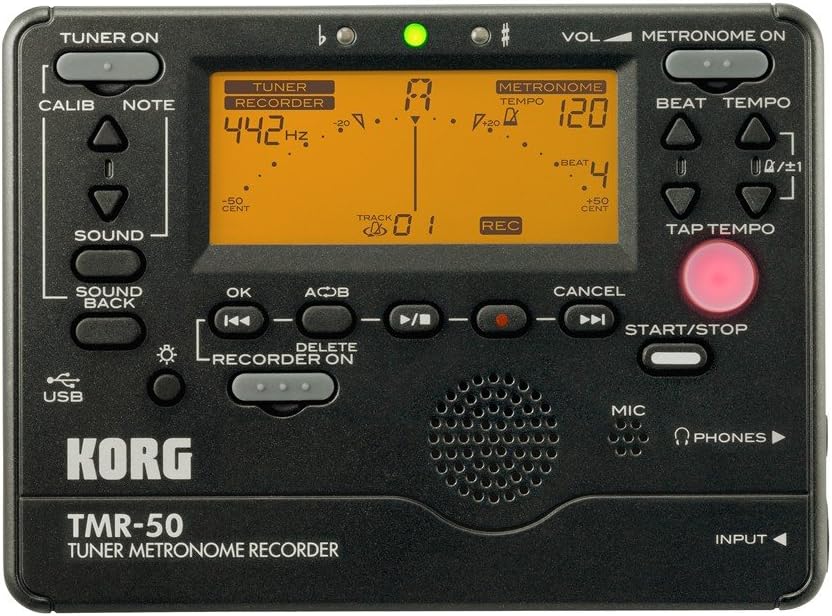
Whakaahua 1: Ka mutu te papa o muaview of the Korg TMR-50, showing all controls and the display.
Mana Tuner
- TUNER ON Button: Activates or deactivates the tuner function.
- Pātene CALIB: Adjusts the calibration frequency (standard is 440Hz, often adjustable to 442Hz as shown).
- NOTE Buttons (Up/Down Arrows): Selects the target note for tuning.
- SOUND Button: Activates the Sound Out function, which outputs a reference tone from the internal speaker.
- SOUND BACK Button: Engages the Sound Back function, allowing the unit to detect the input pitch and output the closest correct pitch for comparison.
Mana Metronome
- METRONOME ON Button: Activates or deactivates the metronome function.
- VOL (Volume) Slider: Adjusts the output volume of the metronome and other audio.
- BEAT Buttons (Up/Down Arrows): Adjusts the number of beats per measure.
- TEMPO Buttons (Up/Down Arrows): Adjusts the metronome tempo in beats per minute (BPM).
- PĀTAI PĀTAI PĀTAI: Allows you to set the tempo by tapping the button in time with the desired beat.
Recorder Controls
- RECORDER ON Button: Activates the recorder function.
- REC Button (Red Dot): Initiates recording when the recorder is active.
- Pene OK: Ka whakaū i nga whiringa, i nga mahi ranei.
- Rewind/Fast Forward Buttons (Double Arrows): Navigates through recorded tracks or within a track.
- Play/Pause Button (Triangle/Two Vertical Bars): Starts or pauses playback of a recorded track.
- Stop Button (Square): Ka mutu te purei, te rekoata ranei.
- A<->B Button: Sets a loop playback region within a recorded track.
- Pātene MUMU: Deletes selected recorded tracks.
- Pātene Tīmata/Kati: A general control for starting and stopping various functions, including recording and metronome.
Whakaatu me nga Tohu
- Whakaaturanga LCD: Shows tuning information (note, cent deviation, calibration), metronome tempo and beat, and recorder track number and status.
- Flat (b) / Sharp (#) Indicators: Lights up to indicate if the detected pitch is flat or sharp.
- Maama Tohu Kakariki: Illuminates when the detected pitch is in tune.
Input/Output and Other Features
- MIC (Maikorooro): Built-in microphone for recording and tuning.
- PHONES (Headphone Jack): Output for connecting headphones.
- TUKU HAKI: Input for connecting an external microphone or instrument pickup.
- Tauranga USB: For connecting to a computer to transfer recorded data.
- Kaikōrero: Built-in speaker for metronome clicks, reference tones, and playback.
Tatūnga
Tāuta Pūhiko
- Whakatuwheratia te uhi o te wahanga pākahiko kei muri o te waeine.
- Whakauruhia kia rua (2) pākahiko AAA, kia tika te polarity (+/-) e tohuhia ana ki roto i te waahanga.
- Katia kia mau te uhi o te wahanga pākahiko.
Te Hiko / Whakaweto
- Kia kaha tonu, paatohia kia mau te KAUPAPA KAUPAPA or METRONOME ON pātene mo te kotahi hēkona.
- Ki te whakaweto, patohia kia mau te KAUPAPA KAUPAPA or METRONOME ON button again for approximately one second. The unit will also automatically power off after a period of inactivity to conserve battery life.
Operating the Tuner
- Pehia te KAUPAPA KAUPAPA button to activate the tuner. The display will show tuning information.
- Adjust the calibration frequency using the CALIB button if needed. The default is typically 440Hz, but can be set to 442Hz or other values.
- Play a single note on your instrument. The TMR-50 will detect the pitch via its built-in microphone or an external input.
- Observe the display:
- The note name will be displayed.
- The meter indicates pitch deviation. Adjust your instrument until the meter is centered and the green indicator light illuminates.
- The 'b' (flat) or '#' (sharp) indicators will light up if the pitch is significantly off.
- Whakamahia te TANGI button to output a reference pitch for ear training.
- Whakauruhia te SOUND BACK function to hear the closest correct pitch while you play, aiding in intonation practice.
Operating the Metronome
- Pehia te METRONOME ON button to activate the metronome.
- Whakatikatikahia te tere mā te whakamahi i te TEMPO Up/Down arrow buttons. The tempo range is typically from 30 to 252 BPM.
- Set the desired beat pattern using the PATUA Up/Down arrow buttons. This controls the number of beats per measure and rhythm variations.
- I tua atu, whakamahia te TAP TEMPO button to set the tempo by tapping it at your desired speed.
- Pehia te TITIAKI/TATA button to begin or end the metronome click.
- Adjust the metronome volume using the VOL rēreti.
Te whakahaere i te Kaituhi
- Pehia te RECORDER ON button to enable the recording function.
- Hei timata te tuhi, pehia te REC button (red dot). The display will show "REC" and the track number.
- Play your instrument or sing into the built-in microphone.
- Hei whakamutu i te hopukanga, paatohia te KATI pātene.
- To play back a recorded track:
- Use the Rewind/Fast Forward buttons to select the desired track.
- Pehia te Purei/Tatari paatene ki te tiimata te purei ano.
- Pehia te KATI pātene ki te whakamutu purei anō.
- To use the Loop Play function:
- I te purei, pehia te A<->B button at the desired start point (A).
- Pehia te A<->B button again at the desired end point (B). The section between A and B will loop continuously.
- Perehi A<->B a third time to cancel the loop.
- To delete a track:
- Select the track you wish to delete using the Rewind/Fast Forward buttons.
- Pehia te MUMU pātene.
- Confirm the deletion if prompted (usually by pressing OK).
Te hono ki te Rorohiko
The TMR-50 features a USB port for transferring recorded audio files to your computer. Connect the unit to your computer using a standard USB cable (not included). The device should appear as a removable storage device, allowing you to copy files. Refer to your computer's operating system instructions for managing external storage devices.
Te tiaki
- Horoia te waeine ki te kakahu ngohengohe, maroke. Kaua e whakamahi i nga kai horoi me nga whakarewa.
- Ki te kore e whakamahia te wae mo te wa roa, tangohia nga pākahiko kia kore ai e pakaru me te waikura.
- Whakaorangia te waeine ki te waahi makariri, maroke atu i te ra tika.
Raparongoā
| Raruraru | Te Take Taea / Rongoa |
|---|---|
| Karekau te waeine i te hiko. |
|
| Kāore te kaiwhakatakoto i te tika, kāore rānei i te aro mai. |
|
| He iti rawa, he ngaro rānei te oro o te metronome. |
|
| Recorded audio is too quiet or distorted. |
|
| Kaore e taea te whakawhiti filemā te USB. |
|
Whakatakotoranga
| Āhuahira | Taipitopito |
|---|---|
| Tau tauira | TMR-50 |
| Ahu (W x D x H) | 5.2 x 5.2 x 1.3 inihi (hua) |
| Taumaha | 6.7 ounces (excluding batteries) |
| Tuku Hiko | 2 x AAA pākahiko |
| Awhe Tuner | A0 (27.50 Hz) - C8 (4186.01 Hz) |
| Awhe Whakatau | A4 = 410 – 480 Hz |
| Te Awhe Tempo Metronome | 30 – 252 BPM |
| Metronome Beat Settings | 0 – 9 beats, duplets, triplets, quadruplets, etc. (15 variations) |
| Hōputu Tuhituhi | Linear PCM (WAV) |
| Raukaha Hopu | Up to 100 tracks (approx. 20 minutes total) |
| Whakauru/Putanga | INPUT jack (mono), PHONES jack (stereo), USB port (Type B) |
Pūtāhui me te Tautoko
For warranty information and technical support, please refer to the warranty card included with your product or visit the official Korg website. Keep your proof of purchase for warranty claims. Do not attempt to repair the unit yourself, as this may void your warranty.
Official Korg Webpae: www.korg.com


