1. Kupu Whakataki
This manual provides essential information for the safe and effective operation of the Rigol DG5352 Function/Arbitrary Waveform Generator. The DG5352 is a high-performance, 2-channel device capable of generating various waveforms with a maximum frequency of 350 MHz and a sampling rate of 1 GSa/s. Please read this manual thoroughly before using the instrument to ensure proper functionality and to prevent damage.
2. Nga korero haumaru
Observe the following safety precautions to prevent injury and avoid damage to the instrument or any connected products.
- Puna Hiko: Connect the instrument to a power source that provides the specified voltage awhe.
- Whakapapa: Ensure the instrument is properly grounded to prevent electric shock.
- Whakahau: Kaua e aukati i ngā pūaha hau. Me whakarite kia tika te rere o te hau huri noa i te taputapu.
- Taiao: Operate the instrument in a dry, well-ventilated area, away from direct sunlight, high temperatures, and excessive dust.
- Te horoi: Momotuhia te hiko i mua i te horoi. Whakamahia he ngohengohe, damp cloth; avoid abrasive cleaners or solvents.
- Ratonga: Refer all servicing to qualified service personnel. Do not attempt to repair the instrument yourself.
3. Hua Neke Atuview
The Rigol DG5352 is a versatile function/arbitrary waveform generator designed for a wide range of applications in electronics testing and development. It features two independent output channels, allowing for simultaneous generation of different waveforms or synchronized signals.
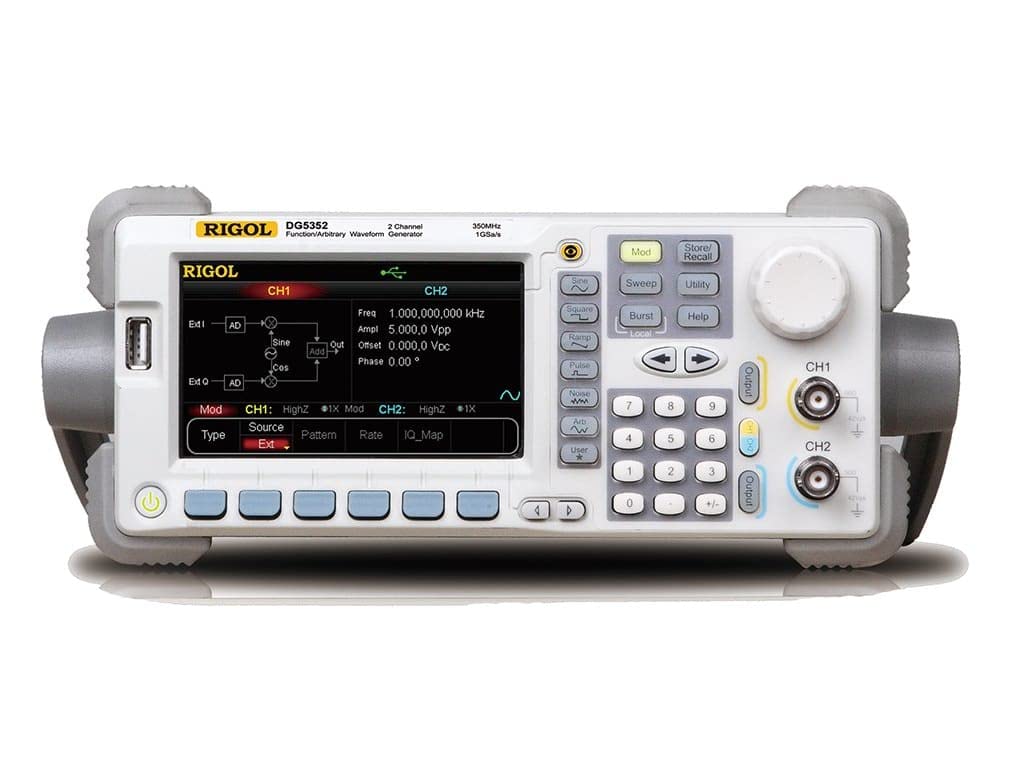
Figure 3.1: Front Panel of the Rigol DG5352. This image displays the front panel of the Rigol DG5352, highlighting its main display, control buttons, rotary knob, and output connectors for Channel 1 (CH1) and Channel 2 (CH2). The display shows current settings for frequency, amplitude, offset, and phase, along with waveform type and modulation options.
Āhuatanga matua:
- Hongere: 2 independent output channels.
- Awhe Auautanga: Up to 350 MHz.
- Sampreiti ling: 1 GSa/s.
- Nga Momo Ngaru: Sine, Tapawhā, Ramp, Pulse, Noise, Arbitrary, and more.
- Modulation Functions: AM, FM, PM, FSK, ASK, PSK, PWM, Sweep, Burst.
- Atanga Kaiwhakamahi: Intuitive front panel with a clear display, dedicated function buttons, and a rotary knob for precise adjustments.
4. Tatūnga
- Wewete ana: Carefully remove the DG5352 from its packaging. Verify that all accessories listed in the packing list are present.
- Hononga Hiko: Connect the provided power cord to the AC input on the rear panel of the instrument, then plug the other end into a grounded AC power outlet.
- Whakahiko: Press the power button located on the front panel to turn on the instrument. The display will illuminate, and the system will perform a self-test.
- Hononga Huaputa: Connect your test leads or cables to the desired output channels (CH1 or CH2) on the front panel. Ensure proper impedance matching for your application.
- USB/LAN Connection (Optional): For remote control or data transfer, connect a USB cable to the USB host/device port or an Ethernet cable to the LAN port on the rear panel.
5. Nga Tohutohu Whakahaere
This section outlines basic operation procedures for generating standard waveforms.
5.1. Generating a Standard Waveform (e.g., Sine Wave)
- Tīpako Hongere: Pehia te CH1 or CH2 button on the front panel to select the desired output channel. The active channel will be highlighted on the display.
- Select Waveform Type: Pehia te Hine button (or other waveform buttons like Tapawhā, Ramp, Putu) located on the left side of the control panel. The display will show the default sine wave parameters.
- Tautuhi Auautanga: Use the numeric keypad to enter the desired frequency value, then press the corresponding unit button (e.g., MHz, kHz). Alternatively, use the rotary knob to adjust the frequency.
- Tautuhi Ampahuru: Pehia te Ampl softkey on the display. Use the numeric keypad and unit buttons (e.g., Vpp) or the rotary knob to set the peak-to-peak ampahuru.
- Set Offset: Pehia te Whangai softkey. Use the numeric keypad and unit buttons (e.g., Vdc) or the rotary knob to set the DC offset voltage.
- Whakahohehia te Putanga: Pehia te Putanga button for the selected channel (CH1 or CH2) to enable the waveform output. The button will illuminate when active.
5.2. Modulation Functions
The DG5352 supports various modulation types. To access these, press the Mod button on the front panel. Follow the on-screen prompts and use the softkeys and rotary knob to configure the desired modulation parameters (e.g., AM, FM, PM).
5.3. Storing and Recalling Settings
To save current instrument settings, press the Toa/Maharahara button. Select a memory location using the softkeys and rotary knob, then confirm to save. To recall settings, press Toa/Maharahara again, select the desired memory location, and confirm.
6. Tiaki
- Te horoi: Regularly clean the exterior of the instrument with a soft, dry cloth. For stubborn dirt, use a cloth lightly dampkua oti ki te wai. Kaua e whakamahia nga matū kino, nga whakarewa ranei.
- Whakahau: Ensure that the ventilation openings on the instrument remain clear of dust and obstructions to prevent overheating.
- Rokiroki: When not in use for extended periods, store the DG5352 in a clean, dry environment within its specified operating temperature range.
- Whakatikatika: Periodic calibration by qualified personnel is recommended to maintain measurement accuracy. Refer to Rigol's official support for calibration services.
7. Te Raru
| Raruraru | Take pea | Rongoā |
|---|---|---|
| Kaore te taputapu e kaha ana. | Power cord not connected; power outlet faulty; internal fuse blown. | Check power cord connection; test power outlet; contact service for fuse replacement. |
| Kāore he tohu putanga. | Output channel not enabled; incorrect waveform parameters; faulty cable. | Pehia te Putanga button for the channel; verify frequency/amplitude settings; check/replace cables. |
| Ka whakaatuhia te karere hapa i te mata. | System error; invalid input. | Refer to the on-screen message for specific instructions; restart the instrument; contact support if persistent. |
8. Whakatakotoranga
The following are key specifications for the Rigol DG5352 Function/Arbitrary Waveform Generator.
- Tau tauira: DG5352
- Kaihanga: Rigol
- Hongere: 2
- Auautanga Mōrahi: 350 MHz
- Sampreiti ling: 1 GSa/s
- ASIN: B00EPECMLC
- Wātea Tuatahi: Mahuru 3, 2014
9. Pūtāhui me te Tautoko
Rigol products typically come with a standard manufacturer's warranty. For detailed warranty terms, technical support, or service inquiries, please refer to the official Rigol website or contact your local Rigol distributor. Keep your purchase receipt as proof of purchase for warranty claims.


