1. Neke atu i teview
The Donner DMX512 Wireless DMX System provides a reliable and efficient solution for controlling stage lighting without the need for extensive cabling. This system includes one DMX512 wireless transmitter and seven DMX512 wireless receivers, designed for seamless integration with DMX-compatible lighting fixtures. It operates on a 2.4G wireless frequency, offering high anti-jamming capabilities and automatic frequency hopping across 126 channels to ensure stable data transmission over distances up to 500 meters (visible distance).
The system simplifies setup for various applications, including stage, disco, party, and bar lighting, by eliminating the complexities of wired DMX connections. Each unit features tricolor LED indicators for easy identification of ID codes and operational status, allowing users to establish up to seven individual wireless networks without interference.
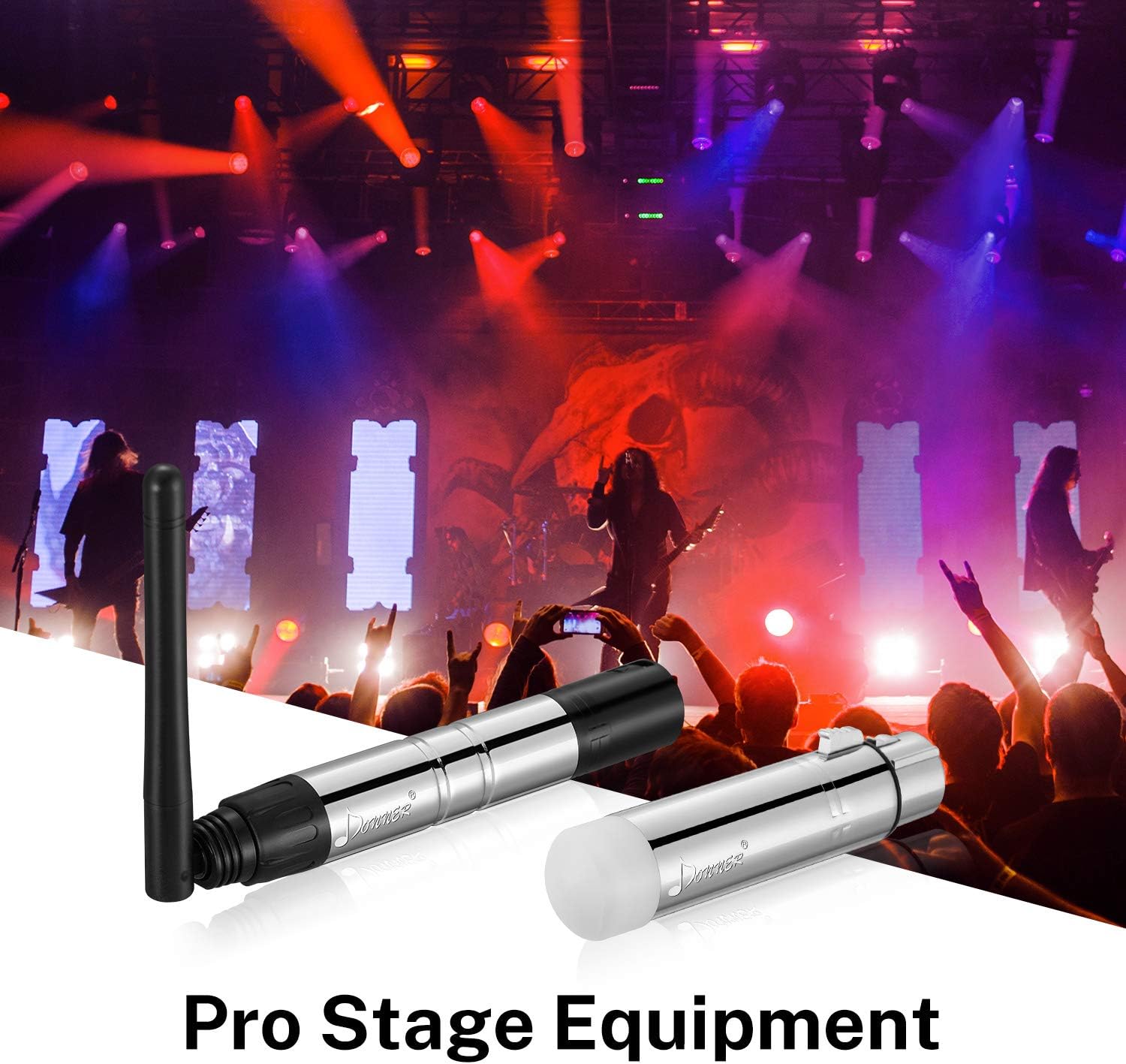
Image: The Donner DMX512 Wireless DMX System components shown in a professional stagte tatūnga rama e.
2. Ihirangi mokete
- 1 x DMX512 Kaituku Ahokore
- 7 x DMX512 Wireless Receivers
- 8 x Power Adapters (Note: Units require external power; no built-in battery.)
3. Nga waahanga matua
- Kawa DMX512 Ahokore: Transmits standard DMX512 protocol data wirelessly.
- Awhe Toroa: Communication distance up to 500 meters (visible distance).
- Automatic Frequency Hopping: 126 channels for high anti-jamming ability and reliable operation.
- Multiple ID Codes: 7 settable ID codes allow for up to 7 individual wireless networks without interference.
- Tricolor LED Indicators: Visual feedback for ID code and connection status.
- Mono-me-Play: Simple setup and operation.
- No Latency: Ensures real-time data transmission without delay.
4. Tatūnga
4.1 Tautuhinga Wae
The system consists of a transmitter and multiple receivers. The transmitter sends DMX signals from your controller, and the receivers distribute them to your DMX-compatible lighting fixtures.

Whakaahua: He tata view of the DMX512 wireless transmitter (with antenna) and receiver units.
4.2 Hononga
- Connect the DMX512 Wireless Transmitter to the DMX output of your DMX controller.
- Connect each DMX512 Wireless Receiver to the DMX input of your DMX-compatible lighting fixtures.
- Plug the provided power adapters into each transmitter and receiver unit, then connect them to a power source.

Image: An illustration demonstrating the easy wireless connection from a DMX controller to multiple lighting fixtures via the Donner DMX system.
4.3 Te Honohono (Te Honohono i te Waehere ID)
The transmitter and receivers must be set to the same ID code to communicate. The units use tricolor LED indicators to display the selected ID code.
- Press the button on the transmitter to cycle through the 7 available ID codes. Observe the color of the LED indicator.
- For each receiver, press its button until the LED indicator matches the color of the transmitter's LED.
- Once the colors match, the transmitter and receiver are paired. Repeat for all receivers.
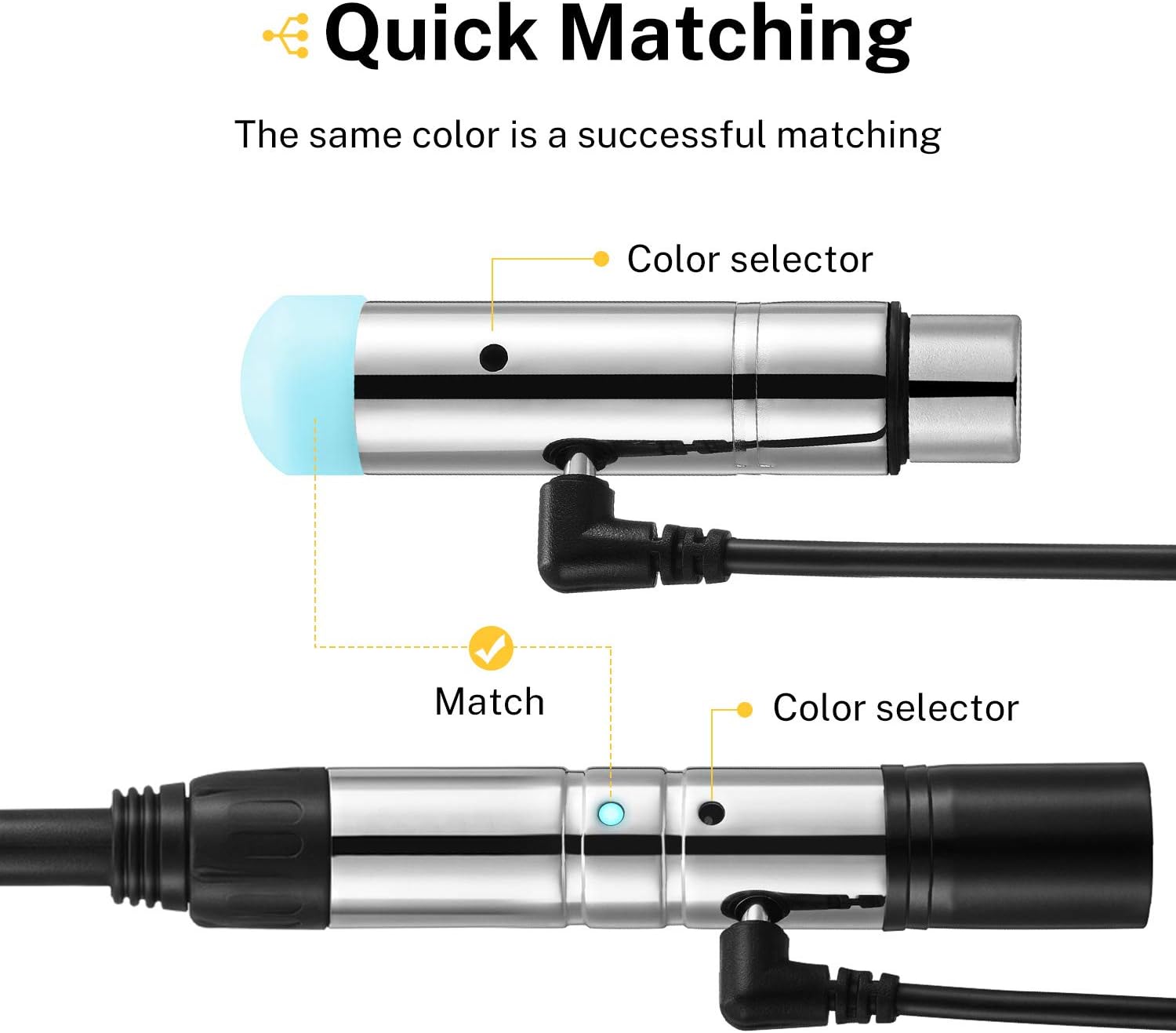
Image: A visual guide illustrating how to match the color indicators on the transmitter and receiver for successful pairing.
4.4 Te Whakakaha
After connecting and pairing, ensure all units are powered on. The LED indicators will show a solid color (matching the selected ID) when a stable connection is established.
5. Mahi
5.1 Kōwhiringa Hongere DMX
The system supports 7 groups of ID codes, each represented by a different LED color. This allows for multiple independent DMX universes to operate in the same area without interference. Ensure your DMX controller and all associated lighting fixtures are configured to the correct DMX channels within the selected wireless ID group.
5.2 Whakawhiti Tohu
The transmitter continuously broadcasts DMX signals to all paired receivers. The 2.4G frequency hopping technology automatically selects the clearest channel, minimizing interference and ensuring a stable connection. There is no noticeable time delay during data transmission, providing real-time control of your lighting.
Image: An illustration depicting the wireless signal range of the Donner DMX system, extending up to 400 meters.
5.3 Multiple Receiver Setup
One DMX512 wireless transmitter can control multiple DMX512 wireless receivers simultaneously, as long as they are all set to the same ID code. This allows for flexible and scalable lighting setups.
6. Tiaki
- Te horoi: Use a soft, dry cloth to clean the exterior of the units. Do not use harsh chemicals or abrasive cleaners.
- Rokiroki: Penapenahia ngā waeine ki te wāhi hauhautanga, maroke hoki, kia matara atu i te rā tika me ngā pāmahana tino kino ina kore e whakamahia.
- Te whakahaere: Kaua e tukua ngā waeine kia taka, kia tukua rānei ki ngā pānga kaha, nā te mea ka kino pea ngā wāhanga o roto.
7. Te Raru
- No Signal/Lights Not Responding:
- Ensure the transmitter and all receivers are powered on.
- Verify that the transmitter and all receivers are set to the same ID code (matching LED color).
- Check all DMX and power cable connections.
- Confirm that your lighting fixtures are DMX512 compatible and correctly addressed.
- Reduce the distance between the transmitter and receivers, or clear any obstructions.
- Intermittent Signal/Lag:
- This can sometimes be resolved by power cycling the transmitter and receivers.
- Ensure no other 2.4G wireless devices are causing significant interference nearby.
- Check for any physical obstructions that might be blocking the signal path.
- Tohu Arahina Kaore i te Maama:
- Verify the power adapter is securely connected and receiving power.
- Try a different power outlet or adapter if available.
8. Whakatakotoranga

Image: Detailed dimensions of the Donner DMX512 Wireless DMX Transmitter and Receiver units.
| Āhuahira | Whakatakotoranga |
|---|---|
| Tau tauira | EC757+EC775X7 |
| Tae | Hiriwa |
| Rauemi | Kirihou, Metal |
| Puna Mana | External Power Adapter (No built-in battery) |
| Voltage | 5 Volts |
| Taumaha Tūemi | 7.04 ounces (total for 8 units) |
| Ngā Ahu o te Hua (Kaituku) | 4.72"L x 1.18"W x 3.5"H (approx. with antenna) |
| Ngā Ahu o te Hua (Kaiwhiwhi) | 3.1"L x 0.9"W (approx.) |
| Auau Ahokore | 2.4G ISM |
| Nga hongere | 126 (hopu auau aunoa) |
| Ngā Waehere Tautuhi | 7 Groups (color-coded) |
| Tawhiti Whakawhitiwhiti | Tae atu ki te 500 mita (tawhiti e kitea ana) |
| Hototahi | DMX512 Protocol |
9. He Tuhipoka Nui
- This system only supports devices marked with the DMX512 protocol.
- The units do not have built-in batteries and require a power adapter for operation.
- For optimal performance, ensure a clear line of sight between the transmitter and receivers.
10. Pūtāhui me te Tautoko
For detailed warranty information, product registration, and technical support, please refer to the official Donner website or the documentation included with your purchase. You may also contact Donner customer service directly for assistance.


