1. Kupu Whakataki
This manual provides essential information for the safe and efficient installation, operation, and maintenance of the Balluff BES0028 Inductive Proximity Sensor. This sensor is designed for non-contact detection of metallic objects.
2. Nga Tohutohu Haumaru
- Read this manual thoroughly before installation or operation.
- Ko te whakaurunga me te tiaki me mahi e nga kaimahi whai mana anake.
- Momotuhia te hiko i mua i te mahi i tētahi waea, i tētahi mahi tiaki rānei.
- Ensure proper grounding and observe all local and national electrical codes.
- Kaua e nui ake i te vol kua whakariteatage me nga whakatauranga o naianei.
3. Hua Neke Atuview
The Balluff BES0028 is an M8 cylindrical inductive proximity sensor with a 2mm sensing range, featuring a PNP-NO output and an M12 connector for electrical connection. It is designed for flush mounting.
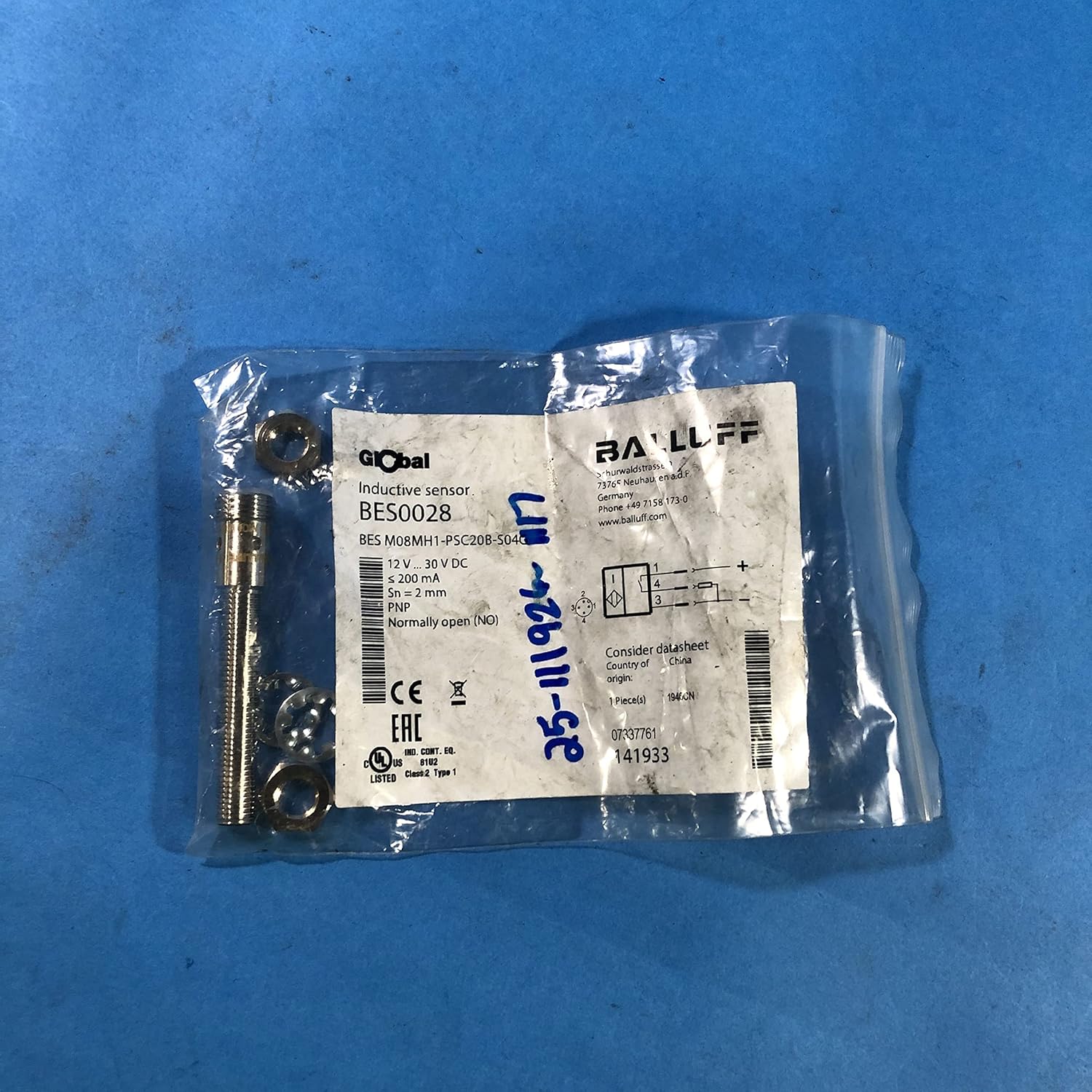
Whakaahua 3.1: Balluff BES0028 Inductive Sensor in its original packaging. The label shows model BES0028, BES M08MH1-PSC20B-S04G, 12V...30V DC, ≤200mA, Sn=2mm, PNP, Normally Open (NO). Additional identifiers visible include 141933.

Whakaahua 3.2: Kati-ake view of the sensor's label, detailing specifications and a wiring diagram for the M12 connector. The diagram indicates Pin 1 for positive supply (+), Pin 3 for negative supply (-), and Pin 4 for the PNP-NO output signal.

Whakaahua 3.3: The Balluff BES0028 sensor, removed from its packaging, showing the M8 threaded body and accompanying mounting nuts and washers.

Whakaahua 3.4: Ko tetahi atu view of the sensor in packaging, showing similar product details and a different internal identifier, 262993, and date 17-Oct-20.
4. Tatūnga
4.1. Te whakaurunga miihini
- Select a suitable mounting location where the sensor can detect the target object within its 2mm sensing range.
- The BES0028 is an M8 threaded sensor designed for flush mounting. Drill an appropriate M8 hole in the mounting surface.
- Insert the sensor into the mounting hole and secure it using the provided nuts and washers. Ensure the sensor head is flush with the mounting surface.
- Tighten the nuts sufficiently to prevent movement, but do not overtighten.
4.2. Hononga Hiko
The sensor uses an M12 connector. Refer to the wiring diagram (Figure 3.2) for correct connections.
- Pin 1: + (Positive Supply, 12V...30V DC)
- Pin 3: - (Negative Supply / Ground)
- Pin 4: Output (PNP Normally Open)
- Pin 2: Not used for this configuration.
Me whakarite kei roto i te putunga hiko kua tohuatage range (12V to 30V DC) and can provide the necessary current (up to 200mA).
5. Nga Tikanga Whakahaere
The Balluff BES0028 is an inductive proximity sensor. It generates an electromagnetic field at its sensing face. When a metallic object enters this field within the 2mm sensing range, it causes a change in the field, which the sensor detects.
Upon detection, the sensor's PNP-NO (Normally Open) output switches from an OFF state to an ON state (supplying positive voltage). When the metallic object moves out of the sensing range, the output returns to its OFF state.
6. Tiaki
- Te horoi: Keep the sensing face free from dirt, dust, and metallic debris. Use a soft, dry cloth for cleaning. Avoid abrasive cleaners or solvents.
- Tirotiro: Periodically check the sensor for physical damage, loose connections, or signs of wear. Ensure mounting nuts remain tight.
- No internal user-serviceable parts. Do not attempt to disassemble the sensor.
7. Te Raru
- Karekau he kitenga:
- Verify power supply is connected correctly and within specifications (12-30V DC).
- Check wiring for breaks or incorrect connections (Pin 1+, Pin 3-, Pin 4 Output).
- Ensure the metallic target is within the 2mm sensing range.
- Clean the sensor face if obstructed.
- Te Kimi Wā-poto:
- Check for loose mounting or vibrations that might cause the target to move in and out of range.
- Ensure the target material and size are appropriate for inductive sensing.
- Check for electromagnetic interference from nearby equipment.
- Output Always ON/OFF:
- Verify the sensor is not continuously detecting a metallic object (e.g., mounting bracket).
- Check for short circuits or open circuits in the output wiring.
- If all checks fail, the sensor may be faulty and require replacement.
8. Whakatakotoranga
| Tawhā | Uara |
|---|---|
| Tau tauira | BES0028 (BES M08MH1-PSC20B-S04G) |
| Momo Pūoko | Pūoko Tata Inductive |
| Rahi Whare | M8 Cylindrical |
| Sensing Distance (Sn) | 2 mm |
| Momo Whakaeke | Horoi |
| Momo Putanga | PNP Normally Open (NO) |
| Mahinga Mahi Voltage | 12 V ... 30 V DC |
| Kohi o naianei | ≤ 200 mA |
| Hononga | M12 Hono |
| Ahu | 1 x 3 x 1 inihi (tata) |
| Taumaha | 1.38 hekere (tata) |
| Kaihanga | Balluff |
| ASIN | B014U9JA4S |
9. Nga Korero Whakaputanga
Balluff products are manufactured to high-quality standards. For specific warranty terms and conditions, please refer to the official Balluff website or contact your local Balluff distributor. Warranty coverage typically applies to defects in materials and workmanship under normal use.
10. Tautoko
For technical assistance, product inquiries, or further information, please visit the official Balluff website or contact Balluff customer support directly.
Official Balluff Webpae: www.balluff.com


