1. Kupu Whakataki
This manual provides detailed instructions for the installation, operation, and maintenance of your HOMELY LC-5 5-Band EQ Guitar Preamp with Tuner and Microphone. Please read this manual thoroughly before using the product to ensure proper function and longevity.
2. Nga Hua o te Hua
- 5-Rohe Whakairite: Adjust Bass, Midd1, Midd2, Treble, and Presence for precise tone shaping.
- Integrated Digital Tuner: Convenient LCD display tuner for accurate guitar tuning.
- Tango hopuoro: Enhances sound capture, especially for acoustic nuances.
- Mana Rōrahi: Master volume adjustment.
- Tohu Pūhiko Iti: Alerts when battery replacement is needed.
- Blend Control: Mixes the signal from the piezo pickup and the microphone.

Figure 2.1: The HOMELY LC-5 preamp unit highlighting the LCD display and 5-band equalizer controls.
3. Tatūnga me te Tāuta
Proper installation is crucial for optimal performance. If you are unfamiliar with guitar electronics, professional installation is recommended.
3.1 Nga Waahanga Nekeview
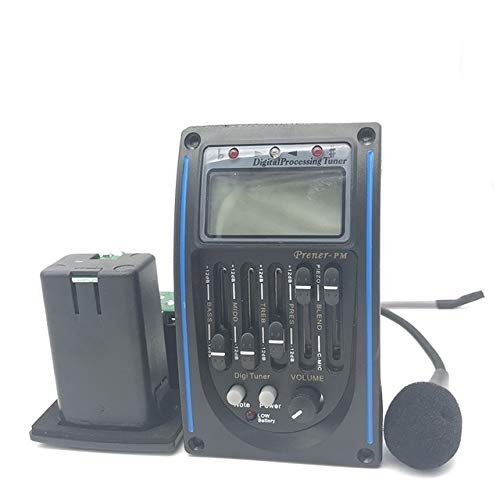
Whakaatu 3.1: Neke Atuview o te LC-5 i muaamp unit, including the main control panel, separate battery compartment, and attached microphone.
3.2 Nga Waahi Whakataunga
- Whakaritea te Kītā: Carefully cut the necessary openings in your guitar body for the preamp te waeine me te hononga pito. Me whakarite kia tika ngā inenga kia kore ai e pakaru.
- Tāutahia te Tuhinga o muaamp Waeine: Secure the main preamp control panel into its designated opening.
- Install the Endpin Jack: Mount the endpin jack assembly, which includes the output jack and battery compartment, at the bottom of the guitar.
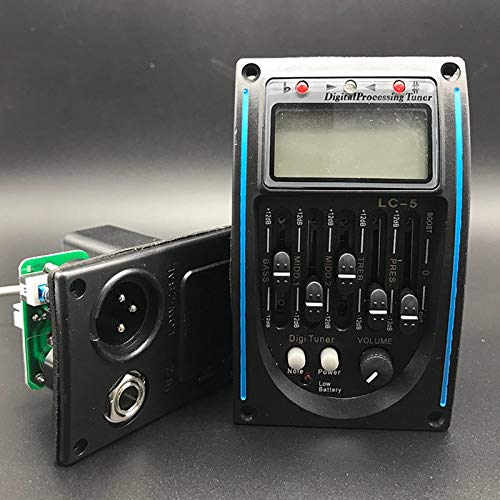
Whakaahua 3.2: Taha view o te LC-5 i muaamp unit, illustrating the output jacks (XLR and 1/4-inch) and the integrated battery compartment.
- Connect the Piezo Pickup: Route the piezo pickup wire from the bridge saddle to the preamp unit and connect it to the designated input.
- Honoa te hopuoro: Ensure the attached microphone is positioned correctly inside the guitar body for optimal sound capture.
- Whakauruhia te Pataha: Open the battery compartment (usually located within the endpin jack assembly) and insert a 9V battery, observing correct polarity.
- Hononga Whakamatau: Before fully securing, connect the guitar to an amplifier and test all functions to ensure proper wiring and operation.
4. Nga Tohutohu Whakahaere
Familiarize yourself with the controls for effective sound management.
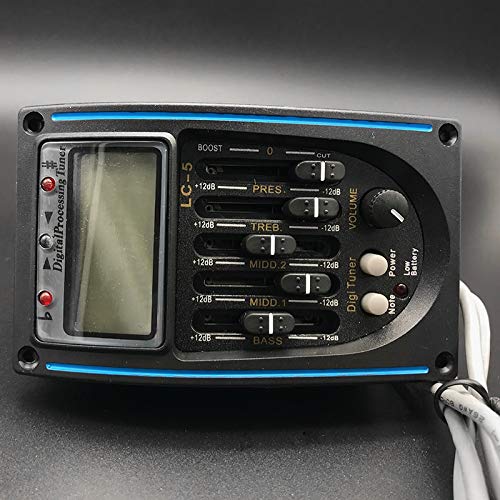
Whakaatu 4.1: Taipitopito view o te LC-5 i muaamp's control panel, showing the 5-band EQ sliders, volume knob, digital tuner display, and control buttons.
4.1 Hiko / Whakaweto
Tuhinga o muaamp typically powers on automatically when a guitar cable is plugged into the endpin jack. Disconnect the cable to power off and conserve battery life.
4.2 Mana Rōrahi
- PUKA PUKA: Rotate to adjust the overall output level of your guitar. Start with a low setting and gradually increase to avoid sudden loud sounds.
4.3 5-Taipu Whakairite
Use the five slider controls to shape your guitar's tone:
- BASS: Adjusts low-frequency response (0-80 Hz). Boost for a fuller, warmer sound; cut for clarity.
- MIDD 1 & MIDD 2: Adjusts mid-range frequencies (250 Hz - 2 kHz). These are crucial for the guitar's presence and projection. Experiment to find your desired tone.
- TREB: Adjusts high-frequency response (2 kHz - 20 kHz). Boost for brightness and sparkle; cut to reduce harshness.
- PRES (Tuhinga): Adjusts upper mid-range frequencies (around 3-5 kHz) for added clarity and attack.
4.4 Mamati Mamati
- DIGI TUNER Button: Press this button to activate the built-in digital tuner. The LCD display will show the note being played.
- Whakatika: Pluck each string individually. The display will indicate if the note is flat, sharp, or in tune. Adjust your guitar's tuning pegs until the display shows the correct note and indicates it is in tune.
- Note Button: Some models may have a 'Note' button to cycle through different tuning modes (e.g., chromatic, guitar). Refer to the display for current mode.
- Power Button (Tuner): This button typically controls the tuner's power, separate from the main preamp mana.
4.5 Blend Control (if applicable)
The "BLEND" slider allows you to mix the signal from the piezo pickup and the internal microphone. Slide towards "PIEZO" for a direct, punchy sound, or towards "MIC" for a more natural, ambient acoustic tone. Adjust to find the desired balance.
4.6 Tohu Pūhiko Iti
A "LOW BATTERY" LED or indicator on the LCD will illuminate when the 9V battery needs replacement. Replace the battery promptly to ensure consistent performance.
5. Tiaki
5.1 Whakakapinga Pūhiko
When the low battery indicator activates, replace the 9V battery. Open the battery compartment, remove the old battery, and insert a new one, ensuring correct polarity. Always use a fresh alkaline 9V battery.
5.2 Te horoi
Wipe the preamp's control panel with a soft, dry cloth. Avoid using abrasive cleaners or solvents, as they may damage the finish or electronic components.
5.3 Rokiroki
When not in use for extended periods, disconnect the guitar cable from the output jack to prevent battery drain. Store the guitar in a stable environment, away from extreme temperatures and humidity.
6. Te Raru
- Kore Putanga Oro:
- Check if the guitar cable is fully inserted into both the guitar's output jack and the ampkaikawe
- Me whakarite te amplifier is powered on and its volume is up.
- Verify the preamp's volume knob is not set to minimum.
- Check the battery. Replace if the low battery indicator is on or if the battery is old.
- Inspect all internal wiring connections (professional inspection recommended).
- Poor Sound Quality / Buzzing / Hum:
- Check for loose connections inside the guitar.
- Ensure the piezo pickup is correctly seated under the bridge saddle.
- Adjust EQ settings; extreme boosts can introduce unwanted noise.
- Test with a different guitar cable and ampte rongoā hei whakakore i ngā raruraru o waho.
- Ensure the microphone is not touching any vibrating parts of the guitar body that could cause feedback.
- Tuner Not Working:
- Ensure the tuner is activated by pressing the "DIGI TUNER" button.
- Tirohia te taumata pākahiko.
- Hutia ngā aho kia mārama, kia mau.
- Low Battery Indicator Always On:
- Whakakapia te pākahiko 9V ki tētahi mea hou.
- If the issue persists with a new battery, there might be an internal circuit issue requiring professional service.
7. Whakatakotoranga
| Tauira | LC-5 |
| Waitohu | HOMELY |
| Roopu Whakairite | 5-Band (Bass, Midd1, Midd2, Treble, Presence) |
| Whakaatu | LCD Digital Tuner |
| Tuku Hiko | Pūhiko 9V (kāore i roto) |
| Momo Tiki | Piezo and Microphone |
8. Pūtāhui me te Tautoko
For warranty information or technical support, please contact HOMELY customer service through their official channels. Keep your purchase receipt as proof of purchase.
Manufacturer: Homely
Date First Available: 26 March 2019


