1. Kupu Whakataki me Nekeview
The OSD Audio MX1680 GEN2 is a high-performance, multi-channel amplifier designed for distributed audio systems. This Class D amplifier provides 16 channels across 8 independent zones, delivering 80 Watts per channel into 4 Ohms or 50 Watts per channel into 8 Ohms. It is suitable for both residential and commercial audio installations, serving as a main amplifier for multi-room audio or integrating into home theater systems.
Key features include front-panel on/off buttons for each zone, efficient Class D amplification for low distortion, and built-in protection circuitry against thermal overload and short circuits. Its slim, 2U rack-mountable design (hardware included) allows for flexible installation.

Whakaahua 1.1: Mua me muri view of the OSD Audio MX1680 GEN2 Multi-Zone Digital Ampkaikawe
2. Nga korero haumaru
Tena panuihia me te mohio ki nga tohutohu haumaru katoa i mua i te whakahaere i tenei taputapu. Puritia tenei pukapuka hei tohutoro a meake nei.
- Puna Hiko: Honoa te ampte whakamātao anake ki te momo pūtake hiko kua tohua ki te waeine. Kia tino mōhio kei tetage tika ana mo to rohe.
- Whakahau: Kaua e araia nga whakatuwheratanga hau. Tāutahia kia rite ki nga tohutohu a te kaihanga. Kia mau tonu te waahi huri noa i te waahanga kia pai ai te rere o te hau.
- Te wai me te makuku: Kaua e tukuna tenei taputapu ki te ua, ki te makuku ranei. Kaua e waiho nga mea kua whakakiia ki te wai, penei i nga ipu, ki runga i te taputapu.
- wera: Kaua e whakauruhia ki te taha o nga puna wera penei i nga radiators, nga rehita wera, nga umu, me etahi atu taputapu (tae atu ki ampkaiwhakaora) e whakaputa ana i te wera.
- Whakapapa: This appliance must be grounded. Ensure the power cord is connected to a properly grounded outlet.
- Ratonga: Kaua e tarai ki te mahi i tenei hua maau ake. Tirohia nga ratonga katoa ki nga kaimahi tohu tohu.
- Te horoi: Wewetehia te waeine mai i te putanga hiko i mua i te horoi. Whakamahia he kakahu maroke mo te horoi.
3. Tatūnga me te Tāuta
3.1 Te Wetewete
Tango tupato te amplifier from its packaging. Verify that all components listed in the 'What's in the Box' section are present. This includes the MX1680 GEN2 amplifier and the Quick Start Guide.
3.2 Whakanoho
The MX1680 GEN2 is designed for rack mounting (2U height) or placement on a flat, stable surface. Ensure adequate ventilation around the unit to prevent overheating. Avoid placing it near other heat-generating equipment.
3.3 Hononga
Refer to the rear panel diagram for all input and output connections.
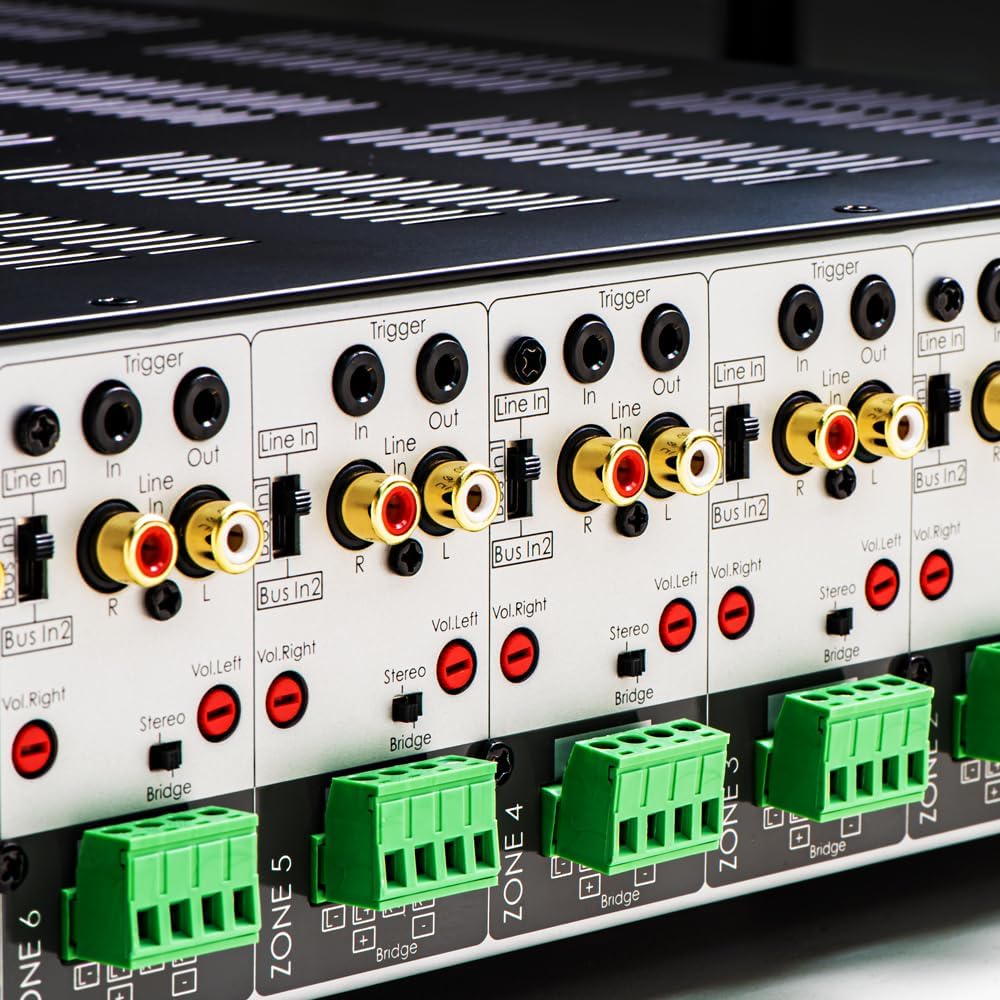
Whakaahua 3.1: Taipitopito view of the rear panel input and output connections.
- Putanga Tukuoro: Connect your speakers to the corresponding zone terminals. Ensure correct polarity (+ to + and - to -). The amplifier supports both 4-ohm and 8-ohm speakers. For bridged mode operation, refer to section 4.3.
- Line Inputs (RCA): Each zone has a dedicated stereo RCA Line In. Connect your audio sources (e.g., pre-amplifier, media player) to these inputs.
- Bus Inputs (RCA): Ko te amplifier features two stereo Bus Inputs (Bus In 1, Bus In 2). These allow a single audio source to be distributed to multiple zones.
- Nga Putanga Raina (RCA): Each zone also has a stereo RCA Line Out, allowing the audio signal from that zone to be passed to another amphe taputapu ororongo ranei.
- Keu ki roto/waho: The 12V Trigger In allows the amplifier to be turned on/off by an external device. The 12V Trigger Out can be used to control other devices.
- Whakauru Hiko AC: Connect the supplied power cord to the AC IN receptacle and then to a suitable wall outlet.

Whakaahua 3.2: Taipitopito view of Bus inputs and Trigger connections on the rear panel.
4. Nga Tohutohu Whakahaere
4.1 Hiko / Whakaweto
Pēhia te pātene mana matua i te papa o mua hei huri i te amplifier on or off. A red LED indicator will illuminate when the unit is powered on.

Image 4.1: Front panel power button.
4.2 Mana Rohe
Each of the 8 zones has a dedicated button on the front panel. Pressing a zone button will activate or deactivate that specific audio zone. The corresponding LED will indicate the zone's status.

Image 4.2: Front panel zone selection buttons.
4.3 Input Selection and Volume Adjustment
On the rear panel, each zone features switches for input selection and rotary controls for volume adjustment:
- Kaitoha Whakauru: A slide switch allows you to select the audio input for each zone: Raina ki roto (dedicated input for that zone), Bus In 1, ranei Bus In 2.
- Mana Rōrahi: Separate rotary controls for Left and Right channels (Vol. Left, Vol. Right) allow for precise volume balancing within each zone.
- Stereo/Bridge Switch: A switch allows you to configure the zone for stereo operation or bridged mono operation. In bridged mode, two amplifier channels combine to deliver higher power to a single speaker. Ensure the speaker impedance is appropriate for bridged mode (typically 8 ohms minimum).
4.4 Audio Sensing
Ko te amplifier incorporates an audio sense feature that automatically activates a zone when an input signal is detected and turns it off after a period of no signal. This helps conserve power and prolong the unit's lifespan.

Whakaahua 4.3: Example of multi-zone audio distribution with the ampkaikawe
5. Tiaki
The OSD Audio MX1680 GEN2 amplifier requires minimal maintenance. Follow these guidelines to ensure optimal performance and longevity:
- Te horoi: Periodically wipe the exterior surfaces with a soft, dry cloth. Do not use liquid cleaners or aerosol sprays, as they may damage the finish or internal components.
- Whakahau: Ensure that the ventilation openings on the top and sides of the unit remain clear of dust and obstructions. Dust accumulation can impede airflow and lead to overheating.
- Hononga: Occasionally check all cable connections to ensure they are secure and free from corrosion. Loose connections can lead to signal loss or degradation.
- Rokiroki: Mena kei te penapena te ampte pūhiko mō te wā roa, momotuhia te hiko ka rongoa ki te wāhi hauhautanga, maroke, kia matara atu i te rā tika me ngā pāmahana tino kino.
6. Te Raru
If you experience issues with your MX1680 GEN2 amplifier, consult the following troubleshooting guide. For problems not resolved here, please contact OSD Audio support.
| Raruraru | Take pea | Rongoā |
|---|---|---|
| Karekau he kaha | Kua momotu te taura hiko; He he te putanga hiko; Ampka puhipuhi te kuini | Check power cord connection; Test outlet with another device; Contact service for fuse replacement. |
| Kāore he oro mai i tētahi rohe | Zone not activated; Incorrect input selected; Source device off/muted; Speaker wires loose/incorrectly connected; Volume too low | Press the zone button on the front panel; Verify input selector switch position; Check source device; Inspect speaker connections; Adjust zone volume controls. |
| Oro kerekere | Input signal too high; Speaker impedance mismatch; Faulty speaker cable; Ampte whakawera wera | Reduce source device output level; Ensure correct speaker impedance (4 or 8 ohms, or 8 ohms for bridged); Check speaker cables; Ensure proper ventilation. |
| Amplifier shuts off unexpectedly | Overheating; Short circuit in speaker wiring; Protection circuit activated | Ensure proper ventilation; Check all speaker wiring for shorts; Allow unit to cool down before restarting. |
7. Whakatakotoranga
| Āhuahira | Whakatakotoranga |
|---|---|
| Tau tauira | MX1680-GEN2 |
| Nga hongere | 16 Channels (8 Zones) |
| Putanga Hiko (4 Ohms) | 80 Watts per channel (1KHz) |
| Putanga Hiko (8 Ohms) | 50 Watts per channel (1KHz) |
| Ampakomanga lifier | Te akomanga D |
| Rahi Hua (L x W x H) | 16.81 x 16.14 x 3.46 inihi |
| Taumaha Tūemi | 23 pauna |
| Rakau Maunga | Yes (2U, hardware included) |
| Kaihanga | OSD Ororongo |
| Te Ra Tuatahi Wātea | Hanuere 31, 2020 |
8. Nga Korero Whakaputanga
Warranty information for the OSD Audio MX1680 GEN2 amplifier is typically provided with your purchase documentation or can be found on the official OSD Audio webpae. Tena koa tirohia enei rauemi mo nga korero mo te kapi whakamana, nga tikanga me nga tikanga.
9. Tautoko
For technical assistance, product inquiries, or service requests, please contact OSD Audio customer support. You can typically find contact information, including phone numbers and email addresses, on the official OSD Audio webpae:
Please have your model number (MX1680-GEN2) and purchase details ready when contacting support.


