Kupu Whakataki
This user manual provides detailed instructions for the operation, setup, and maintenance of your Pymeter Digital Temperature Controller. Designed for precise temperature management, this dual-probe thermostat is ideal for various applications including terrariums, heat mats, heating pads, cooling fans, freezers, and refrigerators. Please read this manual thoroughly before use to ensure safe and optimal performance.
Whakatupato Haumaru
- Always ensure the device is properly grounded.
- Do not immerse the main unit in water or expose it to excessive moisture. The probes are waterproof, but the main unit is not.
- Me whakarite te wat katoatagkāore e neke ake i te 1200W (10A) te kaha o ngā taputapu hono.
- Kaua e taea e nga tamariki me nga kararehe.
- Momotuhia te hiko i mua i te horoi, te mahi tiaki ranei.
- Kaua e ngana ki te wetewete, ki te whakatika ranei i te waahanga. Whakapa atu ki nga kaimahi whai mana mo te ratonga.
- Different measurement methods and contact status can lead to varied results. Do not compare with common inaccurate thermometers. Calibrate with an ice-water mixture (0℃/32℉) if necessary for verification.
Ihirangi mokete
Manatokona kei roto katoa nga mea kei roto i to kete:
- 1 x Pymeter Digital Temperature Controller (10A 1200W)
- 2 x Waterproof Temperature Probes
- 1 x Manual Kaiwhakamahi (tenei tuhinga)

Image: Contents of the Pymeter Digital Temperature Controller package, showing the main unit, two temperature probes, and the instruction manual.
Nga waahanga hua me nga waahanga
The Pymeter Digital Temperature Controller is designed for versatile temperature management with its dual-zone control capabilities.
- Dual Zones Control: Two independent outlets, each capable of controlling heating or cooling devices.
- Dual Waterproof Sensors: Allows for monitoring and control of two separate areas simultaneously.
- Āhuatanga Haumaru: High and low temperature alarms, and temperature difference alarm for enhanced security.
- Whakatupato Compressor: Features a Power-On delay to protect compressors from frequent on/off cycles, suitable for converting freezers to refrigerators.
- Taupānga Whānui: Suitable for reptile terrariums, heat mats, aquariums, greenhouses, grow tents, and more.

Image: The Pymeter Digital Temperature Controller, displaying its digital screen, control buttons (SET, SAV, Up, Down), and two distinct power outlets labeled OUT 1 and OUT 2.
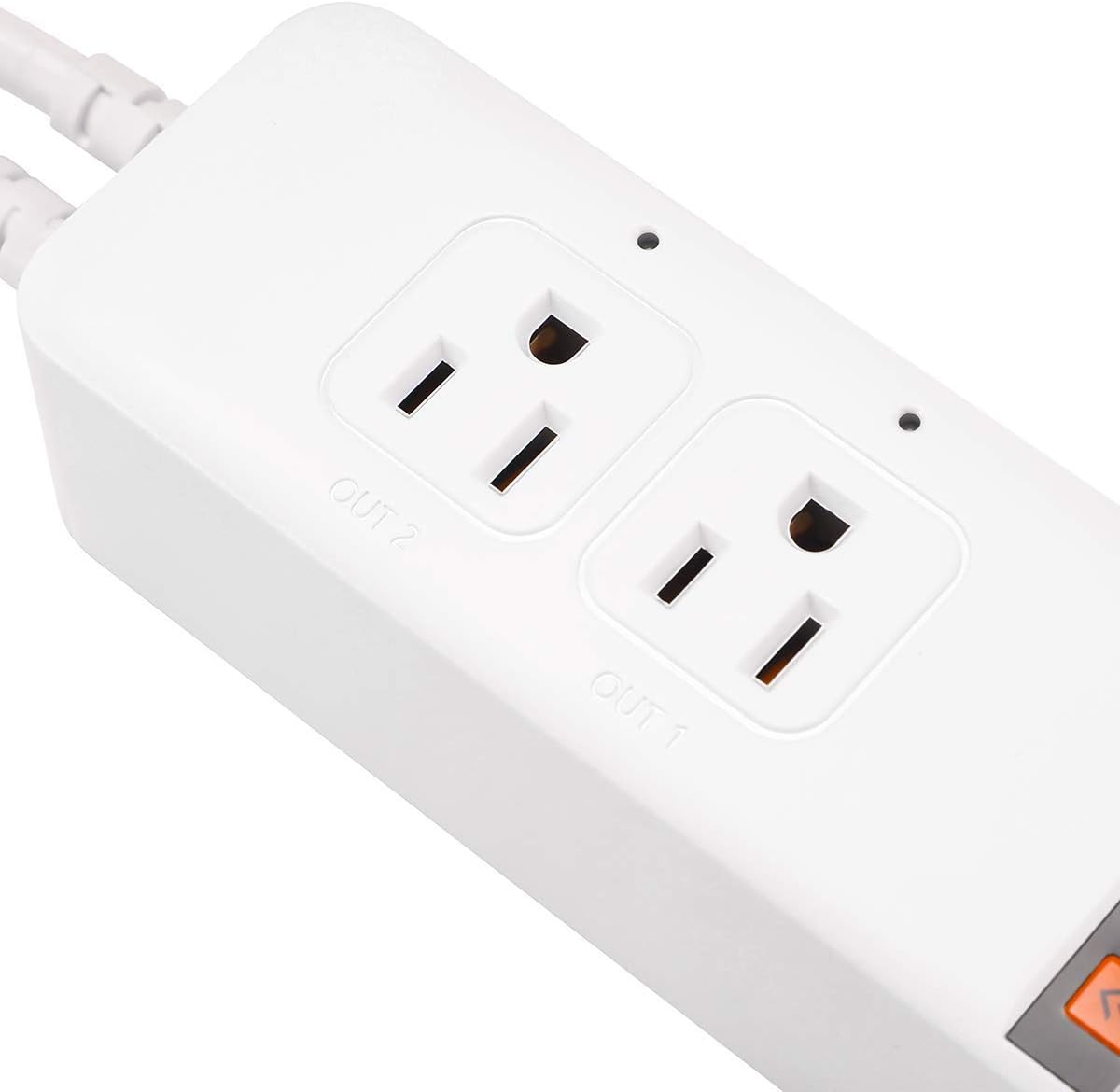
Whakaahua: He taipitopito view of the two controlled outlets on the Pymeter thermostat, showing their individual indicator lights and labels.

Image: An illustration demonstrating the Pymeter controller's use with a terrarium, showing how it can manage both a heat lamp and a heat mat for optimal heating.
Whakauru me te Tatūnga
- Whakapiki: The unit can be wall-mounted or placed on a flat surface. Ensure it is in a location with good ventilation and away from direct heat or moisture.
- Tūhono Probe: Insert the two waterproof temperature probes into the designated ports at the bottom of the unit. Place the probe tips in the areas where temperature monitoring and control are required.
- Tūhono Pūrere: Plug your heating or cooling devices (e.g., heat mat, fan, lamp) into the "OUT 1" and "OUT 2" controlled outlets.
- Whakahiko: Plug the Pymeter controller into a standard 120V AC power outlet. The display will light up, showing the current temperature readings.

Image: The Pymeter controller installed on a wall, illustrating its compact design and how it can be integrated into a setup.
Nga Tohutohu Whakahaere
Te Maramatanga ki te Whakaaturanga
The display shows two main temperature values:
- PV (Uara Tukanga): The current temperature measured by the probe.
- SV (Uara Tautuhi): The target temperature or setting value.
Basic Navigation and Settings
- Pehia te SET button to cycle through the settings for each outlet (1oN, 1oF, 2oN, 2oF, AL, AH, d7, P0-P8).
- Whakamahia te Up a Ki raro arrows to adjust values.
- Perehi SAV to save your changes and exit the setting mode. If no button is pressed for a few seconds, the unit will automatically save and exit.
Temperature Control Logic
The Pymeter controller operates by setting ON-Temp and OFF-Temp for each outlet.
Heating Mode (1oN & 1oF for Outlet 1, 2oN & 2oF for Outlet 2)
- Heating starts when the temperature drops to the ON-Temp (1oN/2oN).
- Heating stops when the temperature rises to the OFF-Temp (1oF/2oF).
- For heating, you MUST SET ON-Temp LESS than OFF-Temp.
- In heating mode, ON-Temp is the minimum temperature you allow, and OFF-Temp is the maximum temperature you allow.
Cooling Mode (1oN & 1oF for Outlet 1, 2oN & 2oF for Outlet 2)
- Cooling starts when the temperature rises to the ON-Temp (1oN/2oN).
- Cooling stops when the temperature drops to the OFF-Temp (1oF/2oF).
- For cooling, you MUST SET ON-Temp GREATER than OFF-Temp.
- In cooling mode, ON-Temp is the maximum temperature you allow, and OFF-Temp is the minimum temperature you allow.
Advanced Settings (P0-P8)
Patohia me te pupuri i te SET button for 3 seconds to enter the advanced settings menu (P0-P8).
| Tawhā | Whakaahuatanga | Uara Taunoa |
|---|---|---|
| P0 | Wae Paemahana (℃/℉) | ℉ |
| P1 | Power-On Delay (0-10 minutes) | 0 |
| P2 | Temperature Calibration (Sensor 1) | 0.0 |
| P3 | Temperature Calibration (Sensor 2) | 0.0 |
| AL | Whakaoho Temperature Iti | Default (usually very low) |
| AH | Te Whakaoho Pawera Nui | Default (usually very high) |
| d7 | Temperature Difference Alarm (between Sensor 1 and Sensor 2) | Default (usually high) |
Tuhipoka: To factory reset settings, change the temperature unit (P0) from Fahrenheit to Celsius or vice versa. This will revert all alarm settings (AL, AH, d7) to their default values.
Te tiaki
- Te horoi: Wipe the unit with a soft, dry cloth. Do not use abrasive cleaners or immerse in water.
- Tiaki Tiaki: Ensure probes are clean and free of debris for accurate readings. Avoid bending or damaging the probe cables.
- Rokiroki: When not in use, store the controller in a cool, dry place away from direct sunlight.
Raparongoā
Issue: Reading temperature is inaccurate.
Rongoā: Every Pymeter controller is calibrated at the factory. Do not compare its readings to common inaccurate thermostats or temperature guns. If you suspect inaccuracy, calibrate the device using an ice-water mixture (which is 32℉ / 0℃ when ice is melting). You can also use the P2 and P3 parameters in the advanced settings to fine-tune the calibration if needed, comparing it to a known accurate thermometer.
Issue: Beeper keeps sounding.
Rongoā: This is likely due to the alarm settings (AL, AH, d7) being triggered.
- AL (Low Temperature Alarm): Sounds when the current temperature is at or below the AL setting.
- AH (High Temperature Alarm): Sounds when the current temperature is at or above the AH setting.
- d7 (Temperature Difference Alarm): Sounds when the temperature deviation between Sensor 1 and Sensor 2 exceeds the d7 setting.
Whakatakotoranga Hangarau
| Whakatakotoranga | Uara |
|---|---|
| Waitohu | Taarua |
| Tau tauira | 10A 1200W |
| Hunga Hua | 8.26"D x 2.16"W x 1.57"H |
| Momo Kaiwhakahaere | Patene Pana |
| Āhuahira Motuhake | Dual Zones Control, Each outlet works for Heating or Cooling |
| Tae | Mā |
| Nga Whakamahinga Motuhake mo te Hua | Heat Pump, Refrigerator |
| Momo Mana Pawera | Te whakamahana, te whakamahana |
| Nga Waahanga kei roto | Pūoko Takirua |
| Puna Mana | AC |
| Taumaha Tūemi | 1.04 Pauna |
| Voltage | 120 Volts |
| Rauemi | Polycarbonate (PC) |
| Hanga | Tapawhā |
| Momo Whakaatu | LED |
| Momo Mana | Mana Patene |
| Tikanga Mana | Mamao |
| Momo Whakaeke | Maunga Taiepa |
| Kāhua | Hou |
| Whakamuri | Ae |
| Wattage | 1200 watts |
| UPC | 791386439637 |
| Kaihanga | Taarua |
| E hiahiatia ana nga pākahiko | Kao |

Image: Dimensional drawing of the Pymeter controller, indicating its length, width, and height.

Image: The back of the Pymeter controller, displaying its electrical specifications and regulatory compliance markings.
Pūtāhui me te Tautoko
For warranty information and technical support, please refer to the contact details provided on the product packaging or visit the official Pymeter webpae. Puritia to rihiti hoko mo nga kereme whakamana.


