1. Kupu Whakataki
The PeakTech P 8005 is a high-precision Class 2 sound level meter designed for accurate noise measurement and data logging. It is suitable for a wide range of applications including noise projects, quality control, disease prevention, and environmental sound measurements in factories, schools, offices, traffic, and households. This device features a 4-digit 20mm LCD multi-function display with a bargraph and backlight, a USB interface for continuous measurements, and AC/DC outputs for connection to frequency analyzers or X-Y wave recorders. This manual provides detailed instructions for the proper use, maintenance, and troubleshooting of your PeakTech P 8005.
2. Nga korero haumaru
Please read all safety instructions carefully before operating the device. Failure to follow these instructions may result in damage to the device or personal injury.
- Kaua e tukuna te taputapu ki te wera nui, te makuku, te ra tika ranei.
- A ape i nga wiri kaha, i nga paanga ranei.
- Kaua e ngana ki te whakatuwhera, ki te whakarereke ranei i te taputapu. Ma nga kaimahi mohio anake e whakatika.
- Puritia te taputapu mai i nga mara hiko kaha.
- Ensure proper ventilation when using the AC adapter for extended periods.
- Whakakorehia nga pākahiko kia rite ki nga ture o te rohe.
3. Ihirangi mokete
Manatokohia ko nga mea katoa kei raro nei kei roto i to kete:
- PeakTech P 8005 Sound Level Meter
- Te Kawe i te Keehi
- 3m Additional Microphone Cable
- Tauira Atanga USB
- Software for Windows (on CD-ROM)
- Takitoru Mini
- Pūurutau Hiko AC 9V
- 9V Pūhiko
- Pukapuka Kaiwhakamahi

4. Hua Neke Atuview
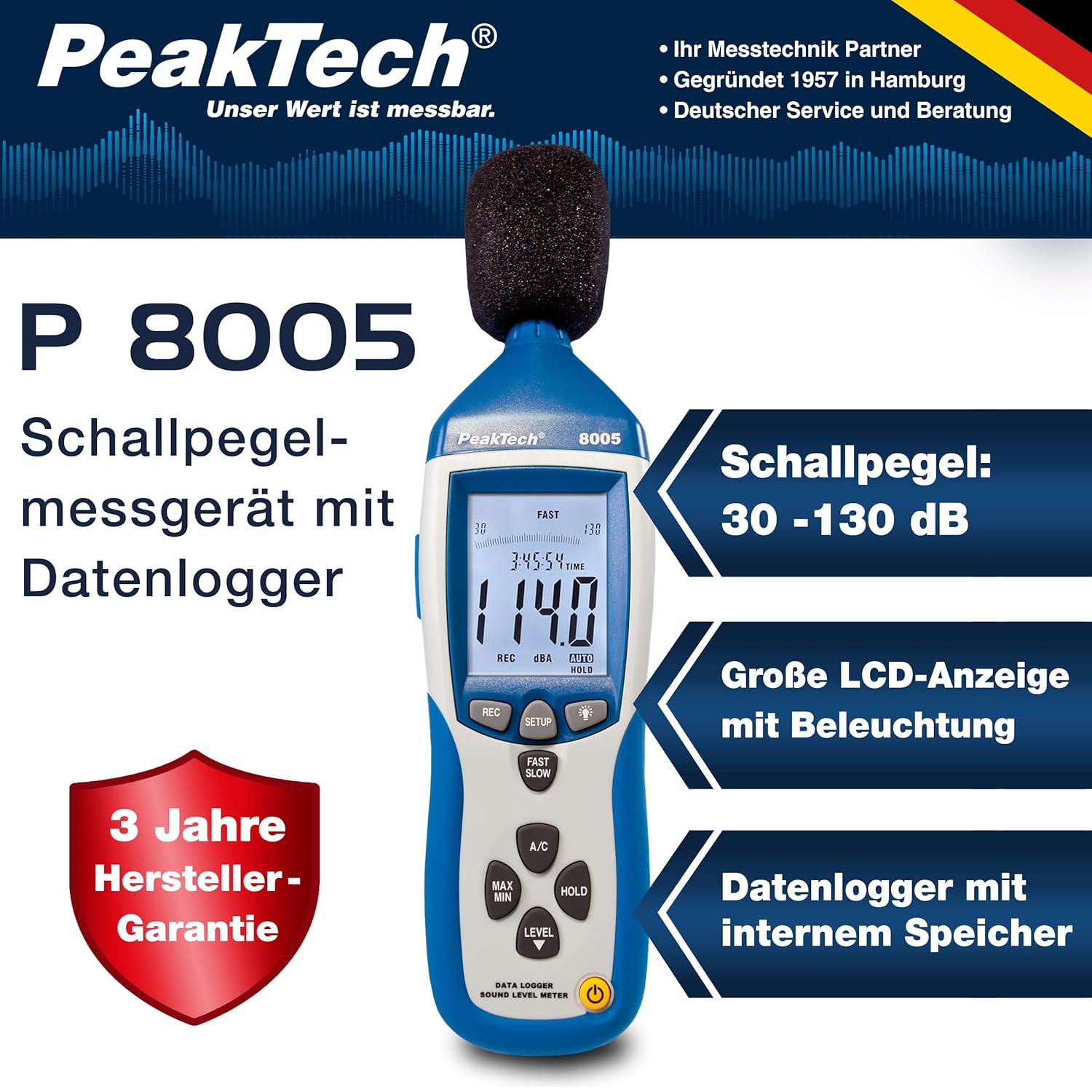
The PeakTech P 8005 is designed for user-friendly operation while providing professional-grade accuracy. Familiarize yourself with the main components and controls.
4.1. Nga waahanga matua
- Inenga Tika: Class 2 sound level meter (IEC-61672-1 compliant) for accurate readings even in noisy environments.
- Awhe inenga whanui: 30 to 130 dB across 4 ranges with 0.1 dB resolution.
- Takitaki Raraunga: Internal memory for up to 32,000 readings (1x/sec to 1x/min).
- Hononga: USB 2.0 interface for PC connection and data transfer.
- Putanga tairitenga: AC/DC outputs for connecting to frequency analyzers or X-Y wave recorders.
- Whakaatu: 4-digit 20mm LCD with bargraph and backlight.
- Aratau Ine: Fast (125 ms) and Slow (1 s) response times, A and C weighting.
- Nga Mahi Apiti: MIN/MAX measurements, over-range/under-range indication.

5. Tatūnga
5.1. Tāuta Pūhiko
The PeakTech P 8005 operates on a 9V battery or via the included 9V AC power adapter.
- Kimihia te wahanga pākahiko kei muri o te taputapu.
- Whakatuwheratia te uhi pākahiko.
- Insert the 9V battery, ensuring correct polarity.
- Katia kia mau te taupoki pākahiko.
5.2. Whakakaha i te Pūrere
- Hei whakakaha, pehia te MANA pātene.
- Ki te whakaweto, patohia kia mau te MANA pātene kia weto te whakaaturanga.
- For continuous operation, connect the 9V AC power adapter to the DC 9V input port on the side of the device.
5.3. Hononga hopuoro
The device comes with a built-in microphone. For remote measurements or specific setups, you can use the included 3m additional microphone cable.
- Unscrew the microphone cap from the top of the device.
- Connect the 3m microphone cable to the microphone input.
- Attach the external microphone to the other end of the cable.
- For stable measurements, attach the device to the mini tripod using the threaded mount at the bottom.

Ataata 5.1: Kua mutuview of the PeakTech 8005 Sound Level Meter, demonstrating its features and setup, including the use of the external microphone and power adapter.
6. Nga Tohutohu Whakahaere
6.1. Te Ine Taketake
After powering on, the device will immediately begin measuring sound levels.
- The current sound level in dB is displayed on the LCD.
- Whakamahia te TAUMATA button to cycle through the four measurement ranges (30-80 dB, 50-100 dB, 80-130 dB, Auto 30-130 dB).
- Perehi KAUPAPA/POHO to switch between fast (125 ms) and slow (1 s) response times. Fast is suitable for sudden noise changes, while slow is for average noise levels.
- Perehi A/C to select A-weighting (dBA) or C-weighting (dBC). A-weighting mimics human ear response, C-weighting is for mechanical noise.

6.2. Data Logging and PC Connection
The P 8005 can record up to 32,000 measurement values internally. To access and analyze this data, use the included Windows software.
- Install the software from the provided CD-ROM onto a Windows PC (Windows 95/98/NT/2000/XP/VISTA/7/8/10 supported).
- Connect the sound level meter to your PC using the USB interface cable.
- Open the software. The software allows for real-time data display, data import from the device's internal memory, and export to formats like Excel for further analysis.
- Refer to the software's help documentation for detailed instructions on data logging setup and analysis.

7. Tiaki
7.1. Te horoi
Clean the device regularly to ensure optimal performance.
- Horoia te waho ki te kakahu ngohengohe, maroke.
- Kaua e whakamahi i nga kai horoi me nga whakarewa.
- Keep the microphone free from dust and debris.
7.2. Rokiroki
Ki te kore e whakamahia, rongoatia te taputapu i roto i tana putea ki te wāhi hauhautanga, maroke, kia matara atu i te rā tika me te pāmahana tino kino.
7.3. Whakatau
The PeakTech P 8005 is a precision instrument. Regular calibration is recommended to maintain accuracy, especially for professional applications. Refer to the included test report for the last calibration date. Contact PeakTech support for calibration services.
8. Te Raru
| Raruraru | Take pea | Rongoā |
|---|---|---|
| Kaore te taputapu i te hiko. | Low or dead battery; AC adapter not connected or faulty. | Replace the 9V battery or connect the AC adapter. Ensure the adapter is working. |
| Ko nga panui kore tika. | Incorrect measurement range; microphone obstructed; device needs calibration. | Adjust the measurement range using the TAUMATA button. Clear any obstructions from the microphone. Consider professional calibration. |
| Software not recognizing device. | USB cable faulty; driver issue; software compatibility. | Try a different USB port or cable. Reinstall the software and drivers. Check software compatibility settings (e.g., Windows 98 compatibility mode for older systems). |
| Data logging issues. | Memory full; incorrect logging settings. | Download and clear data from the device. Review data logging settings in the software. |
9. Whakatakotoranga
| Tawhā | Uara |
|---|---|
| Paerewa Whakamahi | IEC-61672-1 Type 2, ANSI S1.4 Type 2 |
| Te Tika (1 kHz Sine; A, C) | ± 1.4 dB |
| Tika (Awhe Auautanga) | According to EN-61672-1 Class 2, max. ± 5.6 dB |
| Awhe Auautanga | 31.5 Hz - 8 kHz |
| Awhe Hihiko | 50 dB |
| Awhe Taumata | Low: 30 dB ~ 80 dB, Med: 50 dB ~ 100 dB, High: 80 dB ~ 130 dB, Auto: 30 dB ~ 130 dB |
| Wā Whakautu | Fast: 125 ms / Slow: 1 s |
| hopuoro | ½-inch Electret Condenser Microphone |
| Whakatau | 0.1 dB |
| Whakaatu Whakahou | 2 wa / hekona |
| Putanga tairitenga | AC/DC Outputs, AC: 1 Veff = 10 mV/dB |
| Mahinga Mahi Voltage | 9V Battery or 9V AC Power Adapter |
| Ahu (WxHxD) | 80 x 280 x 50 mm |
| Taumaha | 350 g |
| Data Logger Memory | Tae atu ki te 32,000 panui |
10. Pūtāhui me te Tautoko
PeakTech products are designed for reliability and performance. For warranty information and technical support, please refer to the documentation included with your product or visit the official PeakTech webpae. Puritia to riirii hoko hei tohu mo te hoko mo nga kereme whakamana.
Kaihanga: TihiTech
Webpae: PeakTech Official Store


