1. Kupu Whakataki
Mauruuru koe mo te hokoasing the PRIMO PR501SV Cordless 3-in-1 Stick Vacuum Cleaner. This manual provides essential information for the safe and efficient use, maintenance, and troubleshooting of your appliance. Please read it thoroughly before first use and keep it for future reference.
2. Nga Tohutohu Haumaru
Hei whakaiti i te tupono o te ahi, te wiri hiko, te whara ranei, me whai tonu i nga tikanga haumaru ina whakamahi taputapu hiko.
- Panuihia nga tohutohu katoa i mua i te whakamahi i te taputapu.
- Kaua e whakamahi i waho, i runga ranei i nga papanga maku.
- Kaua e tukua kia whakamahia hei taakaro. Me aro nui ina whakamahia e nga tamariki e tata ana ranei.
- Whakamahia anake kia rite ki te korero i roto i tenei pukapuka. Whakamahia anake nga taapiri a te kaiwhakanao.
- Kaua e whakamahia ki te taura pakaru, mono ranei. Mena karekau te taputapu e mahi ana, kua makahia, kua pakaru, kua waiho ki waho, kua taka ranei ki te wai, whakahokia ki te pokapu ratonga.
- Kaua e toia, kaua e haria ma te taura, whakamahia te aho hei kakau, kati he kuaha ki te taura, toia ranei te aho ki nga taha koi, ki nga kokonga ranei. Kaua e rere te taputapu ki runga i te taura. Kia matara atu te taura mai i nga papanga wera.
- Kaua e wetewete ma te toia te taura. Hei wetewete, mauhia te mono, kaua ki te taura.
- Kaua e hapai i te mono me te taputapu ma nga ringa makuku.
- Kaua e maka tetahi mea ki roto i nga tuwhera. Kaua e whakamahi me tetahi tuwhera kua araia; kia noho kore te puehu, te kiri, te makawe, me nga mea katoa ka whakaiti i te rere o te hau.
- Tiakina nga makawe, nga kakahu taratara, nga maihao, me nga wahanga katoa o te tinana mai i nga tuwhera me nga waahanga neke.
- Kaua e kohia tetahi mea e wera ana, e kai paipa ana ranei, penei i te hikareti, te mati, te pungarehu wera ranei.
- Kaua e whakamahi ki te kohi i nga wai ka mura, ka wera ranei, penei i te penehīni, te whakamahi ranei i nga waahi kei reira.
- Kaua e kohia nga mea paitini (hei tauira, te waiu maota, te horoi haukinia, te horoi horoi).
- Kaua e whakamahi me te kore kapu puehu me/ranei he whiriwhiringa.
- Whakawetohia nga mana katoa i mua i te tango.
- Me tino tupato ki te horoi i nga arawhata.
- Kaua e whakamahi ki te tiki i nga mea pakeke, koi ranei penei i te karaihe, i nga whao, i nga wiri, i nga moni, me era atu.
- Aukati i te tiimata kore. Me mohio kei te noho kee te whakawhiti i mua i te hono atu ki te kete pākahiko, te tiki, te kawe ranei i te taputapu.
- Whakaorangia anake me te riihi kua tohua e te kaihanga. Ko te rihi e tika ana mo tetahi momo kete pākahiko ka puta he morearea ki te ahi ina whakamahia me tetahi atu kete pākahiko.
- I raro i nga tikanga kino, ka puta te wai mai i te pākahiko; karo whakapā. Mēnā ka tūpono te whakapā, horoia ki te wai. Mena ka pa te wai ki nga kanohi, me rapu awhina hauora. Ko te wai ka puta mai i te pākahiko ka whakapataritari, ka wera ranei.
3. Ihirangi mokete
Carefully unpack your PRIMO PR501SV and ensure all components are present and in good condition. Refer to the image below for identification.

Whakaahua 3.1: Nga Waahanga Whakauru
This image displays the main components of the PRIMO PR501SV vacuum cleaner: the motor unit with integrated dust reservoir, the long lightweight metallic tube, the motorized floor brush, a crevice tool for narrow spaces, a dusting brush for delicate surfaces, the power adapter for charging, and a wall mount for convenient storage.
- Motor Unit with Dust Reservoir (0.6 L capacity)
- Lightweight Metallic Tube
- Paraihe Papa Papa
- Utauta kowhatu
- Paraihe Puehu
- Pūurutau Hiko
- Maunga Taiepa me nga Tiu
4. Hua Neke Atuview
The PRIMO PR501SV is a versatile 3-in-1 cordless vacuum cleaner designed for various cleaning tasks. It can be configured as a stick vacuum, a handheld vacuum, or a crumb collector.

Figure 4.1: 3-in-1 Configurations
This image illustrates the three primary modes of the PR501SV: as a complete stick vacuum for floor cleaning, as a handheld unit equipped with the crevice tool for tight spots, and as a handheld unit with the dusting brush for upholstery or delicate surfaces. The wall mount is also visible, indicating a storage solution.
5. Tatūnga me te Runanga
A pee i enei mahi ki te whakahiato i to kai horoi korehau:
- Huihuia te Pūwero Rākau: Insert the metallic tube into the main motor unit until it clicks into place. Then, attach the motorized floor brush to the other end of the metallic tube, ensuring it is securely fastened.
- Whirihoranga Ringaringa: To use as a handheld vacuum, detach the metallic tube and motorized floor brush from the motor unit. Attach either the crevice tool or the dusting brush directly to the motor unit's suction opening.
- Tautanga Maunga Taiepa: Choose a suitable location near a power outlet. Use the provided screws to securely attach the wall mount to the wall. Ensure it is at a height that allows the vacuum to hang freely.

Figure 5.1: Wall Mount Storage
This image shows a user placing the assembled stick vacuum onto the wall mount, demonstrating how the appliance can be conveniently stored and charged when not in use.
6. Te Whakataki i te Pūhiko
The PRIMO PR501SV is powered by an 18.5V Lithium-ion battery. Before first use, fully charge the battery.
- Connect the power adapter to the charging port on the motor unit.
- Whakanohia teurutau ki roto i te putanga pakitara.
- The battery indicator lights will illuminate during charging. A full charge typically takes 4-5 hours.
- Once fully charged, the indicator lights will show a full battery level. Disconnect the charger.

Figure 6.1: Battery Indicator and Runtime
This close-up image displays the battery charge indicator on the vacuum cleaner. It shows two modes: 'MAX-R' (Max Power) offering approximately 20 minutes of runtime, and 'ECO-G' (Eco Mode) providing around 40 minutes of runtime, indicating the battery's endurance based on the selected power setting.
7. Nga Tohutohu Whakahaere
Your vacuum cleaner offers two speed settings and multiple configurations for versatile cleaning.
7.1. Ngā Tautuhinga Whakakā/Whakaweto me te Tere
- Press the power button once to turn on the vacuum in ECO mode.
- Press the power button a second time to switch to MAX power mode.
- Patohia te paatene hiko mo te toru o nga wa hei whakaweto i te korehau.
7.2. Rakau Aratau Korehau
Use this mode for cleaning floors, carpets, and larger areas.
- Ensure the metallic tube and motorized floor brush are securely attached to the motor unit.
- Select the desired power mode (ECO or MAX).
- Guide the vacuum over the surface to be cleaned. The motorized brush helps agitate dirt for effective cleaning.

Figure 7.1: Agile and Flexible Cleaning
This image highlights the vacuum's maneuverability, showing it easily reaching under furniture like a sofa. The design allows for a 180-degree swivel, making it agile and flexible for cleaning hard-to-reach areas.
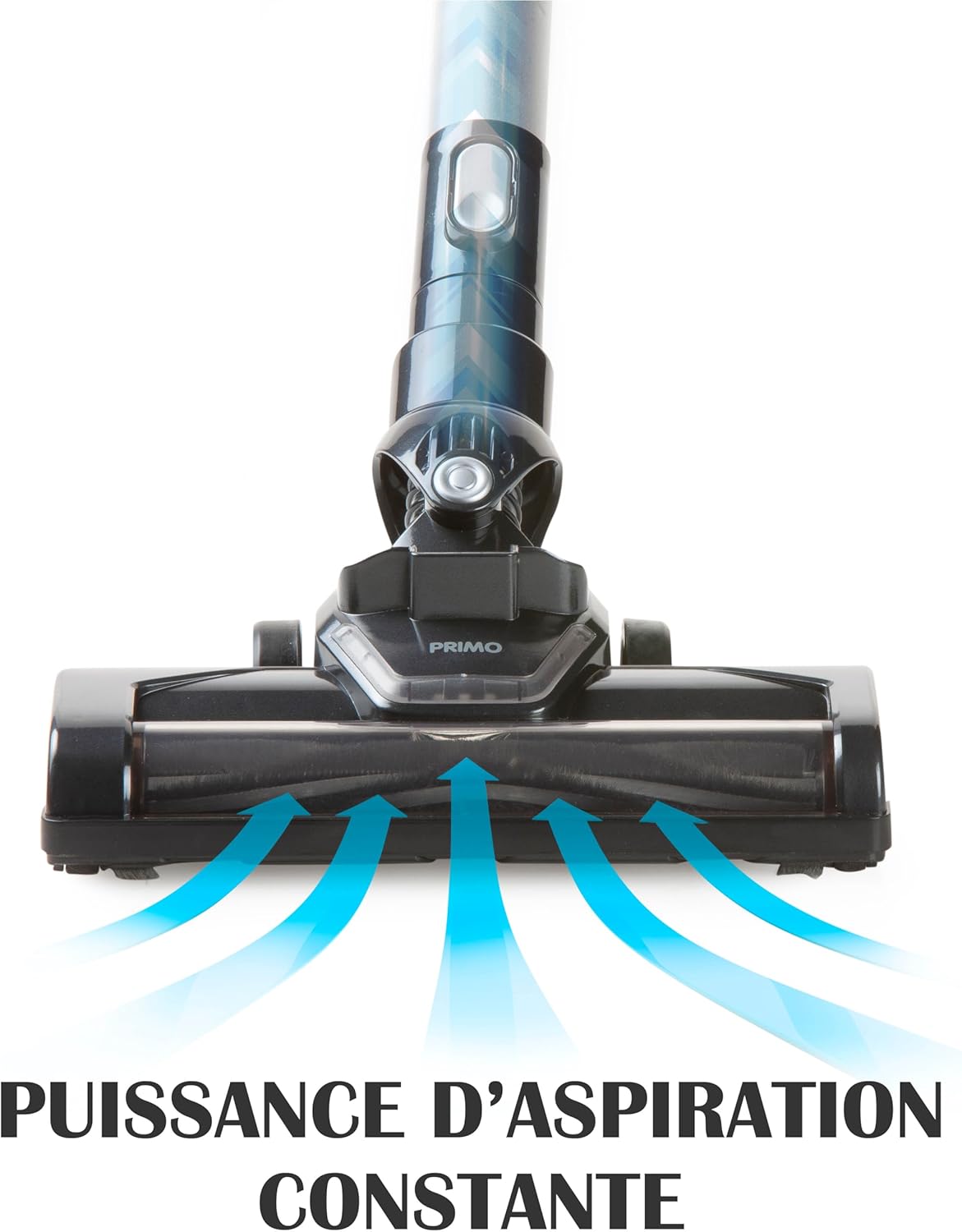
Figure 7.2: Constant Suction Power
This graphic illustrates the consistent and powerful suction generated by the vacuum's floor brush. Blue arrows depict the airflow, demonstrating how dirt and debris are effectively drawn into the vacuum head for thorough cleaning.
7.3. Aratau Korehau Torima
Ideal for cleaning upholstery, car interiors, stairs, and small spills.
- Detach the metallic tube and motorized floor brush from the motor unit.
- Attach the crevice tool for narrow gaps or the dusting brush for surfaces like curtains or keyboards.
- Turn on the vacuum and clean the desired area.

Figure 7.3: Handheld Cleaning on Upholstery
This image shows the PRIMO PR501SV being used as a handheld vacuum to clean a sofa. It highlights the convenience and effectiveness of this mode for cleaning furniture and other elevated surfaces.
8. Tiaki
Ko te tiaki i nga wa katoa ka tino pai te mahi me te whakaroa i te oranga o to kai horoi korehau.
8.1. Emptying the Dust Reservoir
Empty the 0.6 L dust reservoir regularly, especially when it reaches the 'MAX' line.
- Me mohio kua weto te korehau.
- Press the release button on the dust reservoir to detach it from the motor unit.
- Hold the dust reservoir over a trash bin and open the bottom flap to empty the contents.
- Close the flap and reattach the dust reservoir to the motor unit until it clicks securely.

Figure 8.1: Easy Dust Reservoir Emptying
This image illustrates the simple process of detaching the 0.6-liter dust reservoir from the main unit for emptying. The design allows for quick and hygienic disposal of collected debris.
8.2. Te horoi i te Tātari HEPA
The HEPA 13 filter retains 99.95% of dust particles. Clean it regularly to maintain suction power.
- Remove the dust reservoir as described above.
- Carefully remove the HEPA filter from inside the dust reservoir.
- Pato ata te tātari ki runga i te ipu para hei tango i te puehu marara.
- If heavily soiled, rinse the filter under running water. Ensure it is completely dry before reinserting. Do not use detergents or hot water.
- Reinsert the dry HEPA filter into the dust reservoir and reattach the reservoir to the motor unit.
8.3. Cleaning the Motorized Floor Brush
Hair and debris can get tangled in the brush roll, affecting performance.
- Ensure the vacuum is turned off and disconnected from the metallic tube.
- Locate the release mechanism on the side of the motorized brush head.
- Remove the brush roll from the housing.
- Use scissors or a brush to remove any tangled hair or debris from the brush roll.
- Reinsert the clean brush roll and secure it in place.
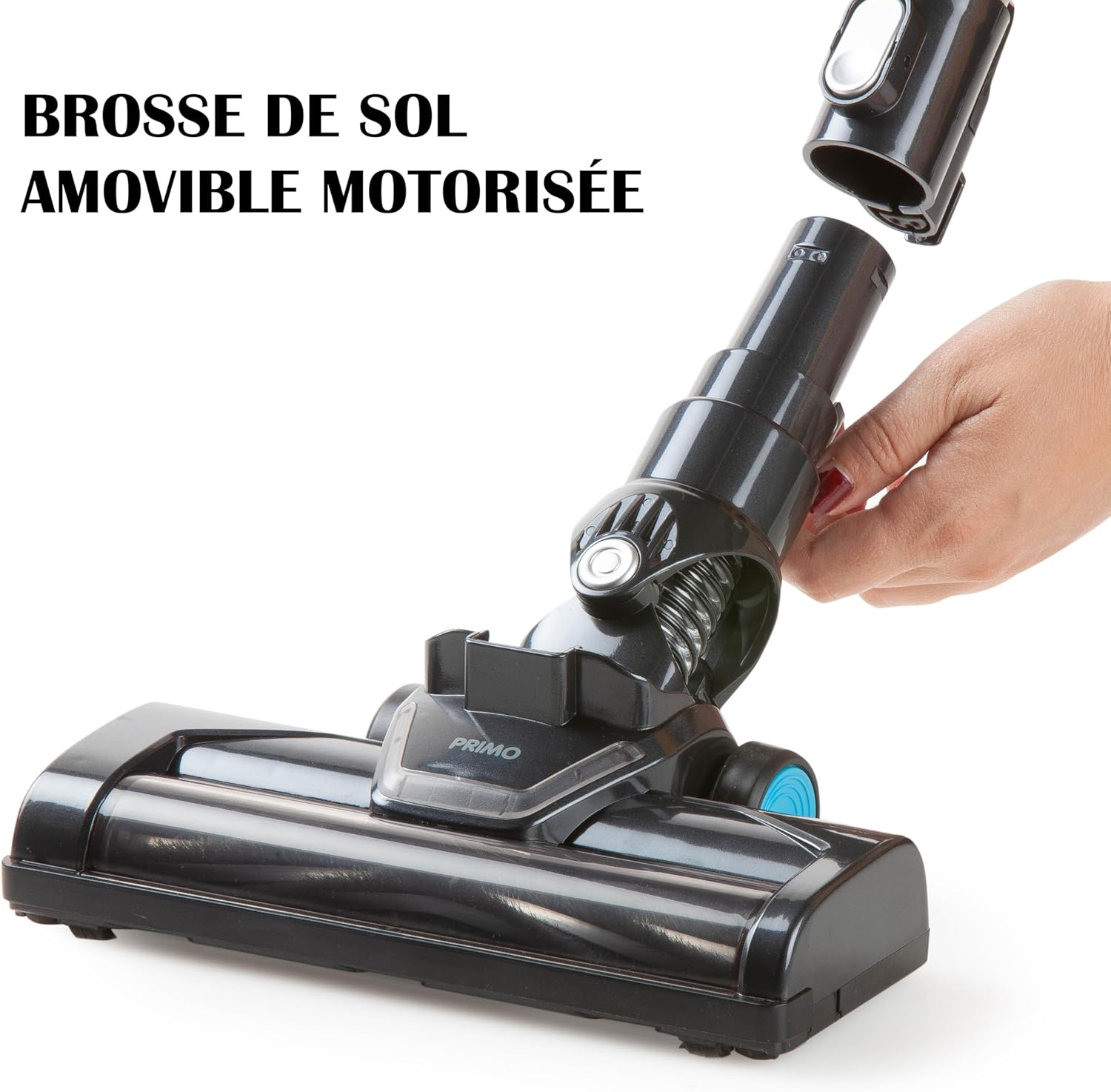
Figure 8.2: Removable Motorized Floor Brush
This image shows the motorized floor brush being detached from the vacuum's main body. This feature allows for easy access to the brush roll for cleaning tangled hair and debris, ensuring consistent performance.
9. Te Raru
If you encounter issues with your PRIMO PR501SV, refer to the following common problems and solutions:
| Raruraru | Take pea | Rongoā |
|---|---|---|
| Karekau e ka ana te korehau | Kua tukuna te pati Kaore i tika te pehi i te paatene hiko | Whakatakina katoatia te pākahiko Patohia te paatene mana |
| Te mana momi iti | Dust reservoir is full Kua purua te tātari Kua rawe te pukapuka paraihe Nozzle/tube is blocked | Empty the dust reservoir Horoia te tātari HEPA Clean the motorized brush roll Check and clear any blockages in the nozzle or tube |
| Motorized brush not rotating | Kua rawe te pukapuka paraihe Connection to main unit is loose | Horoia te roi paraihe Ensure the brush head is securely attached to the tube or motor unit |
| Wā whakahaere pūhiko poto | Kaore i tino utua te puhiko Using MAX power mode continuously Te paheketanga o te pākahiko | Ensure battery is fully charged (4-5 hours) Use ECO mode for longer runtime Contact customer support if battery life significantly decreases over time |
Mena ka mau tonu te raru i muri i te whakamatau i enei otinga, tena koa whakapā atu ki te tautoko a te kaihoko.
10. Whakatakotoranga
| Āhuahira | Whakatakotoranga |
|---|---|
| Tau tauira | PR501SV |
| Waitohu | PRIMO |
| Momo | Korekore 3-i-1 Rakau Korehau Kaihoroi |
| Pūhiko | 18.5V Lithium-ion |
| Waa Whakatau | 4-5 haora |
| Runtime (ECO mode) | Approx. 40 meneti |
| Runtime (MAX power) | Approx. 20 meneti |
| Te kaha o te puna puehu | 0.6 rita |
| Momo Tātari | HEPA 13 |
| Te maha o nga tere | 2 |
| Taumata Haruru | 75 dB |
| Taumaha | 2 Kirokaramu |
| Ahu (L x W x H) | 16 x 23 x 113 cm |
| Mata e taunakitia ana | Nga papa pakeke |
| Nga Waahanga kei roto | Motor unit, metallic tube, motorized floor brush, crevice tool, dusting brush, power adapter, wall mount |
11. Pūtāhui me te Tautoko
For warranty information and customer support, please refer to the warranty card included with your purchase or visit the official PRIMO webpae. Puritia to tohu hoko mo etahi kereme whakamana.


