1. Kupu Whakataki
The E32-900T30D is a wireless serial port module (UART) designed for long-distance communication using LoRa spread spectrum technology. It operates within the 862MHz to 931MHz frequency band and provides TTL output. This module is engineered for robust performance in various IoT applications, offering features such as advanced anti-interference capabilities and ultra-low power consumption modes.
Key characteristics include a maximum transmit power of 30dBm, enabling communication distances up to 8km under ideal conditions, and a data transmission rate ranging from 0.3kbps to 19.2kbps. It supports a wide operating voltage of 3.3V to 5.5V and is built to industrial-grade standards, ensuring reliable operation in temperatures from -40℃ to +85℃.
2. Nga ahuatanga
- Advanced LoRa modulation for extended communication range and enhanced anti-interference.
- Communication distance up to 8km under ideal conditions, surpassing traditional GFSK.
- Supports fixed-point transmission, broadcast transmission, and channel monitoring.
- Incorporates FEC (Forward Error Correction) for improved communication stability.
- Air wake-up functionality for ultra-low power consumption, ideal for battery-powered applications.
- Utilizes an industrial-grade active temperature-compensated crystal oscillator for stability and consistency.
- Maximum transmit power of 30dBm, with multi-level software adjustable power.
- Compatible with 868/915MHz EU general frequency bands.
- Data transmission rates from 0.3kbps to 19.2kbps.
- Mahi voltage range of 3.3V to 5.5V (optimal performance at >3.3V).
- Industrial-grade design for long-term use in harsh environments (-40℃ to +85℃).
- IPEX/stamp hole interface for flexible antenna connection options.
- Features data encryption and compression for secure and efficient data handling.
- Complies with FCC, CE, and CCC design standards, meeting various RF certification requirements.
3. Hua Neke Atuview
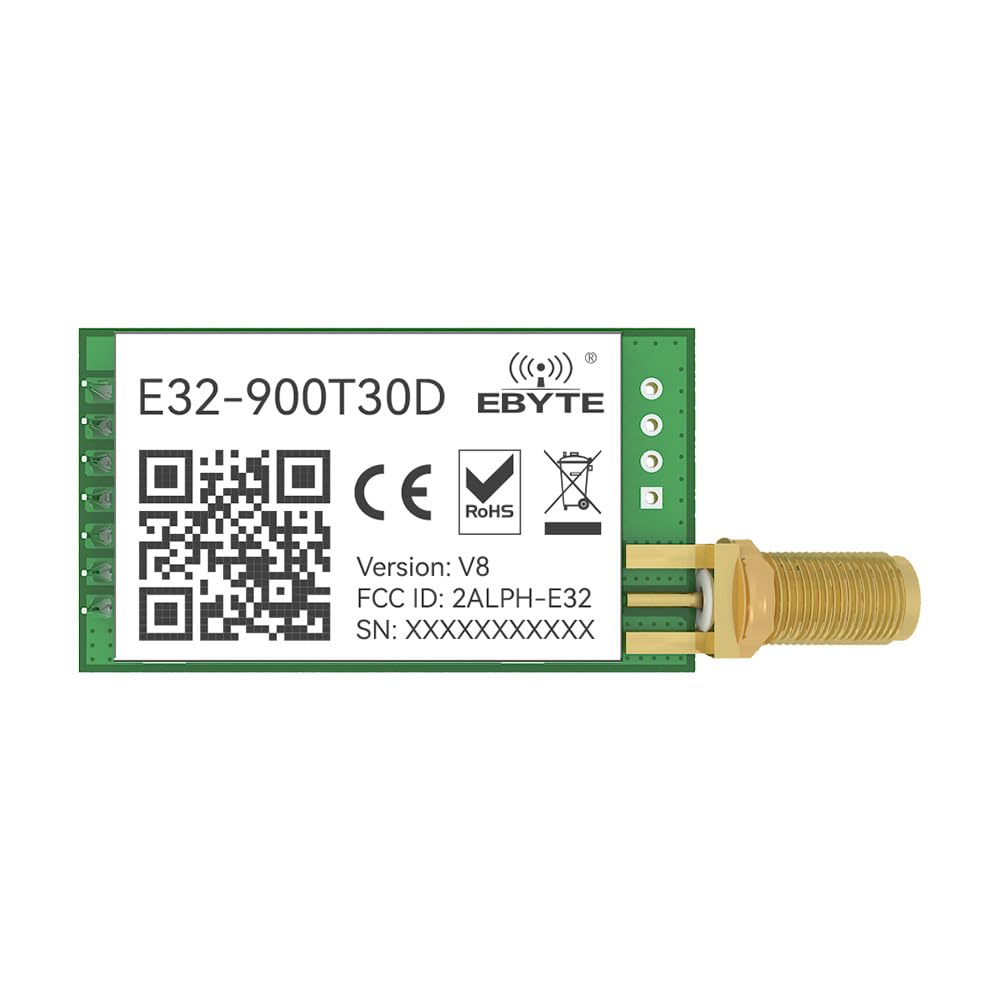
Whakaahua 3.1: Mua view of the E32-900T30D LoRa module, showing the model number, EBYTE branding, CE and RoHS certifications, version V8, FCC ID, and serial number placeholder. The SMA-K antenna connector is visible on the right.
Mo etahi atu korero, haere ki te rangatira webpae: www.cdebyte.com

Whakaahua 3.2: E32-900T30D LoRa module with indicated dimensions: 24mm width and 43mm length. This view highlights the compact size of the module.
Mo etahi atu korero, haere ki te rangatira webpae: www.cdebyte.com
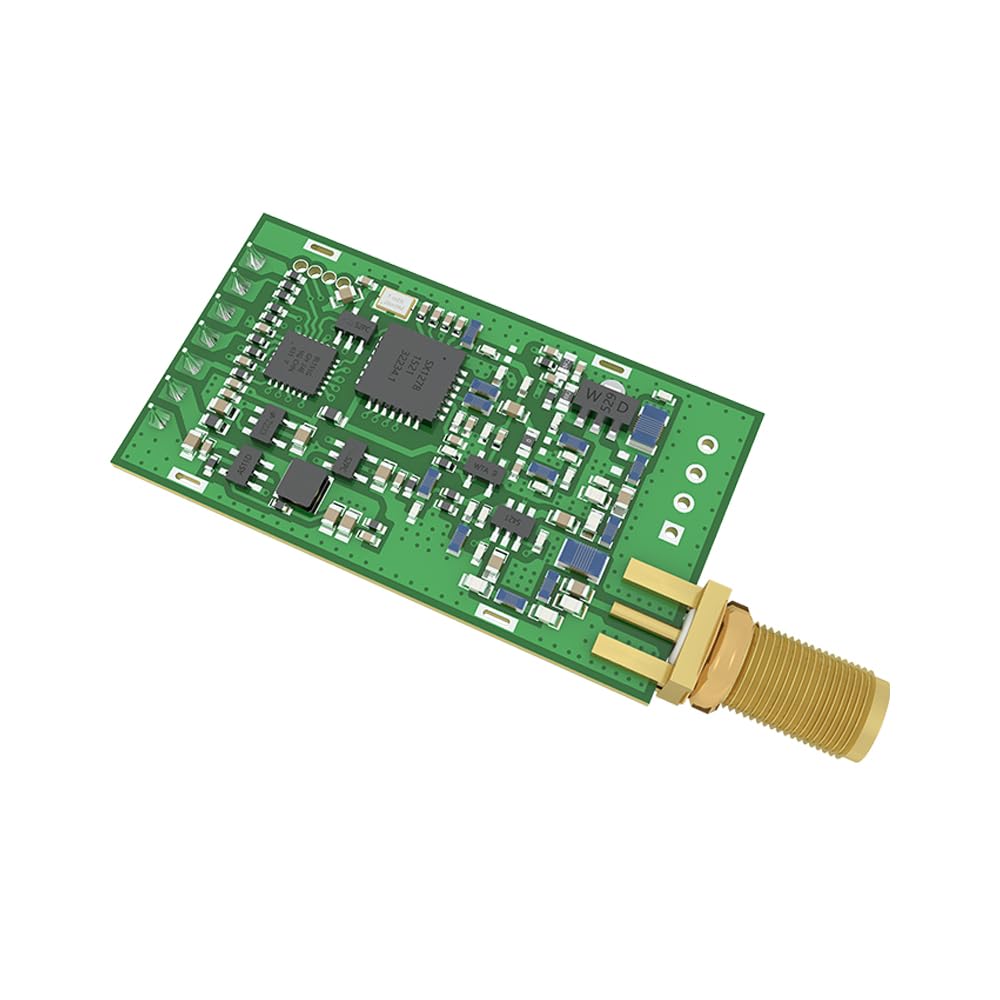
Whakaahua 3.3: Whakamuri view of the E32-900T30D LoRa module, showcasing the printed circuit board (PCB) with various electronic components, including the SX1276 chip, which is central to its LoRa functionality. The SMA-K connector is also visible from this angle.
4. Tatūnga me te Hononga
Hei whakarite i te kōwae E32-900T30D, whai i enei aratohu whanui:
- Tuku Hiko: Connect the module to a stable power supply within the 3.3V to 5.5V range. Ensure the power supply can provide sufficient current for transmission (especially at 30dBm output).
- Hononga Antenna: Attach a compatible 868MHz or 915MHz LoRa antenna to the SMA-K connector. Ensure the antenna is securely fastened. For optimal performance, use an antenna designed for the specific frequency band and application.
- Atanga UART: Connect the module's UART (Universal Asynchronous Receiver-Transmitter) pins (TXD, RXD, GND) to your microcontroller or host device. Ensure the voltage levels are compatible (TTL).
- Whirihoranga: Configure the module's parameters (e.g., operating frequency, air data rate, transmit power, operating mode) using the appropriate software tool or AT commands, as specified in the detailed datasheet.
- Whakapapa: Ensure proper grounding of the module and connected devices to prevent noise and ensure stable operation.
Refer to the official EBYTE datasheet for detailed pinout diagrams and electrical characteristics.
5. Aratau Mahi
The E32-900T30D module supports multiple operating modes to optimize performance and power consumption for different application scenarios:

Whakaahua 5.1: Diagram illustrating the four primary operating modes of the E32-900T30D module: Transmission mode, Wake-up mode, Power saving mode, and Deep sleep mode.
- Aratau Whakawhiti: This is the transparent transmission mode, which is the most commonly used working mode. In this mode, data received via UART is directly transmitted wirelessly.
- Aratau Whakaara: Also known as "wake on air" for the transmitter. In this mode, the transmitter automatically adds a wake-up code before sending data, allowing the receiver to wake up from a low-power state.
- Aratau Tiaki Mana: This is a "wake on air" receiver mode. The module operates in a low-power state, periodically listening for wake-up codes. In this mode, the module cannot transmit data.
- Aratau Moe Hohonu: In this mode, the module enters an ultra-low power state, with an overall power consumption of only 2uA. This mode is suitable for applications requiring minimal power draw when inactive.
6. Whakatakotoranga
| Tawhā | Uara |
|---|---|
| Awhe Auautanga | 862MHz ~ 931MHz |
| Tuku Mana | 30dBm (Max), multi-level adjustable |
| Tawhiti Whakawhitiwhiti | Tae atu ki te 8km (nga tikanga pai) |
| Ahutanga Kōwae | 24mm x 43mm |
| Atanga | UART (TTL) |
| Reiti Raraunga | 0.3kbps ~ 19.2kbps |
| Tukuna Voltage | 3.3V ~ 5.5V |
| Te Waahi Mahi | -40℃ ~ +85℃ |
| Atanga Antenna | SMA-K / Stamp Kohao |
| Whakawaenga | LoRa Spread Spectrum |
| Tauira Tuemi | E32-900T30D |
| Kaihanga | EBYTE |
7. Nga tono
The E32-900T30D module is suitable for a wide range of IoT and wireless communication applications due to its robust features and long-range capabilities. Potential application scenarios include:

Whakaahua 7.1: Visual representation of various application scenarios for the E32-900T30D module, including smart agriculture, wireless remote control, industrial scenes, and smart wearables.
- Ko nga punaha whakaoho mo te kaainga me te urunga kore matua.
- Nga kaainga atamai me nga whatunga puoro ahumahi.
- Nga punaha haumaru whakaoho ahokore.
- Nga otinga aunoatanga hangahanga.
- Nga punaha whakahaere mamao-a-ahumahi ahokore.
- Health care products requiring wireless data transmission.
- Hangahanga Panui Panui Mita Ake (AMI).
- Nga tono ahumahi motika.
- Nga mita taputapu me nga kaupapa whakahou IoT.
8. Te Raru
Mena ka raru koe ki to waahanga E32-900T30D, whakaarohia nga mahi rapurongoā e whai ake nei:
- Karekau he Whakawhitiwhiti:
- Manatokohia vol supply hikotage me te pumau.
- Check UART connections (TXD to RXD, RXD to TXD, GND to GND) and baud rate settings.
- Ensure the module is in the correct operating mode for communication (e.g., Transmission Mode).
- Confirm antenna is properly connected and suitable for the frequency band.
- Poor Range/Signal:
- Check antenna type and placement. Obstructions (walls, metal) significantly reduce range.
- Ensure transmit power is set to the desired level (30dBm for maximum range).
- Verify frequency channel settings match between modules.
- Whakaitihia te pokanoa mai i etahi atu taputapu ahokore.
- Kōwae Kāore i te Whakautu:
- Cycle power to the module.
- Check for short circuits or incorrect wiring.
- Ensure the module is not in Deep Sleep mode if you expect it to respond.
- Te pirau Raraunga:
- Verify matching air data rates and UART baud rates on both ends.
- Check for excessive noise on the power supply or data lines.
- Ensure FEC (Forward Error Correction) is enabled if communication stability is critical.
For persistent issues, consult the detailed product datasheet or contact EBYTE technical support.
9. Pūtāhui me te Tautoko
EBYTE products are designed for reliability and performance. For specific warranty information, please refer to the terms and conditions provided at the time of purchase or visit the official EBYTE website. General support and technical documentation can be found on the manufacturer's webpae.
Whaimana Webpae: www.cdebyte.com
For technical assistance, product inquiries, or to report issues, please contact EBYTE customer support through the channels provided on their official webpae.


