Kupu Whakataki
This manual provides detailed instructions for the installation, operation, and maintenance of your VIMAR 02971.B Smart Thermostat. Please read this manual thoroughly before using the device to ensure proper function and safety.
Ka mutu te huaview
The VIMAR 02971.B is a smart thermostat designed for ambient temperature control in both heating and air conditioning systems. It features a rotary wheel for intuitive control, supports 2-pipe and 4-pipe installations, and includes fan-coil control with 3 speeds and proportional settings. This device offers advanced temperature control capabilities and can be integrated into a home automation system.
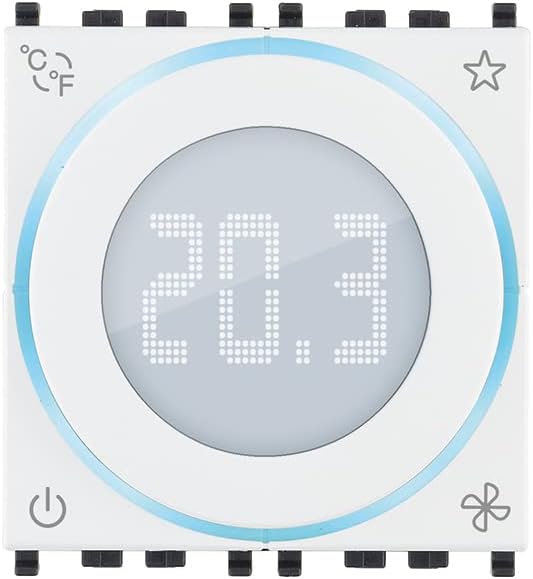
Whakaahua 1: Mua view of the VIMAR 02971.B Smart Thermostat. The central display shows the current temperature, and the rotary wheel allows for adjustments. Icons indicate various functions.
Whakatakotoranga
| Āhuahira | Taipitopito |
|---|---|
| Tau tauira | 02971.B |
| Waitohu | VIMAR |
| Tae | Mā |
| Hononga | Waea |
| Nga waahanga motuhake | Advanced Temperature Control |
| Momo Kaiwhakahaere | Mechanical Knob, Button |
| Whakamahinga Tauwhāiti | Whakamahana, Āhuarangi |
| Momo Mana Pawera | ā-ringa |
| Puna Mana | Pūhiko Powered |
| Voltage | 230 Volts |
| Hototahi | Requires Eikon, Arké, Plana plates and dedicated support 16723 for Idea installation. |
| Temperature Control Class (ON/OFF) | Class I (1% contribution) |
| Temperature Control Class (PID) | Class IV (2% contribution) |
| Modulating Thermostat Class | Class V (3% contribution) with analog actuator 01466.1 |
| Whakauru Whakauru | 1 input for electronic temperature sensor (20432, 19432, or 14432) or wired temperature sensor (02965.1) |
| Whakamuri | Maama LED |
| Kōwae | 2 kōwae |
Tatūnga me te Tāuta
Whakatupato Haumaru
- Ensure power is disconnected before beginning any installation or wiring.
- Ko te whakaurunga me mahi e tetahi tohunga hiko i runga i nga tikanga hiko o te rohe.
- Kaua e tukuna te taputapu ki te makuku, ki te wera nui ranei.
Whakaeke
- The thermostat is designed for installation with dedicated support 16723 (for Idea series) and requires Eikon, Arké, or Plana plates for completion.
- Choose a central location on an interior wall, away from direct sunlight, drafts, and heat sources, to ensure accurate temperature readings.
- Mount the dedicated support (e.g., 16723) securely to the wall.
Waea waea
The VIMAR 02971.B is a wired thermostat. Refer to the wiring diagram provided with your HVAC system and the specific instructions for the 02971.B model. Ensure all connections are secure and correctly terminated.
- Connect the power supply (230 Volts).
- Connect to the HVAC system for heating and cooling control.
- If using an external temperature sensor (e.g., 20432, 19432, 14432, or 02965.1), connect it to the designated input.
- For modulating control (Class V), interface with analog actuator 01466.1.
Mahi
Te Hia/Weto
Pehia te Mana icon (bottom-left) to turn the thermostat on or off. The display will illuminate when the device is active.
Figure 2: Location of the Power icon on the thermostat.
Te Whakatikatika i te Mahana
Rotate the central wheel to adjust the desired temperature. The digital display will show the set temperature as you turn the wheel.
Ngā Wāhanga Pāmahana Hurihuri (°C/°F)
Pehia te ° C / ° F. icon (top-left) to toggle between Celsius and Fahrenheit temperature display units.
Figure 3: Location of the °C/°F unit selection icon.
Mana Mana
The thermostat supports 3-speed fan-coil control. Press the Kaiwhaiwhai icon (bottom-right) to cycle through fan speeds or modes (e.g., Auto, Low, Medium, High). Refer to your system's specific configuration for available fan modes.
Figure 4: Location of the Fan control icon.
Favorite/Program Mode
Ko te Whetu icon (top-right) may be used to access favorite settings or activate a pre-programmed mode. Consult your home automation system's documentation for specific functionality related to this icon.
Figure 5: Location of the Star icon, typically for favorite or program modes.
Te tiaki
Te horoi
- Wipe the thermostat's surface with a soft, dry cloth.
- Do not use abrasive cleaners, solvents, or chemical sprays, as these can damage the device.
Whakakapinga Pūhiko
As the device is battery-powered, replace batteries when the low battery indicator appears on the display (if applicable) or when the device ceases to function. Refer to the installation guide for specific battery type and replacement procedure.
Raparongoā
| Raruraru | Take pea | Rongoā |
|---|---|---|
| Ko te whakaaturanga Thermostat he watea. | Kāore he hiko, kāore hoki he pākahiko kua mate. | Check power supply (230V). Replace batteries if applicable. Ensure the device is switched on. |
| Kāore te pūnaha HVAC e aro mai. | Incorrect wiring, system fault, or thermostat not in correct mode. | Verify wiring connections. Check HVAC system for error codes. Ensure thermostat is set to heating or cooling mode and desired temperature is appropriate. |
| Te panui pāmahana hē. | Thermostat location, external sensor issue. | Ensure thermostat is not exposed to direct sunlight, drafts, or heat sources. Check external sensor connection if used. |
| Fan not operating correctly. | Incorrect fan setting or wiring issue. | Cycle through fan modes using the fan icon. Verify fan-coil wiring. |
Pūtāhui me te Tautoko
For warranty information and technical support, please refer to the documentation provided with your purchase or visit the official VIMAR webpae. Puritia to tohu hoko mo nga kereme whakamana.
Spare parts availability information is not available at this time. Software updates are not guaranteed.


