1. Kupu Whakataki
The EBYTE E22-230T22D is a new generation LoRa wireless module designed for robust and long-range communication. It functions as a wireless serial port module (UART) utilizing an RF chip, offering multiple transmission modes.
This module operates within the 220.125~236.125MHz frequency band (default 230.125MHz) and employs LoRa spread spectrum technology for enhanced performance. It provides TTL level output and is compatible with both 3.3V and 5V IO port voltages.

An image showing the EBYTE E22-230T22D LoRa wireless module, a green circuit board with an integrated SMA-K RF interface connector on the right side. The module is labeled 'E22 230T22D EBYTE' and includes a QR code. For more information, visit the official webpae: http://www.cdebyte.com/
2. Nga waahanga matua
- Hangarau Whānuitanga Horahanga LoRa: Ensures stable communication and anti-interference capabilities.
- Automatic Relay Networking: Supports multi-level relay for ultra-long-distance communication, allowing multiple networks to operate simultaneously in the same area.
- Over-the-Air Wake-up (WOR): Enables ultra-low power consumption, ideal for battery-powered applications.
- Multiple Transmission Modes: Adaptable for various communication needs.
- TTL Level Output: Compatible with 3.3V and 5V IO port voltages.
- Ngā Mahi Whaihua: Includes fixed-point transmission, broadcast monitoring, forward error correction (FEC), watchdog, deep dormancy, Wake On Radio, parameter save, and variable packet length.

A diagram titled 'E22 has more practical functions' showing icons and labels for Fixed-point transmission, Broadcast monitoring, Forward error correction, Watchdog, Deep dormancy, Wake On Radio, Parameter save, and Variable packet length.
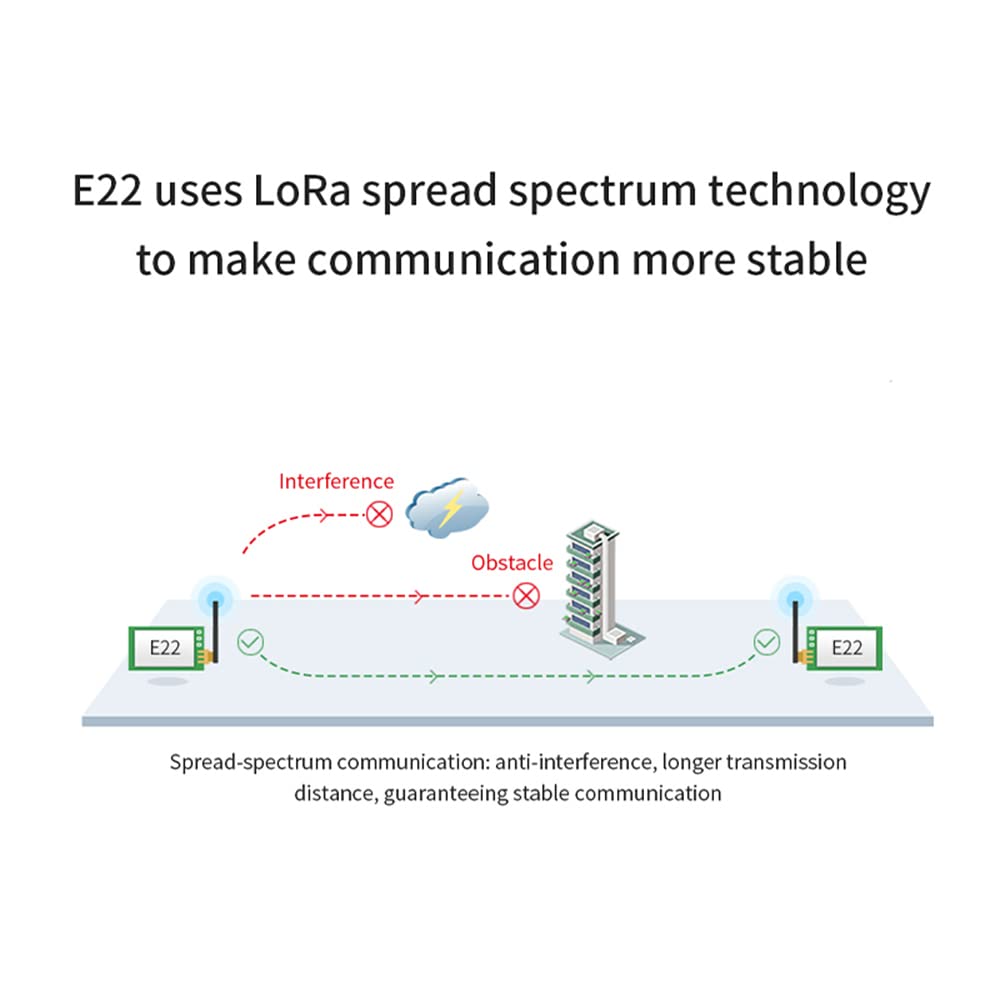
A diagram showing two E22 modules communicating, with lines indicating signal paths. It highlights how LoRa spread spectrum technology helps overcome interference and obstacles for stable, long-distance communication.
3. Whakatakotoranga Hangarau
| Tawhā | Uara |
|---|---|
| Tauira | E22-230T22D |
| Auautanga | 220.125~236.125MHz (Default: 230.125MHz) |
| Mana | 22 dBm |
| Tawhiti | Tae atu ki te 5km |
| Atanga | SMA-K RF Interface |
| Taumata Putanga | TTL |
| IO Voltage Hototahi | 3.3V me te 5V |
| Ahu | 36mm x 21mm |

An image of the EBYTE E22-230T22D module with dimensions indicated: 36mm in length and 21mm in width. For more information, visit the official webpae: http://www.cdebyte.com/
4. Aratohu Tatūnga
This section provides general guidance for setting up your E22-230T22D module. For detailed pinout and connection diagrams, please refer to the official product datasheet available on the manufacturer's webpae.
4.1 Hononga Taketake
Connect the module to your microcontroller or development board using the UART interface. Ensure correct voltage levels (3.3V or 5V) for the IO pins.
4.2 Hononga Antenna
Attach a compatible 230MHz antenna to the SMA-K RF interface. Ensure the antenna is securely fastened for optimal performance.
4.3 Tuku Hiko
Provide a stable power supply within the module's specified voltage range. Refer to the datasheet for exact power requirements.
5. Nga Tohutohu Whakahaere
The E22-230T22D module operates via AT commands or through a dedicated configuration tool, depending on the firmware version.
5.1 Whakawhiti Raraunga
Once configured, data can be sent and received through the UART interface. The module handles the LoRa modulation and demodulation automatically.
5.2 Kōwhiringa Aratau
The module supports various operating modes, including transparent transmission, fixed-point transmission, and broadcast. Select the appropriate mode based on your application requirements.
5.3 Wake On Radio (WOR)
To utilize the ultra-low power Wake On Radio feature, configure the module accordingly. This allows the module to enter a deep sleep state and wake up upon receiving a specific signal.
6. Tiaki
- Puritia te kōwae kia ma, kia kore he puehu, he makuku rānei.
- A ape i te tuku i te kōwae ki te tino mahana, te ra tika ranei.
- Ensure proper ventilation if the module is enclosed.
- Regularly check antenna connections for secure fit.
7. Te Raru
7.1 No Communication
- Manatokohia vol supply hikotage me nga hononga.
- Check UART wiring (TX/RX cross-connection).
- Confirm baud rate and other serial port settings match the module's configuration.
- Ensure the module is in the correct operating mode.
7.2 Poor Range/Signal
- Check antenna type and connection. Ensure it is suitable for 230MHz.
- Verify line-of-sight between modules. Obstacles can significantly reduce range.
- Check for local interference sources.
- Ensure transmit power settings are appropriate.
8. Tauira Taupānga
The E22-230T22D module is versatile and suitable for a wide range of applications, including:
- Home security alarms and remote keyless entry systems.
- Nga kaainga atamai me nga whatunga puoro ahumahi.
- Nga punaha haumaru whakaoho ahokore.
- Nga otinga aunoatanga hangahanga.
- Wireless industrial-grade remote controls.
- Hua hauora.
- Hangahanga Panui Panui Mita Ake (AMI).
- Nga tono ahumahi motika.

A collage of four images depicting various application scenarios: industrial manufacturing with machinery, a smart home thermostat, a smart farm with a drone spraying crops, and a hotel room door lock, illustrating the module's diverse uses.
9. Nga korero a te Kaihanga
Kaihanga: Chengdu Ebyte Electronic Technology Co., Ltd.
Address: 2F, Building B2, No. 199, West District Avenue, High-tech Zone, Sichuan Cheng Du, China.

A label from the product packaging showing manufacturer details for Chengdu Ebyte Electronic Technology Co., Ltd. in China, and EU REP information for evalMaster Consulting GmbH in Germany.
10. Pūtāhui me te Tautoko
For warranty information and technical support, please refer to the official EBYTE webte paetukutuku, whakapā atu ranei ki to kaitoha o to rohe.
Whaimana Webpae: http://www.cdebyte.com/


