1. Kupu Whakataki
The Klein Tools MM720 is an automatically ranging True Root Mean Squared (TRMS) digital multimeter designed for precise electrical measurements. This device measures AC/DC voltage, AC/DC current, and resistance. Additionally, it offers functions for measuring temperature, capacitance, frequency, duty-cycle, diodes, and continuity. Its high-visibility, reverse-contrast LCD display features an optical sensor that automatically adjusts for optimal viewability in various lighting conditions.
This manual provides essential information for the safe and effective use of your MM720 Digital Multimeter. Please read it thoroughly before operation and retain it for future reference.
2. Nga korero haumaru
Always adhere to safety precautions when using electrical test equipment to prevent injury or damage to the meter. Observe all local and national safety codes.
- Haumaru Voltage: Kia tupato ki nga puia kinotages. Contact with live circuits can result in severe injury or death.
- Taputapu Tiaki Whaiaro: Always wear approved eye protection and other personal protective equipment (PPE) when working near live electrical circuits.
- Insulated Test Leads: Use only insulated test leads with finger guards. Ensure they are in good condition, free from cracks or damage.
- Whakatauranga CAT: This meter is rated CAT IV 600V and CAT III 1000V. Do not exceed these voltage limits. CAT IV is for measurements at the source of the low-voltage installation, such as electricity meters and primary overcurrent protection devices. CAT III is for measurements in building installations, such as distribution boards, circuit breakers, wiring, and cables.
- Parenga Puka: The current measurement inputs are fuse protected. Never attempt to measure current on circuits exceeding the specified fuse rating.
- Tirotiro i mua i te whakamahi: Before each use, inspect the meter and test leads for any signs of damage. Do not use if damaged.
- Proper Function Selection: Ensure the function selector switch is in the correct position for the measurement being performed.
- Whakakapinga Pūhiko: Whakakapia tonutia ngā pākahiko ina puta mai te tohu pākahiko iti hei whakarite kia tika ngā pānui.
- Nga Tikanga Taiao: Do not operate the meter in wet conditions or in environments with explosive gas or dust.
3. Ihirangi mokete
Your Klein Tools MM720 Digital Multimeter package includes the following items:
- MM720 Digital Multimeter
- Te Kawe i te Keehi
- Test Leads with CAT III/CAT IV Safety Caps
- Thermocouple Probe
- Pukapuka Tohutohu
- 2 x AAA Pūhiko

The image above displays the red and black test leads, which are essential for making electrical measurements. These leads come with safety caps to ensure secure connections and user protection during operation.

The image above shows the thermocouple probe, which is used for measuring temperature. It connects to the multimeter to provide accurate temperature readings.
4. Nga waahanga hua me nga waahanga
The MM720 Digital Multimeter is designed with user-friendly features and robust construction.

This image presents the front view of the Klein Tools MM720 Digital Multimeter, showcasing its display, function buttons, rotary switch, and input jacks.

The image above highlights key components: the high-visibility, reverse-contrast LCD display, an optical sensor for automatic viewability optimization, auto-ranging capability with a manual option, and the central function selector switch for various measurements.

This image shows the rear of the multimeter, featuring a built-in kickstand for hands-free operation, integrated test lead storage, and a mount for an optional magnetic hanger (Cat. Nos. 69445 or 69417, sold separately).
Āhuatanga matua:
- Taumahinga Waahi: Ine AC/DC voltage up to 1000V, 10A AC/DC current, and 60MΩ resistance. Includes continuity, temperature, capacitance, frequency/duty cycle, diode test, and low impedance (LoZ).
- Low Impedance (LoZ) Mode: Specifically designed to identify and eliminate ghost or stray voltages, providing more accurate readings.
- Whakaaturanga Whakamuri-Whakarerekētanga: Features a large, high-visibility reverse-contrast LCD for improved readability in all lighting conditions.
- Ine tika: Utilizes auto-ranging and True Root Mean Squared (TRMS) technology for precise and accurate measurements of non-sinusoidal waveforms.
- Hoahoa Watea: Includes test lead holders on the back, a kickstand, and compatibility with optional magnetic hangers for hands-free operation.
- Hanga Roa: Rated CAT IV 600V and IP42, built to withstand a 6.6-foot (2 m) drop, making it suitable for demanding professional environments.
5. Tatūnga
5.1 Tāuta Pūhiko
- Ensure the multimeter is powered OFF.
- Kimihia te uhi o te wahanga pākahiko kei muri o te mita.
- Wetekina te tīwiri pupuri, ka tangohia te taupoki.
- Insert the two AAA batteries, observing correct polarity (+/-).
- Whakakapia te taupoki o te wāhanga pākahiko ka whakau ki te/ngā tīwiri.
5.2 Te hono i nga kaiarahi Whakamātautau
- Whakauruhia te taura whakamātautau pango ki te hononga tāuru noa (COM).
- Mo te voltage, resistance, continuity, diode, capacitance, frequency, duty cycle, and temperature measurements, insert the red test lead into the VΩHzCAPTemp input jack.
- For current measurements (up to 10A), insert the red test lead into the 10A input jack.
- Mō te mirionaampere (mA) moroiti rāneiampere (µA) current measurements, insert the red test lead into the mAµA input jack.
Always ensure test leads are fully inserted and securely connected before taking any measurements.
6. Nga Tohutohu Whakahaere
The MM720 features a rotary switch for function selection and several buttons for additional controls.
6.1 Hiko / Whakaweto
Rotate the function selector switch from the OFF position to any measurement function to power on the meter. To power off, rotate the switch back to the OFF position.
6.2 Pihi Mahi
- RANGE: Manually selects the measurement range instead of auto-ranging. Press repeatedly to cycle through available ranges. Hold to return to auto-ranging.
- REL Δ (Relative): Measures the difference between a stored reference value and the current measurement.
- TE MŌRA ITI: Captures and displays the maximum and minimum values during a measurement session.
- Tohu: Ka whakatio i te pānui whakaaturanga o nāianei. Pēhia anō hei tuku.
- SEL (Select): Ka huri i waenga i ngā mahi rerekē i roto i te tūranga pana hurihuri kotahi (hei tauira, te hiko AC/DCtage, continuity/diode).
- Backlight Button (Lightbulb icon): Whakahohe, wetewete ranei te rama whakamuri whakaatu.
6.3 Nga Mahi Ine
Follow these general steps for most measurements:
- Tīpakohia te mahi e hiahiatia ana ma te whakamahi i te huri hurihuri.
- Connect the test leads to the appropriate input jacks.
- Honoa ngā probe whakamātautau ki te ara iahiko, ki te wāhanga rānei e whakamatautauria ana.
- Pānuihia te inenga i runga i te whakaaturanga.
6.3.1 Rererangitage Inenga (AC/DC)
- Rotate the switch to V~ (AC Voltage) rānei V- (DC Voltage). Use the SEL button to toggle if both are on one position.
- Connect the red lead to VΩHzCAPTemp and the black lead to COM.
- Apply probes across the circuit points where voltage me ine.
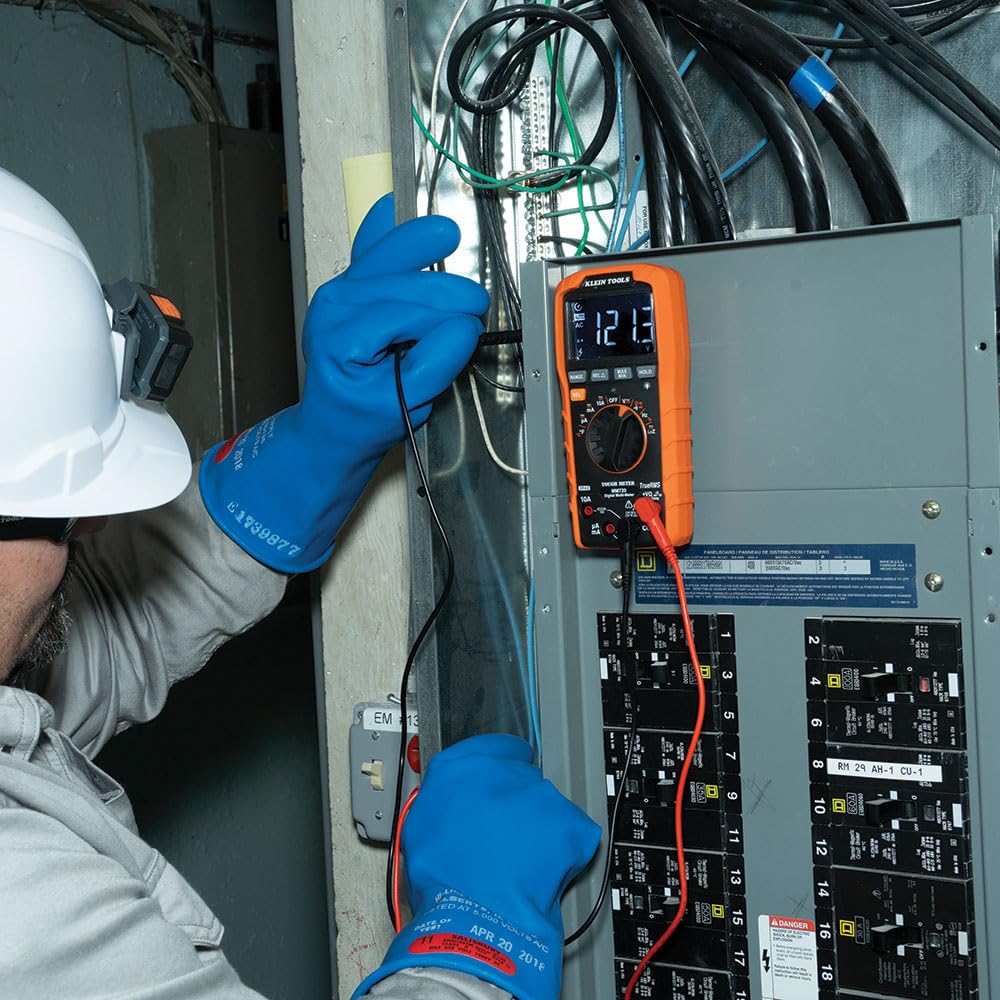
The image above illustrates an electrician using the MM720 to measure voltage within an electrical panel, demonstrating proper probe placement.
6.3.2 Inenga o naianei (AC/DC)
- Rotate the switch to 10A~ (AC Current), 10A- (DC Current), mA~ (AC mA), mA- (DC mA), µA~ (AC µA), or µA- (DC µA). Use the SEL button to toggle if needed.
- Connect the red lead to the appropriate current input (10A or mAµA) and the black lead to COM.
- Hiranga: Connect the meter in series with the circuit to measure current. Never connect in parallel across a voltage source when in current mode.

The image above shows an electrician measuring current in an electrical panel, highlighting the series connection required for accurate current readings.
6.3.3 Ine Atete
- Rotate the switch to Ω.
- Connect the red lead to VΩHzCAPTemp and the black lead to COM.
- Me mohio kua whakakorehia te hiko, te waahanga ranei i mua i te ine i te parenga.
- Apply probes across the component.
6.3.4 Whakamātautau Tonu
- Rotate the switch to the continuity/diode position (often indicated by a speaker icon). Press SEL if needed to select continuity.
- Connect the red lead to VΩHzCAPTemp and the black lead to COM.
- Apply probes across the circuit or component. A continuous beep indicates continuity.
6.3.5 Whakatautau Diode
- Rotate the switch to the continuity/diode position. Press SEL to select diode test (often indicated by a diode symbol).
- Connect the red lead to VΩHzCAPTemp and the black lead to COM.
- Apply probes across the diode. The display will show the forward voltagtaka. Hurihia ngā taura hei tirotiro mēnā he ara iahiko tuwhera.
6.3.6 Inenga Raukaha
- Rotate the switch to the capacitance position (often indicated by a capacitor symbol).
- Connect the red lead to VΩHzCAPTemp and the black lead to COM.
- Me whakarite kua tino tukuna te hiko o te pūnga i mua i te whakamātautau.
- Apply probes across the capacitor terminals.
6.3.7 Frequency/Duty Cycle Measurement
- Rotate the switch to the Hz/% position.
- Connect the red lead to VΩHzCAPTemp and the black lead to COM.
- Apply probes to the signal source. Press SEL to toggle between frequency (Hz) and duty cycle (%).
6.3.8 Te Ineina o te Hahana
- Rotate the switch to the °F/°C position.
- Connect the thermocouple probe to the VΩHzCAPTemp and COM input jacks, observing polarity.
- Place the tip of the thermocouple on the object or area where temperature is to be measured. Press SEL to toggle between Fahrenheit and Celsius.
6.3.9 Low Impedance (LoZ) Mode
- Rotate the switch to the LoZ position.
- Connect the red lead to VΩHzCAPTemp and the black lead to COM.
- This mode applies a low impedance load across the circuit to drain ghost voltages, providing a more accurate reading of actual voltage.
7. Tiaki
7.1 Te horoi
Ensure the meter is turned off and disconnected from all circuits. Wipe the meter with a clean, dry, lint-free cloth. Do not use abrasive cleaners or solvents.
7.2 Whakakapinga Pūhiko
When the low battery indicator appears on the display, replace the batteries as described in Section 5.1. Failure to do so may result in inaccurate readings.
7.3 Whakakapinga Puka
If the current measurement functions cease to operate, the internal fuses may need replacement. Refer to the full user manual for detailed instructions on fuse replacement. This procedure typically requires opening the meter casing and should only be performed by qualified personnel.
7.4 Rokiroki
When not in use for extended periods, remove the batteries to prevent leakage. Store the meter and its accessories in the provided carrying case in a cool, dry environment, away from direct sunlight and extreme temperatures.
8. Te Raru
If the meter is not functioning correctly, review ngā take noa e whai ake nei:
- Kore Whakaatu: Check if the batteries are correctly installed and have sufficient charge. Replace if necessary. Ensure the rotary switch is not in the OFF position.
- Nga Panui Heke: Verify that the correct function is selected for the measurement. Check test lead connections and ensure they are not damaged. Replace batteries if the low battery indicator is on.
- Kāore te Ine o Nāianei e Mahi Ana: Check the internal fuses. If blown, they need to be replaced (refer to Section 7.3). Ensure test leads are connected to the correct current input jacks.
- "OL" (Overload) Display: This indicates that the input value exceeds the selected range or the meter's maximum capability. Select a higher range if available, or ensure the measurement is within the meter's specifications.
For persistent issues, contact Klein Tools customer support.
9. Whakatakotoranga
Below are the technical specifications for the Klein Tools MM720 Digital Multimeter.
| Whakatakotoranga | Uara |
|---|---|
| Tau tauira | MM720 |
| AC / DC Voltage | Tae atu ki te 1000V |
| AC / DC Naianei | Tae atu ki te 10A |
| Ātete | Tae atu ki te 60 MΩ |
| Awhe Pawera | -40°F ki te 1832°F (-40°C ki te 1000°C) |
| Te kaha | Ae |
| Huringa Huringa / Mahi | Ae |
| Whakamatau Diode | Ae |
| Tonu | Ae |
| Low Impedance (LoZ) | Ae |
| RMS pono | Ae |
| Awhe-aunoa | Ae |
| Whakaatu | High visibility, reverse contrast LCD |
| Whakatauranga Haumaru | CAT IV 600V, CAT III 1000V |
| Whakatauranga Whakamarutanga (IP). | IP42 |
| Whakataka Parenga | 6.6-Foot (2 m) |
| Puna Mana | 2 x AAA Pūhiko |
| Hunga Hua | 10.63 x 5.87 x 3.73 inihi |
| Taumaha Tūemi | 12.17 hekere (345 Karamu) |

The image above provides a comparison table detailing the features of the MM720 alongside other Klein Tools multimeter models, allowing for a quick overview of its capabilities relative to similar products.
10. Pūtāhui me te Tautoko
Klein Tools products are manufactured to high standards of quality and durability. For specific warranty information, please refer to the warranty card included with your product or visit the official Klein Tools webpae.
For technical support, service, or replacement parts, please contact Klein Tools customer service. You can find more information and contact details by visiting the Klein Tools Store.


