1. Kupu Whakataki
This user manual provides detailed instructions for the Waveshare 0.96inch OLED Module. This module features an embedded SSD1315 driver chip and supports both SPI and I2C communication protocols. It is designed for integration with various development boards, including Raspberry Pi, Arduino, and STM32.
The 0.96inch OLED Module is a compact display solution with a resolution of 128 × 64 pixels, offering clear visual output for your projects.
2. Nga Hua o te Hua
- 0.96inch OLED Display Module with embedded SSD1315 Driver Chip.
- Resolution: 128 × 64 Pixels.
- Communication Interfaces: 4-wire SPI / I2C.
- Ultra-narrow bezel and compact size.
- I runga o te voltage translator for versatile compatibility.
- Display Color: Upper yellow & lower blue (two-color display).
- Comes with online development resources and examples for Raspberry Pi, Arduino, and STM32.
3. Ihirangi Mōkī
- 0.96inch OLED Module x1
- Jumper cable female-female 7PIN x1

Image: The 0.96inch OLED Module shown with the included 7-pin female-female jumper cable.
4. Whakatakotoranga
| Tawhā | Uara |
|---|---|
| Mahinga Mahi Voltage | 3.3V/5V (IO high-level voltage is as same as the power supply.) |
| Atanga Whakawhitiwhiti | 4-wire SPI / I2C |
| Momo Mata | OLED |
| Mana Tipi | SSD1315 |
| Whakatau | 128 × 64 Pika |
| Ahu Whakahuahua | 26.0mm × 26.0mm |
| Rahi Whakaatu | 21.74mm × 11.18mm |
| Nga Tae Whakaatu | Blue/White/Blue and Yellow (1/4 yellow on the top) |
| Te Waahi Mahi | -20°C ~ 70°C |
| Paemahana Rokiroki | -30°C ~ 80°C |
| Viewing Koki | > 160° |
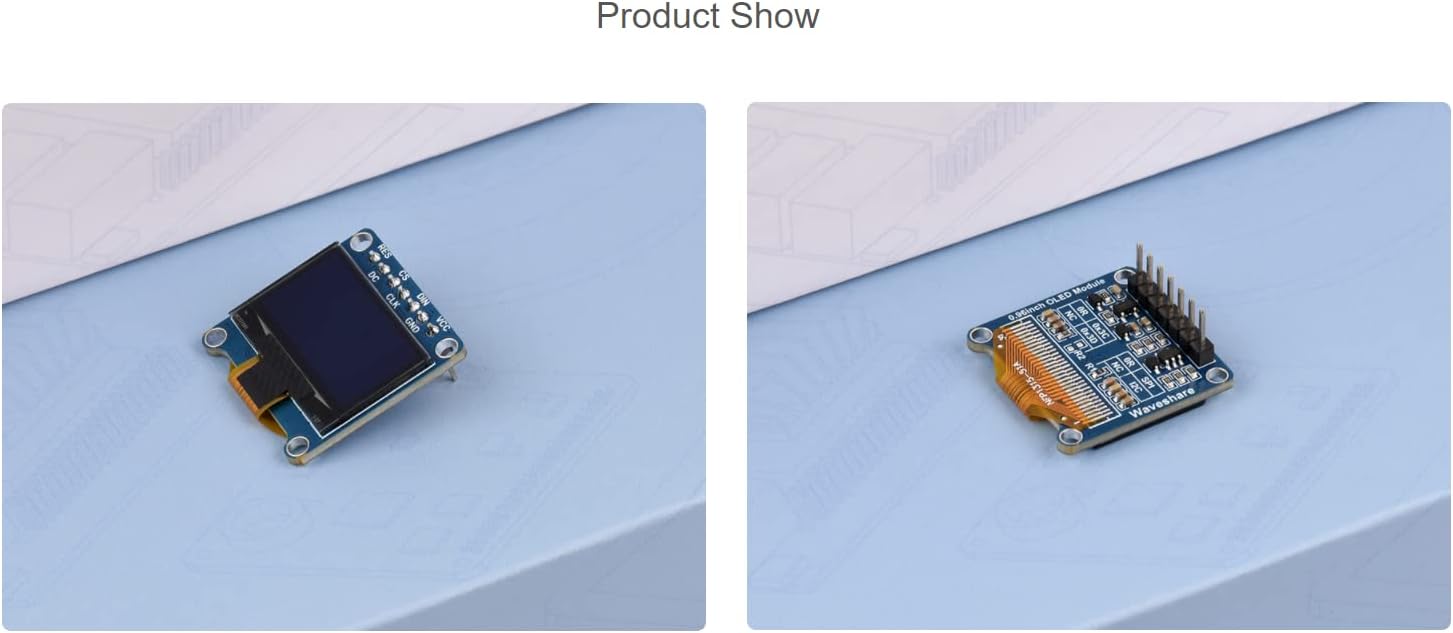
Image: Diagram showing the physical dimensions of the OLED module and a summary of its key specifications.
5. Control Interface Pinout
The OLED module features the following control pins:
- RES: Reset pin, active low.
- DC: Data/Command selection pin (high for data, low for command).
- CS: Chip selection pin, active low.
- CLK: Clock input pin for communication.
- DIN: Data input pin.
- GND: Hononga whenua.
- VCC: Power supply input (3.3V / 5V).

Whakaahua: Mua view of the 0.96inch OLED module, highlighting the pin labels (RES, CS, DIN, VCC, DC, CLK, GND) and a sample display showing time and date.

Whakaahua: Hoki view of the 0.96inch OLED module, illustrating the solder pads for configuring SPI or I2C communication modes.
6. Hardware Connection and Setup
6.1. Connecting with Raspberry Pi via SPI Interface
When connecting the OLED module to a Raspberry Pi, use a 7-pin cable and refer to the pin correspondence table below for proper wiring.
| OLED Pin | BCM2835 (Raspberry Pi) | Board Pin (Raspberry Pi) |
|---|---|---|
| VCC | 3.3V | 3.3V |
| GND | GND | GND |
| DIN | MOSI / SDA | 19 / 3 |
| CLK | SCLK / SCL | 23 / 5 |
| CS | CE0 | 24 |
| DC | 25 | 22 |
| RES | 27 | 13 |
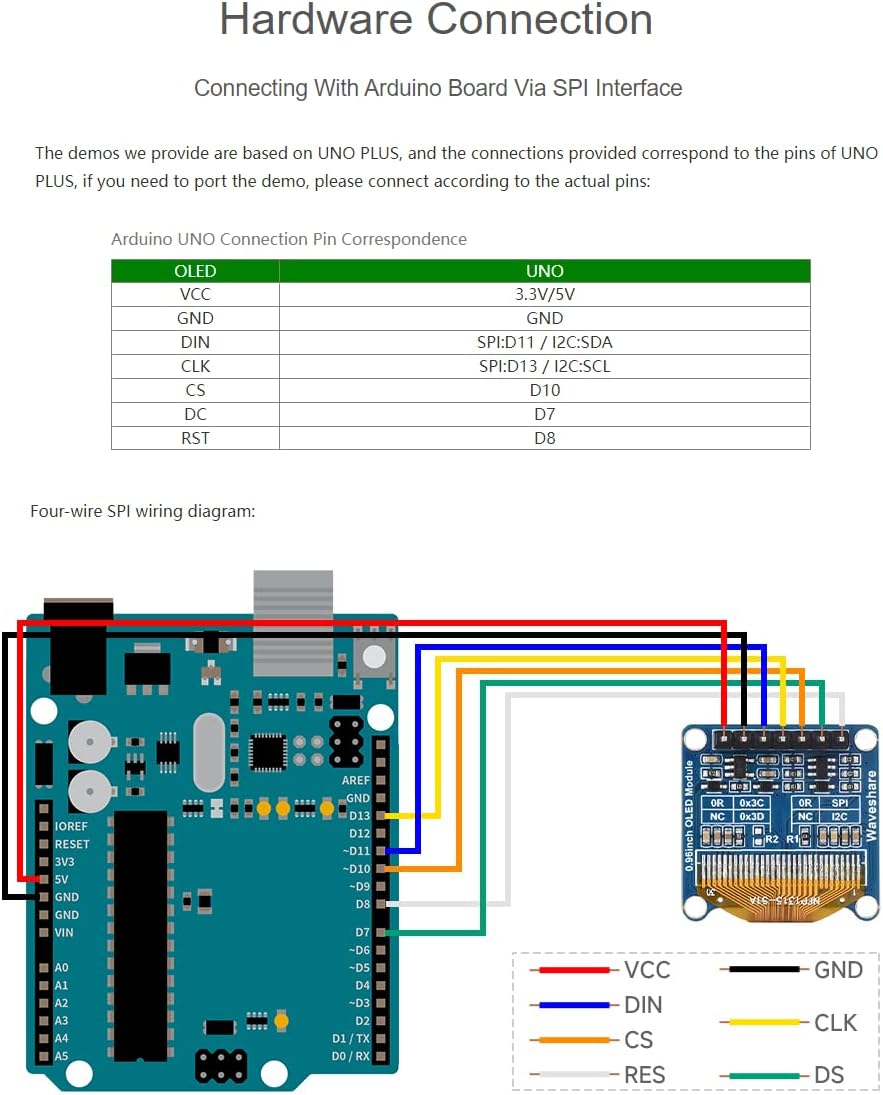
Image: Visual guide demonstrating the correct wiring connections between the 0.96inch OLED module and a Raspberry Pi board using the SPI interface.
6.2. Connecting with Arduino Board via SPI Interface
The provided demos are based on Arduino UNO PLUS. For other Arduino boards, connect the pins according to the actual pinout of your board. Refer to the Arduino UNO connection pin correspondence table below.
| OLED Pin | UNO Pin |
|---|---|
| VCC | 3.3V/5V |
| GND | GND |
| DIN | SPI:D11 / I2C:SDA |
| CLK | SPI:D13 / I2C:SCL |
| CS | D10 |
| DC | D7 |
| RST | D8 |

Image: Visual guide demonstrating the correct wiring connections between the 0.96inch OLED module and an Arduino UNO board using the SPI interface.
6.3. Connecting with STM32
The provided demos are based on the STM32F103RBT6. If you need to port the demo to a different STM32 board, please connect the pins according to the actual pinout of your specific board. Refer to the STM32F103RBT6 connection pin correspondence table below.
| OLED Pin | STM32 Pin |
|---|---|
| VCC | 3.3V |
| GND | GND |
| DIN | SPI:PA7 / I2C:PB9 / I2C_SOFT: PC8 |
| CLK | SPI:PA5 / I2C:PB8 / I2C_SOFT: PC6 |
| CS | PB6 |
| D/C | PA8 |
| RES | PA9 |
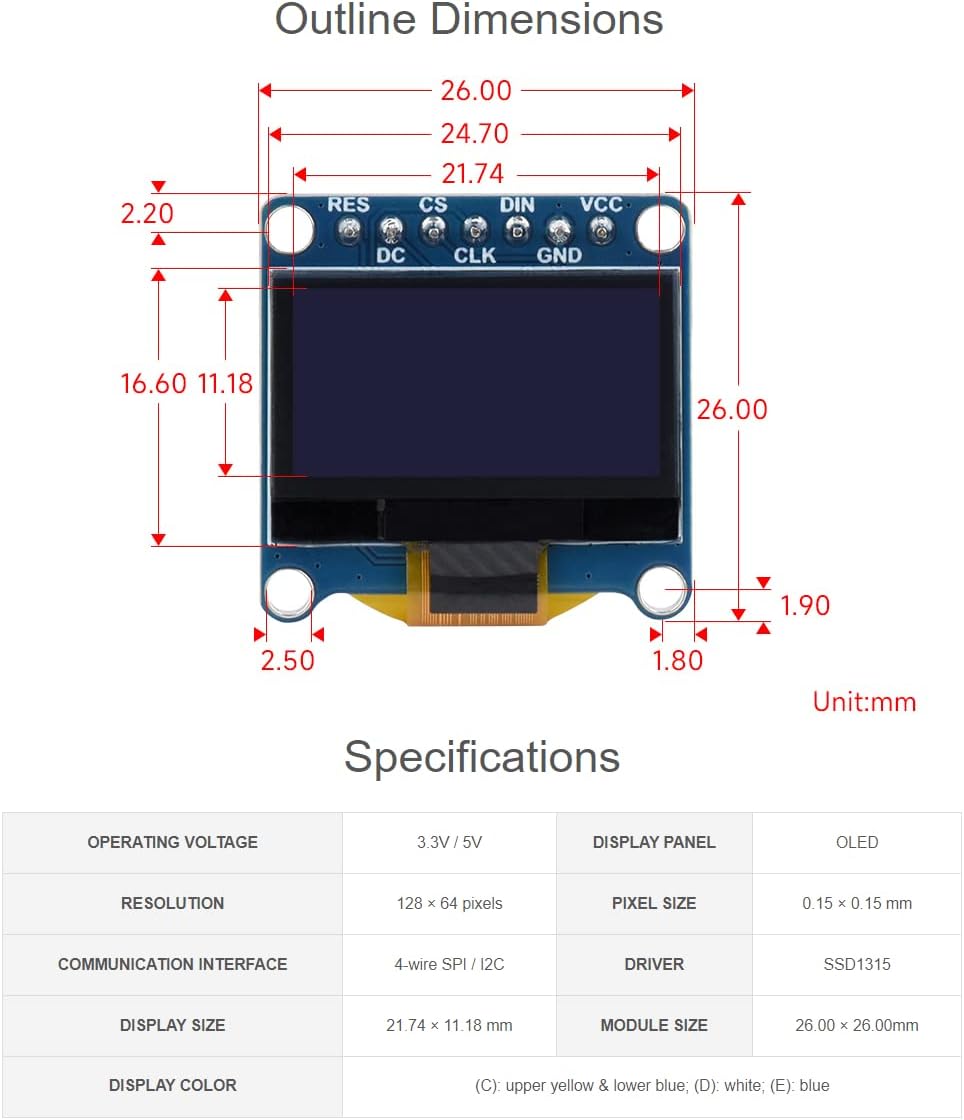
Image: Visual guide demonstrating the correct wiring connections between the 0.96inch OLED module and an STM32 development board.
7. Nga Whakaaro Whakahaere
To ensure optimal performance and longevity of your OLED module, please observe the following:
- Hononga Hiko: Be careful not to reverse the power connection (VCC and GND) as this can damage the module.
- Self-Luminous Display: OLED displays are self-luminous and do not have a backlight. Simply connecting VCC and GND will not illuminate the display. You must use program control to highlight the OLED and display content.
- Pupuri Atahanga: Avoid displaying the same static screen content for prolonged periods. Continuous display of static images can lead to residual images (burn-in) and potentially damage the OLED panel.
8. Raparongoā me te FAQ
- Q: How many volts can the OLED module be used in a system?
- A: The OLED module is designed for use in a 3.3V system by default. However, extensive testing has shown that it functions reliably in a 5V system as well.
- Q: How many hours does the OLED module last?
- A: Under normal operating conditions, the OLED module typically has a lifespan of approximately 50,000 hours.
- Q: OLED module connected to the power supply why does not light?
- A: OLED displays are self-luminous and do not have a backlight. The display will not light up by simply connecting VCC and GND. You must use program control to initialize the display and send data to illuminate the OLED and show content.
9. Tautoko
For further assistance, development resources, or if you encounter any problems, please contact Waveshare support. Online development resources are available to help you get started with your projects.
Visit the official Waveshare store for more information: Waveshare Store


