1. Kupu Whakataki
This manual provides comprehensive instructions for the safe and efficient operation of your Anern ECO-4200 4200W 24V Hybrid Solar Inverter. This all-in-one unit combines the functions of an inverter, solar charger, and battery charger to provide uninterrupted power support. Please read this manual thoroughly before installation and use, and retain it for future reference.
2. Nga korero haumaru
WHAKATŪPATO: Ki te kore e whai i enei tohutohu haumaru ka puta pea te ru hiko, te ahi, te whara kino ranei.
- Ko te whakaurunga me mahi e nga kaimahi mohio.
- Me whakarite kia u nga waea katoa ki nga waehere hiko o te rohe me te motu.
- Kaua e wetewete te inverter. Kaore he waahanga e taea ana e te kaiwhakamahi ki roto.
- Disconnect all power sources (PV array, battery, utility) before performing any maintenance or wiring.
- This inverter is designed for 220V/230V AC output. It does not support 110V/120V AC output directly or parallel operation. For 110V/120V appliances, an external step-down converter (not included) is required.
- Me whakarite kia tika te hau huri noa i te kaihurihuri kia kore ai e wera rawa.
- Avoid installing the inverter in direct sunlight, high humidity, or dusty environments.
3. Nga Hua o te Hua
The Anern ECO-4200 Hybrid Solar Inverter offers advanced functionalities for reliable power management:
- Putanga Ngaru Wai Parakore: Provides high-quality AC power suitable for sensitive electronics.
- Kaiwhakahaere Utu MPPT Whakauru: Features a 120A Maximum Power Point Tracking (MPPT) solar charge controller for efficient solar energy harvesting.
- Tautuhinga Ka taea te whirihora: LCD display allows configuration of input voltage range for home appliances or personal computers, battery charging current, and AC/solar charger priority.
- Versatile Power Source Compatibility: Compatible with utility grid or generator power.
- Tīmata Aunoa: Ka tīmata anō aunoa ina whakahokia mai te mana AC.
- Parenga Matawhānui: Includes overload, over-temperature, and short-circuit protection.
- Pūhiko Pūhiko Atahiko: Designed to optimize battery performance and extend lifespan.
- Taumahi Tīmata Matao: Enables the inverter to start without an AC input.
- Putanga AC Takirua: Features a primary output of 4200W and a secondary output of 1400W. The secondary output can maintain power during low battery or no mains conditions to save energy.
- Hototahitanga Pūhiko: Supports various battery types including GEL, FLD, Li-on (Lithium), and AGM.
- Wi-Fi Monitoring: Allows control and monitoring of the system via a mobile application.

Whakaahua: Ka mutuview of the Anern ECO-4200 inverter highlighting multiple protection features, Wi-Fi monitoring capability, and its ability to operate with or without a battery.
4. Tāutanga
This section outlines the basic system architecture and wiring for the Anern ECO-4200 Hybrid Solar Inverter. Consult a qualified system integrator for specific requirements.
4.1 Hangahanga Pūnaha Matua
The inverter/charger forms the core of your solar power system. A complete operational system typically includes:
- The Anern ECO-4200 Hybrid Solar Inverter
- PV Modules (Solar Panels)
- Battery Bank (e.g., 48V lead-acid or lithium battery)
- Utility Grid or Generator (as an optional AC input source)
4.2 Wiring Hoahoa
Refer to the diagram below for a typical wiring configuration. Ensure all connections are secure and correctly polarized.

Image: Detailed wiring diagram illustrating connections for photovoltaic panels, battery bank, AC input from utility or generator, and AC output to household loads. Recommended wire gauges and fuse sizes are indicated.
Key Wiring Recommendations:
- Photovoltaic (PV) Input: Max tuwhera iahiko voltage 500VDC. MPPT PV voltage range 90VDC-450VDC. Suggested wire: 10 AWG/6mm². Connect panels in series.
- Hononga Pūhiko: For a 48V battery system, use 2 AWG cable (25mm²) and a 150A fuse.
- Tāuru AC: Max tāuru AC voltage 300VAC. Max AC charging current 160A. Suggested cable: 10 AWG/6mm². Recommended switch: 63A.
- Huaputa AC: Rated output 220V/230V. Suggested cable: 10 AWG/6mm². Recommended switch: 63A.
Important Note: The inverter output is 230V. A separate converter (not included) is required for 110V appliances.
5. Nga Tohutohu Whakahaere
The inverter features an LCD display for monitoring and configuring operational parameters.
5.1 Configurable Settings via LCD
You can adjust various settings to suit your application requirements:
- Whakauru Voltage Awhe: Select between appliance mode or personal computer mode.
- Tohutohutia Whakapaa o Naianei: Adjust the charging current based on your battery specifications.
- Te Hiranga o te Tautuhinga: Tautuhia te kaupapa matua mō te rihi AC, te rihi rā rānei.
5.2 Charge Modes
The inverter supports four distinct charge modes:
- Te Pūngao o te Rā Tuatahi: Ka whakatairanga i te hiko o te rā mō te utu.
- Ratonga Tuatahi: Ka whakatairanga i te hiko ratonga mō te utu.
- Te Pūngao Rā me te Pūngao Whaipainga: Uses both solar and utility power for charging.
- Pūhiko me te Pūngao Rā: Charges from both battery and solar (specific to certain configurations).
5.3 Aratau Putanga
Three output modes are available to manage power distribution:
- Mana Matua: Ka whakatairanga i te mana o te rā mō ngā kawenga.
- Mahi Matua: Ka whakatairanga i te mana whakahaere mō ngā kawenga.
- Aratau SBU (Solar-Battery-Utility): Ko te pūngao rā te mea nui, kātahi ko te pūhiko, kātahi ko te taputapu mō ngā kawenga.
The inverter can power various household and office appliances, including refrigerators, lamps, fans, and air conditioners.
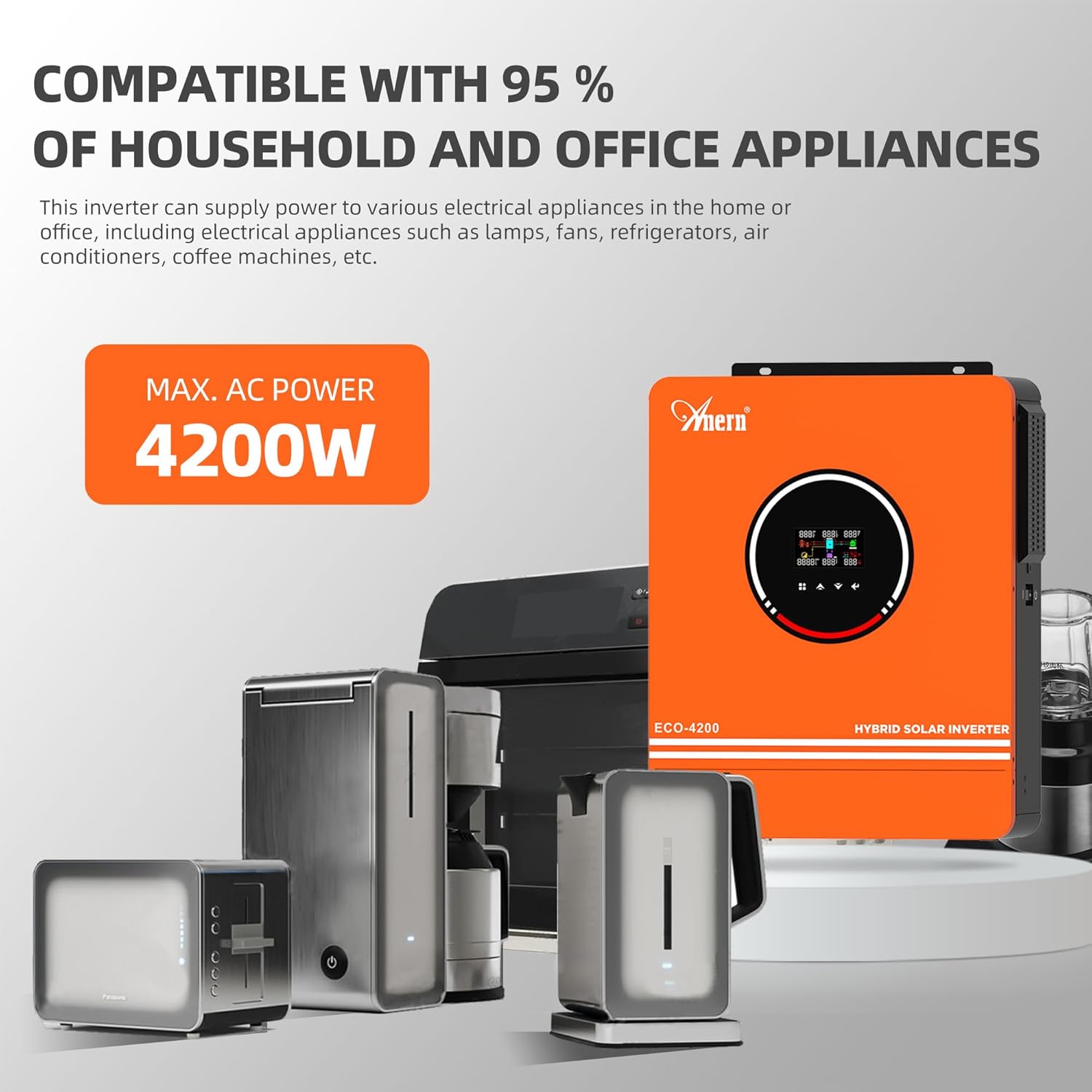
Image: The Anern ECO-4200 inverter demonstrating compatibility with a wide range of household and office appliances, including coffee makers, toasters, and kettles.
6. Tiaki
Ko te tiaki i nga wa katoa ka mau te roa me te mahi tino pai o to kaihurihuri.
- Te horoi: Keep the inverter's exterior clean and free from dust. Use a dry cloth. Do not use liquid cleaners.
- Whakahau: Ensure ventilation openings are clear and unobstructed. The intelligent variable speed fan helps dissipate heat efficiently.
- Hononga: Ia wa, tirohia nga hononga hiko katoa mo te piri me nga tohu o te waikura.
- Taiao: Maintain the inverter in a cool, dry, and well-ventilated area.
7. Te Raru
Ko tenei waahanga he aratohu mo nga take noa. Mo nga raruraru uaua, whakapā atu ki te tautoko hangarau.
- Kāore te Inverter e Tahuri Ana: Tirohia nga hononga pākahiko, voltage, and AC input (if applicable). Ensure the power switch is in the 'ON' position.
- Kāore he Putanga AC: Verify input power sources (PV, battery, utility). Check for overload or short-circuit conditions. The inverter has built-in protection that may temporarily shut down output.
- Low Battery Performance: Ensure correct battery type settings are configured. Check battery health and charging current settings.
- Whakatupato Nui atu: Reduce the connected load. The inverter will automatically attempt to restart after an overload event.
- Whakatūpato mō te wera nui rawa: Ensure adequate ventilation. Clear any obstructions from the fan or vents.
8. Whakatakotoranga
Detailed technical specifications for the Anern ECO-4200 4200W 24V Hybrid Solar Inverter.

Image: Summary of key technical specifications for the Anern 4200W Hybrid Solar Inverter, including Max. AC Output, Max. MPPT PV Charging Current, Minimum voltage for solar modules, and Max. PV Array Open Circuit Voltage.
| Whakatakotoranga | Uara |
|---|---|
| Waitohu | Anern |
| Tau tauira | ECO-4200 |
| Mana | 4200 Watts |
| Voltage | 24 Volts (DC Input) |
| Putanga Voltage | 220-230 VAC (Single Phase) |
| Max. Mana Hiko PV | 6500 W |
| Max. PV Array Open Circuit Voltage | 500 VDC |
| MPPT PV Voltage Awhe | 90-450 VDC |
| Max. Utu PV i naianei | 120 A |
| Putanga Whaimana | 44.3 A |
| Battery Capacity (Charge Controller) | 120 Amp-hours (Max. charging current) |
| Whakamahi Manakohia | Kainga |
| Puna Mana | Ko te hiko o te ra |
| Tae | Karaka |
9. Pūtāhui me te Tautoko
For warranty information and technical support, please refer to the documentation included with your product or visit the official Anern webpae. Puritia to rihiti hoko mo nga kereme whakamana.


