1. Kupu Whakataki
The UNI-T UT334E is a portable, voice-enabled 4-in-1 gas detector designed for continuous monitoring of gas concentrations. This device integrates advanced circuit technology, embedded microcomputer control, and high-quality imported gas sensors to provide excellent sensitivity and repeatability. It features a dot matrix LCD display with support for both Chinese and English interfaces and voice prompts, ensuring ease of use and maintenance. The robust shell is constructed from high-strength engineering plastic, offering good vibration resistance, high strength, and protection against dust, water, and explosions.
This manual provides detailed instructions for the safe and effective operation, maintenance, and troubleshooting of your UT334E gas detector.
2. Nga korero haumaru
Please read and understand all safety instructions before operating the device. Failure to follow these instructions may result in injury, damage to the device, or inaccurate readings.
- Whakatikatika: Ensure the device is regularly calibrated according to manufacturer guidelines to maintain accuracy.
- Taiao Mahi: Use the device within the specified temperature and humidity ranges. Avoid extreme conditions.
- Pūmate Pahū: This device is designed with explosion-proof features. However, always exercise caution in potentially explosive atmospheres. Do not attempt to open or repair the device in such environments.
- Haumaru Pūhiko: Use only the specified battery type. Do not expose the battery to high temperatures or attempt to disassemble it.
- Parenga pūoko: Avoid exposing sensors to high concentrations of gas for prolonged periods, as this may damage them or reduce their lifespan.
- Tiaki: Only qualified personnel should perform repairs or advanced maintenance.
- Rokiroki: Store the device in a clean, dry environment away from direct sunlight and corrosive substances.
3. Hua Neke Atuview
The UT334E is a compact and robust gas detector designed for reliable performance in various industrial and safety applications. Its ergonomic design ensures comfortable handheld operation.
Whakaahua 3.1: Mua view of the UNI-T UT334E Handheld Gas Detector, showing the display and control buttons.
This device is capable of detecting four types of gases simultaneously, providing comprehensive air quality monitoring.

Figure 3.2: Illustration highlighting the four gases detected by the UT334E: EX (combustible gases), H2S (Hydrogen Sulfide), CO (Carbon Monoxide), and O2 (Oxygen).
4. Nga waahanga matua
The UT334E gas detector incorporates several features to enhance its functionality and user experience:
- Tautoko Reo-maha: Switch between Chinese and English display interfaces and voice prompts.
- Quadruple Alarm System: Features sound, light, vibration, and screen flashing for comprehensive alarm indications.
- Pūhiko Kaha-Teitei: Equipped with a 5000mAh built-in lithium battery for extended operation.
- Rokiroki Raraunga: Automatic storage of records that can be viewed and deleted directly on the device.
- Whakaaturanga LCD Tae: A 2.4-inch color LCD display provides clear visualization of gas detection indicators.
- Hanga Roa: Made from high-strength engineering plastic, offering anti-compression, anti-drop, and explosion-proof properties.
- Pūoko-Pono Tino: Utilizes imported sensors for sensitive induction, short response time, and accurate detection.
- Curve Drawing: Supports curve drawing functionality, allowing for easy observation of periodic gas concentration states.

Figure 4.1: Visual representation of the key features of the UT334E, including its display, alarm types, and robust design.
5. Whakatakotoranga
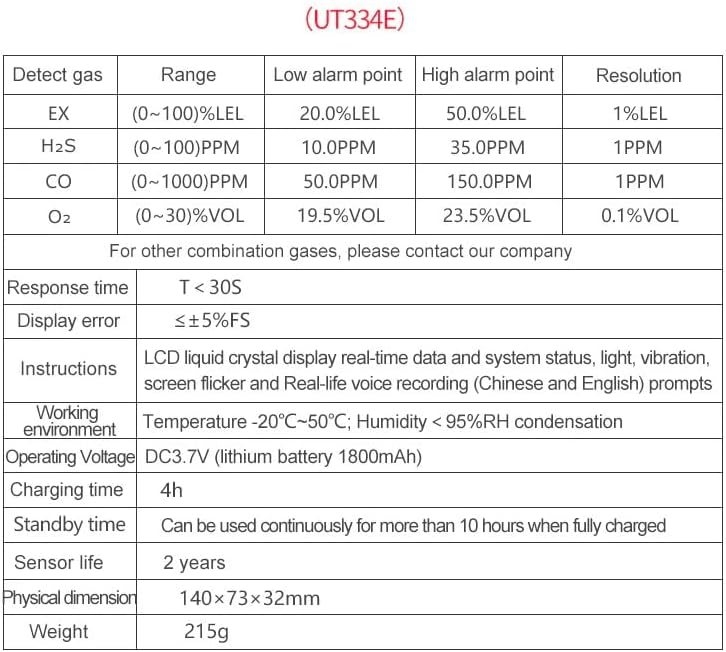
The following table details the technical specifications of the UNI-T UT334E gas detector:
| Tawhā | Uara / Awhe | Pūwāhi Whakaoho Iti | Pūwāhi Whakaoho Teitei | Whakatau |
|---|---|---|---|---|
| Detect Gas: EX | 0~100%LEL | 20.0%LEL | 50.0%LEL | 1%LEL |
| Detect Gas: H2S | 0~100PPM | 10.0PPM | 35.0PPM | 1PPM |
| Detect Gas: CO | 0~1000PPM | 50.0PPM | 150.0PPM | 1PPM |
| Detect Gas: O2 | 0 ~ 30% VOL | 19.5%VOL | 23.5%VOL | 0.1%VOL |
| Wā Whakautu | T < 30S | |||
| Whakaatu Hapa | ≤ ±5%FS | |||
| Tohutohu | LCD liquid crystal display real-time data and system status, light, vibration, screen flicker and Real-life voice recording (Chinese and English) prompts | |||
| Taiao Mahi | Temperature -20℃~50℃; Humidity < 95%RH condensation | |||
| Mahinga Mahi Voltage | DC3.7V (lithium battery 5000mAh) | |||
| Waa Whakatau | 4h | |||
| Wā tūtatari | Can be used continuously for more than 10 hours when fully charged | |||
| Te ora pūoko | 2 tau | |||
| Ahu-tinana | 140 × 73 × 32mm | |||
| Taumaha | 215g | |||
Whakatakotoranga Tāpiri:
- Taumaha Tūemi: 1.32 pauna
- Rahi Hua: 6.5 x 4.33 x 4.72 inihi
- Rauemi: Acrylonitrile Butadiene Styrene (ABS)
- Puna Hiko: Pūhiko Powered
- Wattage: 5 watts
- Tikanga Ine: ±0.1%
- Tiwhikete: CE, ISO 9001, RoHS, UKCA
6. Tatūnga
6.1. Ka tohatohahia te Pūrere
Before first use, fully charge the UT334E gas detector. The device is equipped with a 5000mAh lithium battery. Use a standard MicroUSB cable and a compatible power adapter (not included) to charge the device.
- Connect the MicroUSB cable to the charging port on the device.
- Connect the other end of the cable to a USB power source (e.g., wall adapter, power bank).
- The display will show a charging indicator.
- Ko te roa o te utunga he tata ki te 4 hāora te roa hei utunga katoa.

Figure 6.1: The UT334E connected to a power source via MicroUSB for charging, with the battery charge indicator visible on the screen.
6.2. Hia Tuatahi
After charging, press and hold the power button (usually marked with a power symbol) for a few seconds until the device powers on and the display illuminates. The device will perform a self-test upon startup.
7. Nga Tohutohu Whakahaere
7.1. Te Hiko / Whakaweto
- Whakahiko: Patohia me te pupuri i te paatene kia pa ra ano te mura o te mata.
- Weto Whakakore: Press and hold the power button until the shutdown prompt appears, then confirm.
7.2. Whiriwhiringa Reo
The device supports both Chinese and English interfaces. Refer to the device's menu options (typically accessible via the 'OK' or menu button) to navigate to language settings and select your preferred language.
7.3. Te Maramatanga ki te Whakaaturanga
The 2.4-inch color LCD displays real-time gas concentrations for EX, H2S, CO, and O2. It also shows battery status, time, and other operational indicators. Familiarize yourself with the layout to quickly interpret readings.
7.4. Gas Detection and Alarms
The UT334E continuously monitors the ambient air for the four specified gases. When gas concentrations exceed the preset low or high alarm points, the device will activate its quadruple alarm system:
- Oro oro: An audible buzzer will sound.
- Pūoho Maama: Indicator lights on the device will flicker.
- Pūoho Wiri: The device will vibrate.
- Screen Flashing: The display background may change color (e.g., red) and flash to draw attention to the alarm condition.

Figure 7.1: Visual representation of the quadruple alarm system, showing lights flickering, buzzer alarm, red background reminder on the screen, and body vibration.
7.5. Data Logging and Curve Drawing
The device automatically stores detection records. Users can access these records through the menu to view historical data. The curve drawing function allows for a graphical representation of gas concentration changes over time, aiding in the analysis of periodic states.

Figure 7.2: The UT334E display showing a gas concentration curve, illustrating the device's ability to track and visualize changes over time.
8. Tiaki
Proper maintenance ensures the longevity and accuracy of your UT334E gas detector.
- Te horoi: Horoia te taputapu ki te ngohengohe, damp cloth. Do not use abrasive cleaners or solvents. Ensure no liquid enters the sensor openings or charging port.
- Tiaki pūoko: Keep the sensor area clean and free from obstructions. Avoid direct contact with the sensors.
- Tiaki Pūhiko: Recharge the battery when the low battery indicator appears. Avoid fully discharging the battery frequently. If storing for an extended period, charge the battery to approximately 50% and recharge every few months.
- Whakatikatika: Regular calibration is crucial for maintaining measurement accuracy. Refer to the device's menu for calibration options or contact UNI-T support for service.
- Rokiroki: Store the device in a cool, dry place, away from direct sunlight, extreme temperatures, and corrosive chemicals.
9. Te Raru
If you encounter issues with your UT334E, refer to the following common problems and solutions:
- Kaore te taputapu i te hiko: Ensure the battery is fully charged. If the issue persists, contact support.
- Ko nga panui kore tika: Check if the sensor area is clean and unobstructed. The device may require calibration. Avoid using the device in environments outside its specified operating conditions.
- Alarm constantly active: Move to a well-ventilated area to confirm if there is a real gas leak. If the alarm persists in a clean environment, the sensor might be faulty or require calibration.
- Whakaatu take: If the screen is blank or flickering abnormally, try restarting the device. Ensure the battery is charged.
- Nga take utu: Verify the MicroUSB cable and power adapter are functioning correctly. Ensure the charging port is clean.
For problems not listed here or if troubleshooting steps do not resolve the issue, please contact UNI-T customer support.
10. Pūtāhui me te Tautoko
UNI-T products are manufactured to high-quality standards and are backed by a limited warranty. Please refer to the warranty card included with your product for specific terms and conditions, including warranty period and coverage details.
For technical support, service, or warranty claims, please contact UNI-T customer service through their official website or the contact information provided in your product packaging. When contacting support, please have your product model (UT334E) and purchase information ready.
UNI-T Official Webpae: www.kare-trend.com


