1. Kupu Whakataki
This manual provides detailed instructions for the installation, configuration, and operation of your Rebel KOM1031 Dual-Band Wireless Network Repeater. This device is designed to extend the coverage of your existing Wi-Fi network, providing a stronger and more reliable signal in areas with weak or no coverage. It supports both 2.4 GHz and 5 GHz wireless bands, offering flexible connectivity options and high data transfer rates.
2. Ihirangi mokete
Tena koa tirohia kei roto katoa nga taonga kei roto i to kete:
- Rebel KOM1031 Wireless Network Repeater
- Pukapuka Kaiwhakamahi (tenei tuhinga)
- Ethernet Cable (may be included, check packaging)

Whakaahua 2.1: The Rebel KOM1031 Repeater packaging, showing the device and its key features.
3. Hua Neke Atuview
Familiarize yourself with the physical components and indicators of the Rebel KOM1031 Repeater.
3.1. Tahora Pūrere

Whakaahua 3.1: Mua view of the Rebel KOM1031 Repeater, highlighting the LED indicators and Ethernet ports.

Whakaahua 3.2: Te taha view of the Rebel KOM1031 Repeater, showing the four external antennas in an extended position.

Whakaahua 3.3: Raro view of the Rebel KOM1031 Repeater, illustrating the integrated power plug and two RJ45 Ethernet ports.
3.2. Tohu LED
| Tohutohu | Tūnga | Whakaahuatanga |
|---|---|---|
| SYS/POWER | Mārō Ana | Kei te hiko te taputapu me te mahi noa. |
| 2.4G | Mārō Ana | 2.4 GHz Wi-Fi band is active. |
| 5.8G | Mārō Ana | 5 GHz Wi-Fi band is active. |
| LAN3 / LAN4 | Solid On/Flashing | Indicates an active Ethernet connection and data transfer on the respective LAN port. |
4. Aratohu Tatūnga
Follow these steps to set up your Rebel KOM1031 Repeater.
4.1. Te Whakatakoto Tuatahi me te Whakakā
- Kōwhiria he Tauwāhi: Plug the repeater into an electrical outlet in an area between your main router and the location where you need improved Wi-Fi coverage. Ensure it is within the range of your existing Wi-Fi signal.
- Whakahiko: Plug the device directly into a standard wall socket. The SYS/POWER LED should illuminate. Wait approximately 30-60 seconds for the device to boot up.
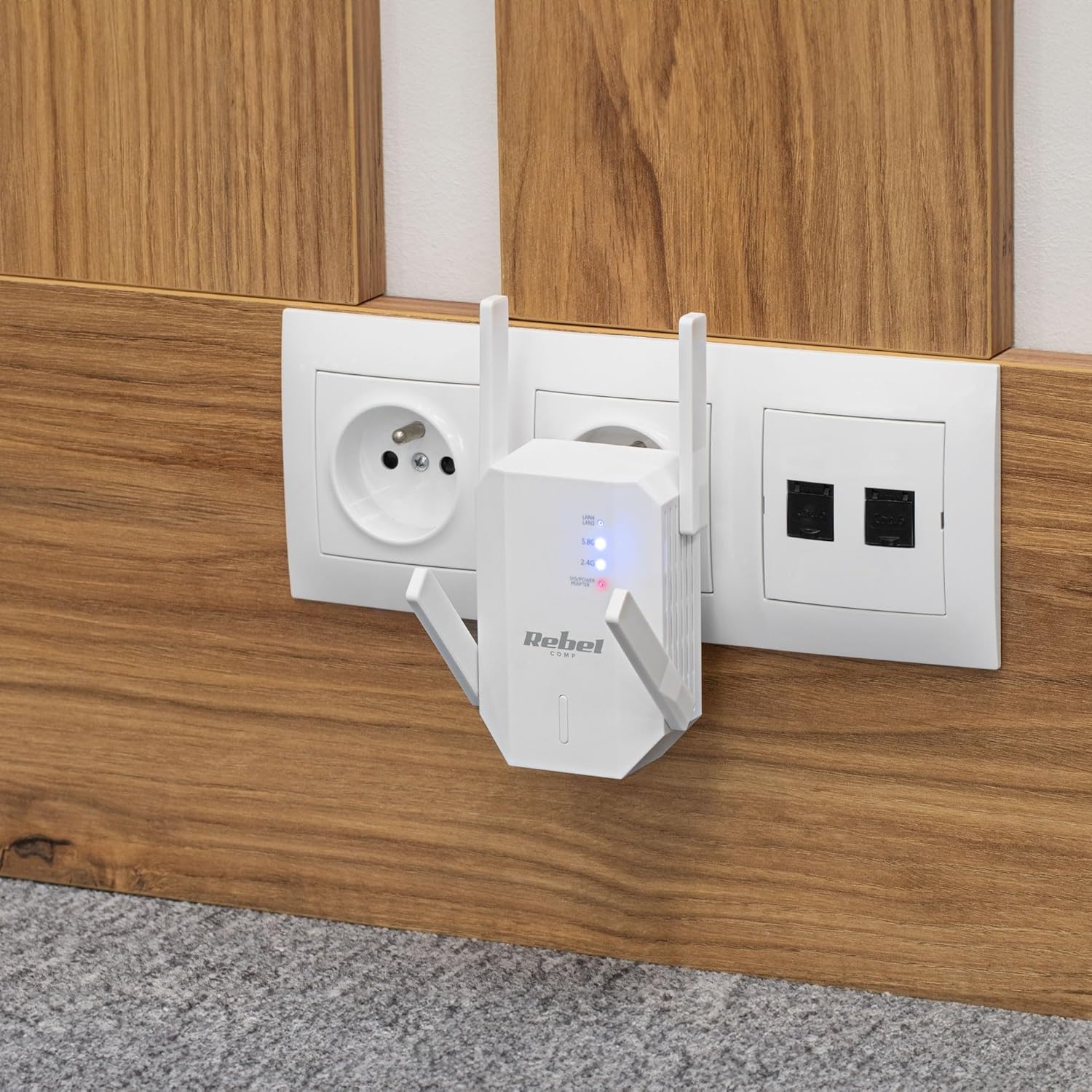
Whakaahua 4.1: The Rebel KOM1031 Repeater plugged into a wall outlet, ready for configuration.
4.2. Te hono atu ki te Kaiwhakahoki
- Hono Ahokore: On your computer or mobile device, search for available Wi-Fi networks. Connect to the network named "Rebel_XXXX" or similar (check the label on the device for the default SSID). No password is required for the initial connection.
- Urunga Web Atanga: Tuwhera a web browser (e.g., Chrome, Firefox, Edge) and enter the default IP address or domain name (usually 192.168.10.1 or rebelrepeater.net) ki te pae wāhitau. Press Enter.
- Takiuru: When prompted, enter the default username and password (usually kaiwhakahaere mo e rua).
4.3. Configuration Wizard (Repeater Mode)
Most users will configure the device in Repeater Mode to extend an existing Wi-Fi network.
- Tīpakohia te Aratau Whakahoki: I runga i te web interface, select "Repeater Mode" or "Wi-Fi Repeater" from the available options.
- Matawai mo nga Whatunga: The device will scan for available Wi-Fi networks. Select your main Wi-Fi network (SSID) from the list.
- Whakauru Kupuhipa: Enter the Wi-Fi password (security key) of your main router.
- Configure Repeater SSID (Optional): You can choose to keep the same SSID as your main network or create a new one (e.g., "MyHome_EXT"). It is recommended to use a different SSID to easily distinguish between networks.
- Hoatu Tautuhinga: Click "Apply" or "Save" to confirm your settings. The repeater will restart. This process may take a few minutes.
- Whakahono ano: After the repeater restarts, disconnect from the repeater's default Wi-Fi network and connect to your newly configured extended network (e.g., "MyHome_EXT") using the password you entered.
Your Rebel KOM1031 Repeater should now be extending your Wi-Fi network. Check the signal strength in previously weak areas.
5. Aratau Mahi
The Rebel KOM1031 supports multiple operating modes to suit various networking needs.
5.1. Repeater Mode (Default)
In Repeater Mode, the device extends the coverage of an existing wireless network. It receives the wireless signal from your main router and re-transmits it, effectively expanding the Wi-Fi range. This is the most common mode for eliminating Wi-Fi dead zones.
5.2. Aratau Tohu Uru (AP).
In AP Mode, the device connects to a wired network (via an Ethernet cable) and broadcasts a new wireless network. This is useful for adding Wi-Fi capability to a wired-only network or creating a new Wi-Fi hotspot from a wired internet connection.
- Honoa te Ipurangi: Connect an Ethernet cable from your router or modem to one of the RJ45 ports on the KOM1031.
- Urunga Web Atanga: Follow steps 4.2 to access the web atanga.
- Tīpakohia te Aratau AP: Choose "AP Mode" or "Access Point" from the configuration options.
- Whirihorahia nga Tautuhinga Wi-Fi: Set a new SSID (network name) and a strong password for your new wireless network.
- Hoatu Tautuhinga: Save the configuration. The device will restart and operate as an Access Point.
6. Tiaki
Ko te tiaki tika ka whakarite i te roa me te mahi tino pai o to taputapu.
- Te horoi: Whakamahia he kakahu maeneene, maroke hei horoi i te taputapu. Kaua e whakamahia nga kai horoi wai, aerosol ranei.
- Whakahau: Me whakarite kia whakanohoia te taputapu ki tētahi wāhi e pai ana te hau. Kaua e aukati i ngā mokowā hau.
- Whakahōu Firmware: Tirohia i ia wa i te kaihanga website for firmware updates. Updating firmware can improve performance and security.
- Tautuhi Anō: If the device malfunctions or you forget the login credentials, you can perform a factory reset. Locate the reset button (usually a small pinhole) and press it with a paperclip for 5-10 seconds while the device is powered on. The device will revert to factory default settings.
7. Te Raru
Mena ka raru koe, tirohia nga raru me nga otinga e whai ake nei.
7.1. Kāore he urunga ki te ipurangi i muri i te tatūnga
- Check Main Router: Me whakarite he hononga ipurangi kaha to pouara matua.
- Manatoko Kupuhipa: Double-check that you entered the correct Wi-Fi password for your main router during setup.
- Relocate Repeater: The repeater might be too far from your main router. Move it closer to ensure it receives a strong signal.
- Tīmataria anō ngā Pūrere: Restart your main router, the repeater, and your client devices.
7.2. Kāore e taea te uru atu Web Whārangi Whakahaere
- Taki Hononga: Ensure your device is connected to the repeater's Wi-Fi network (either the default "Rebel_XXXX" or your configured extended network).
- Manatokohia te Wāhitau IP: Confirm you are using the correct IP address (e.g., 192.168.10.1) or domain name (rebelrepeater.net).
- Ūkui Keteroki Pūtirotiro: Whakamātauria te whakawātea i tō web te keteroki o te pūtirotiro, te whakamahi rānei i tētahi atu pūtirotiro.
- Tautuhi wheketere: If all else fails, perform a factory reset (see Section 6. Maintenance) and try setting up again.
7.3. Weak Signal or Slow Speed
- Turanga Tino Pai: Ensure the repeater is placed optimally, roughly halfway between your router and the dead zone. Avoid physical obstructions like thick walls or metal objects.
- pokanoa: Other electronic devices (microwaves, cordless phones) can cause interference. Try moving the repeater away from such devices.
- Whakaritenga Antenna: Adjust the external antennas for better signal reception and transmission.
8. Whakatakotoranga Hangarau
| Āhuahira | Taipitopito |
|---|---|
| Tauira | KOM1031 |
| Waitohu | Rebel |
| Tiwhikete | MTK7612 |
| Paerewa Ahokore | IEEE 802.11 a/b/g/n/ac |
| Paihere Auautanga | 2.4 GHz / 5 GHz (Dual-Band) |
| Te Raraunga Tuku Raraunga | Tae atu ki te 300 Mbps (2.4 GHz), Tae atu ki te 867 Mbps (5 GHz) |
| Antenna | 4 External (2 dBi each) |
| Kawa Haumarutanga | WEP, WPA/WPA2, WPS (64/128 bit) |
| Tauranga Itarangi | 2x RJ45 (10/100 Mbps) |
| Mokowoko Korekore | Up to 100 meters (environment dependent) |
| Tuku Hiko | 110-240 V; 50/60 Hz; 2 A |
| Ahu | 87 x 63 x 55 mm |
| Taumaha | 76 g |
| Kaiwhakamahi Tuturu | Ka tautokohia ki te 10 nga kaiwhakamahi i te wa kotahi |
9. Nga korero haumaru
Please read and follow these safety guidelines to prevent damage to the device or injury to yourself.
- Kaua e tukuna te taputapu ki te wai, te makuku, te wera nui ranei.
- Kaua e ngana ki te wetewete, ki te whakatika ranei i te taputapu. Tukuna atu nga ratonga katoa ki nga kaimahi whai tohu.
- Ensure the power outlet used is easily accessible and provides the correct voltage (110-240V).
- A ape i te whakanoho i te taputapu ki te taha o nga puna wera, ki te ra tika ranei.
- Tiakina te taputapu mai i nga tamariki me nga kararehe.
10. Pūtāhui me te Tautoko
For warranty information, technical support, or further assistance, please refer to the official Rebel website or contact your retailer. Please have your product model number (KOM1031) and purchase details ready when seeking support.


