Kupu Whakataki
The YANZEO SR290 is a versatile handheld terminal designed for efficient data capture, combining UHF RFID reading capabilities with 1D/2D QR barcode scanning. This device offers multiple connectivity options and reading modes, making it suitable for various environments such as retail stores, supermarkets, and warehouses. Its robust design ensures durability for daily operational demands.

Figure 1: YANZEO SR290 Handheld Terminal Barcode Scanner. This image displays the main unit of the scanner along with its USB dongle and cables, highlighting its compact and ergonomic design.
Tatūnga
Ihirangi mokete
I mua i te tiimata, me whakarite kei roto katoa nga taonga kei roto i te kete:
- YANZEO SR290 Handheld Terminal
- Tauira Whakatau USB
- 2.4G Wireless USB Dongle
- Pukapuka Kaiwhakamahi (tenei tuhinga)
Te utu i te Pūrere
The SR290 is equipped with a 2000mAh lithium-ion battery. For optimal performance, fully charge the device before first use.
- Connect the USB charging cable to the scanner's charging port.
- Honoa te tahi pito o te taura USB ki te urutau hiko USB hototahi (kaore i whakaurua) ki te tauranga USB rorohiko ranei.
- The indicator lights on the device will show charging status. A full charge typically takes several hours.

Figure 2: The SR290 scanner connected to a laptop via USB, illustrating its connectivity options and highlighting its 2000mAh battery capacity for long-lasting performance.
Te Hiko / Whakaweto
Locate the power button on the device. Press and hold the power button for a few seconds to turn the scanner on or off. The device will emit an audible beep and indicator lights will illuminate upon successful power-on.
Operating Modes and Connectivity
Kōwhiringa Hononga
The YANZEO SR290 offers three primary methods for connecting to your host device:
- Nihokikorangi: For wireless connection to Bluetooth-enabled devices like smartphones, tablets, or computers. Effective range is approximately 0-20 meters in an open environment.
- 2.4G Ahokore: Utilizes a dedicated USB dongle for wireless connection to computers. Offers an extended range of approximately 0-80 meters in an open environment.
- USB Waea: Direct connection via USB cable for reliable and secure data transmission, also used for charging.
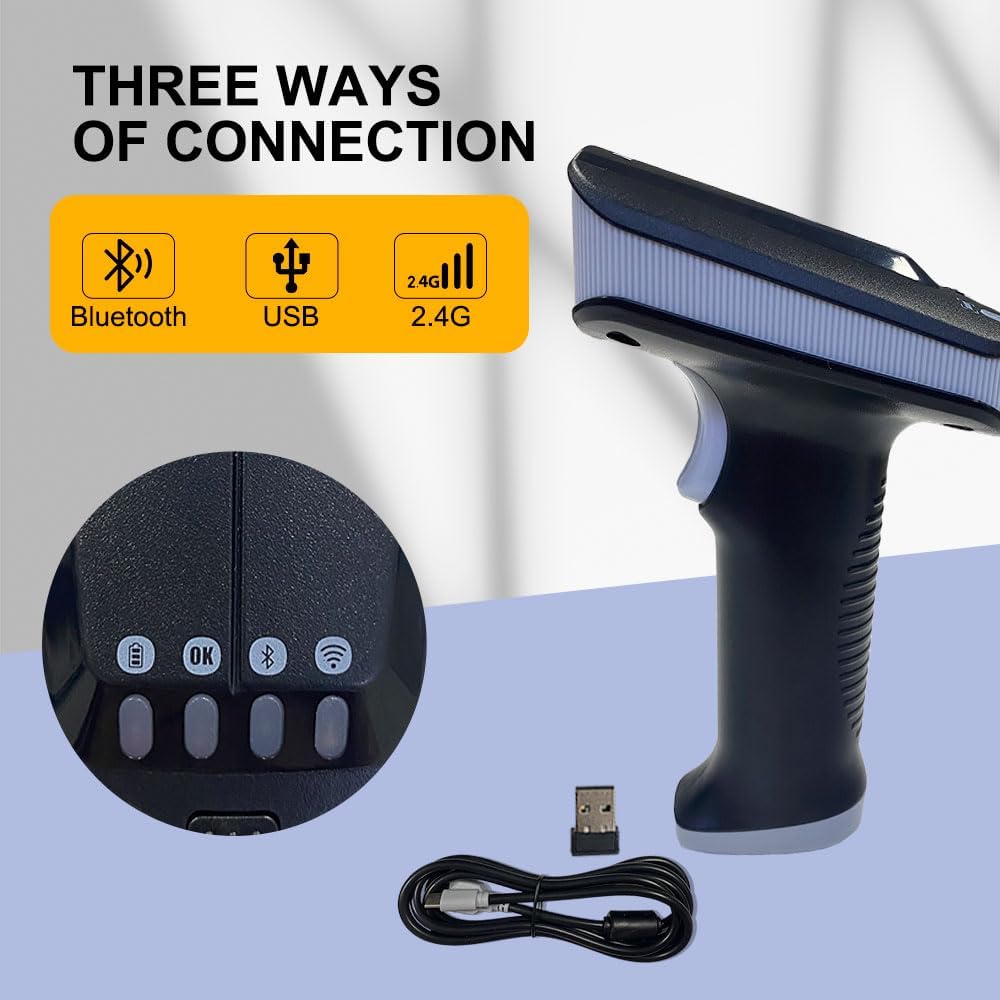
Figure 3: Illustration of the three connection methods: Bluetooth, USB, and 2.4G wireless, along with the 2.4G USB dongle and USB cable.

Figure 4: Diagram showing the wireless communication distances for 2.4G (0-80m) and Bluetooth (0-20m) in an open environment.
Multiple Reading Modes
The SR290 supports various data capture modes to meet diverse operational needs:
- RFID Tags Anake: Dedicated mode for reading UHF RFID tags.
- 1D-2D QR Barcodes Only: For scanning traditional 1D barcodes and 2D QR codes.
- RFID Tags and 1D 2D QR Codes Simultaneously: A combined mode for comprehensive data capture.
To switch between modes, use the dedicated mode switching key on the device. Refer to the indicator lights for the active mode.

Figure 5: Visual representation of the scanner's ability to read 1D barcodes, 2D QR codes, and RFID tags.

Whakaatu 6: Taipitopito view of the mode switching key and instructions for selecting UHF-Mode, Barcode Mode, or UHF+Barcode Mode.
Tukanga Matawai
To scan a barcode or RFID tag:
- Ensure the scanner is powered on and connected to your host device.
- Select the appropriate reading mode (RFID, Barcode, or combined).
- Point the scanner's reading window at the barcode or RFID tag.
- Press the trigger button. The scanner will emit a light beam or RFID signal.
- Upon successful read, the scanner will provide vibration feedback and/or an audible beep, and the indicator lights will change. The data will be transmitted to the connected device.
Nga ahuatanga me nga tohu
The SR290 is designed with user feedback and clear indicators:
- Urupare Wiri: The device provides tactile feedback upon successful scans, confirming data capture.
- Four-Color Indicator Lights: A set of four distinct colored lights (Red, Yellow, Blue, Green) provide visual cues for battery status, connection status, and scanning feedback.

Whakaahua 7: Whakatata view of the SR290's indicator lights and a visual representation of its vibration feedback capability.
Te mauroa me te Hoahoa
The YANZEO SR290 is built for demanding environments, featuring:
- Te Pūmau Tino Pai: Engineered to withstand a 1.5-meter drop onto a concrete floor, ensuring resilience in active work settings.
- Hoahoa Ergonomic: The handheld form factor is designed for comfortable grip and prolonged use, reducing operator fatigue.

Figure 8: Depiction of the SR290's drop-proof design, illustrating its ability to withstand a 1.5-meter fall onto a hard surface.
Te tiaki
Te horoi i te Pūrere
To maintain optimal performance and hygiene, regularly clean your SR290 scanner:
- Whakamahia he kakahu ngohengohe, karekau he ngongo paku dampka whakakikoruatia ki te wai, ki te wairewa horoi ngawari ranei.
- Wipe the exterior of the device, paying attention to the scanning window.
- Do not use harsh chemicals, solvents, or abrasive materials, as these can damage the device.
- Kia tino mohio kei uru te wai ki te putanga utu, ki ētahi atu pūwāhi rānei.
Tiaki Pūhiko
To maximize the lifespan of the lithium-ion battery:
- A ape i te tino tuku i te pākahiko i nga wa katoa.
- Whakaorangia te taputapu ki te waahi makariri, maroke ki te kore e whakamahia mo te wa roa.
- Charge the device regularly, even if not in daily use, to prevent deep discharge.
Raparongoā
This section addresses common issues you might encounter with your YANZEO SR290 scanner.
Kaore te Pūrere i te hiko
- Takina Pūhiko: Ensure the battery is charged. Connect the scanner to a power source and allow it to charge for at least 30 minutes before attempting to power on again.
- Pātene Hiko: Confirm you are pressing and holding the power button for the required duration (typically 2-3 seconds).
Matawai Take
- Aratau Hē: Verify that the scanner is set to the correct reading mode (RFID, 1D/2D Barcode, or combined) for the item you are trying to scan.
- Tawhiti/Koki: Adjust the distance and angle between the scanner and the barcode/RFID tag. Ensure the entire code/tag is within the scanning area.
- Tukino: Inspect the barcode or RFID tag for damage, smudges, or poor print quality.
- Ngā Āhua Taiao: Strong ambient light can sometimes interfere with barcode scanning. Try scanning in a different lighting condition.
Nga raruraru Hononga
- Hononga Nihokikorangi:
- Ensure Bluetooth is enabled on your host device and the scanner is in Bluetooth pairing mode.
- Delete previous pairings on your host device and re-pair.
- Check the distance between the scanner and host device; ensure it's within the 20m range.
- Hononga Ahokore 2.4G:
- Ensure the 2.4G USB dongle is securely plugged into your computer.
- Verify the scanner is in 2.4G wireless mode.
- Check the distance between the scanner and the dongle; ensure it's within the 80m range.
- Hononga USB Waea:
- Ensure the USB cable is securely connected to both the scanner and the host device.
- Whakamātauria tētahi tauranga USB rerekē i tō rorohiko.
- Whakamatautau ki te taura USB rereke mena ka waatea.
Whakatakotoranga
Detailed technical specifications for the YANZEO SR290:
| Āhuahira | Whakatakotoranga |
|---|---|
| Tau tauira | SR290 |
| Ahu mōkihi | 7.68 x 4.21 x 3.27 inihi |
| Taumaha Tūemi | 12.1 hekere |
| Momo Pūhiko | 1 pākahiko Lithium Polymer (kei roto) |
| Pūhiko Raukaha | 2000mAh |
| Hangarau Hononga | Bluetooth, USB Cable, 2.4G Wireless |
| Wireless 2.4G Range | 0-80m (open environment) |
| Awhe Nihokikorangi | 0-20m (open environment) |
| Pūrere Hototahi | Desktop, Laptop, Smartphone |
| Puna Mana | Pūhiko Powered |
| Kaihanga | YANZEO |
| Te Ra Tuatahi Wātea | Hui-tanguru 15, 2024 |
Pūtāhui me te Tautoko
YANZEO products are manufactured to high quality standards. For information regarding warranty coverage, technical support, or service, please contact YANZEO customer support.
You can find more information and contact details on the official YANZEO webpae:


