1. Kupu Whakataki
This manual provides detailed instructions for the installation, operation, and maintenance of the QOLTEC 50900 Three Phase Electronic Energy Consumption Meter. This device is designed for measuring active energy consumption in three-phase, four-wire AC circuits. Please read this manual thoroughly before installation and use to ensure proper function and safety.
2. Nga korero haumaru
WHAKATŪPATO: Installation and maintenance of this device must be performed by qualified personnel only. Failure to follow these instructions can result in electric shock, fire, or serious injury.
- Me momotu te hiko i mua i te tāutanga, i te mahi rānei i te mita.
- Ensure all wiring connections are secure and correct according to the wiring diagram.
- Do not operate the meter in environments exceeding its specified operating conditions.
- Do not open or modify the meter casing. Kaore he waahanga e taea ana e te kaiwhakamahi ki roto.
- Protect the meter from moisture, dust, and direct sunlight.
3. Hua Neke Atuview
The QOLTEC 50900 is a compact, DIN rail mountable electronic energy meter designed for accurate measurement of three-phase energy consumption. It features an LCD display for clear readings and a pulse output for remote monitoring.

Figure 3.1: QOLTEC 50900 Energy Meter showing dimensions (75mm x 92mm x 76mm) and key features like Three Phase Type, 230V Rated Voltage, 1.0 Precision Class, and LCD Display.
Āhuatanga matua:
- Three-phase, four-wire measurement
- LCD digital display for energy consumption (kWh)
- DIN rail mounting (4P width)
- High accuracy (Class 1.0)
- Pulse output (400imp/kWh)
- Mahi voltage: 3x230/400V
4. Whakatakotoranga
| Tawhā | Uara |
|---|---|
| Tauira | 50900 |
| Whakatauhia Voltage | 3x230/400V AC |
| Whakatauhia o naianei | 3x10(100)A |
| Auautanga | 50Hz |
| Karaehe Tika | 1.0 |
| Whakaatu | LCD |
| Puta Putanga | 400imp/kWh |
| Tāutatanga | DIN Rail (4P) |
| Ahu (W x H x D) | 75 x 92 x 76 mm |
| Taumaha | 100 g |
| Rauemi | kiriaku |
5. Tatūnga me te Tāuta
The QOLTEC 50900 meter is designed for standard 35mm DIN rail mounting. Ensure the installation location is dry, well-ventilated, and free from excessive vibration or electromagnetic interference.
5.1 Whakapiki
- Locate a suitable 35mm DIN rail within your electrical panel.
- Align the meter's DIN rail clip with the rail.
- Pēhia te mita ki runga i te reera kia pāwhiri rā anō ki tōna wāhi tika.

Figure 5.1: The QOLTEC 50900 meter securely mounted on a DIN rail, showing its compact form factor.
5.2 Hononga Waea
NUI: All wiring must comply with local electrical codes and regulations. Ensure power is OFF before making any connections.
- Identify the input (IN) and output (OUT) terminals on the meter.
- Connect the incoming three-phase lines (L1, L2, L3) and Neutral (N) to the corresponding IN terminals (typically 5, 6, 7, 8).
- Connect the outgoing three-phase lines (L1, L2, L3) and Neutral (N) to the corresponding OUT terminals (typically 1, 2, 3, 4).
- Me whakarite kia piri, kia mau nga hononga katoa kia kore ai e wetewete nga hononga me te wera nui.

Whakaahua 5.2: Taha view of the meter showing the wiring diagram for input (IN) and output (OUT) connections for L1, L2, L3, and Neutral.

Whakaahua 5.3: Mua view of the meter with its LCD display and a separate view of the terminal block for wiring connections.
6. Nga Tohutohu Whakahaere
Once properly installed and powered, the QOLTEC 50900 meter will automatically begin measuring energy consumption.
6.1 Whakaaturanga LCD
The LCD displays the total active energy consumption in kilowatt-hours (kWh). The display is continuous and does not require any button presses for basic reading.
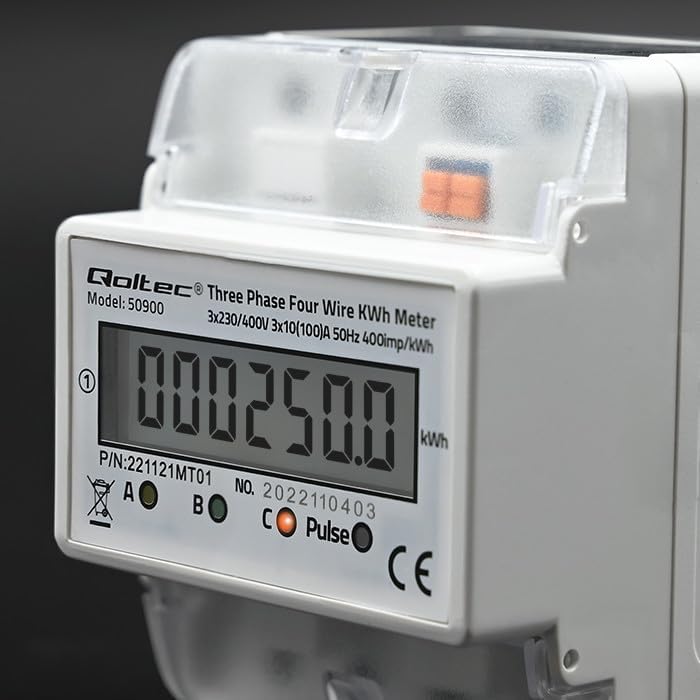
Whakaahua 6.1: Whakatata view of the LCD display showing an example energy reading in kWh.
6.2 Putanga Putanga
The meter features a pulse output (400imp/kWh) which can be used to connect to external monitoring systems for remote data collection. Refer to the external system's documentation for connection details.
7. Tiaki
The QOLTEC 50900 energy meter is designed for maintenance-free operation under normal conditions.
- Te horoi: Use a soft, dry cloth to clean the meter's exterior. Do not use abrasive cleaners, solvents, or liquids that could enter the casing.
- Tirotiro: Periodically inspect the wiring connections for any signs of loosening or damage. Ensure the meter is free from dust accumulation.
- Nga Tikanga Taiao: Me whakarite kia noho tonu te taiao mahi i roto i ngā awhe pāmahana me te haumākū kua tohua hei whakaroa i te roa o te ora o te mita.
8. Te Raru
If you encounter issues with your QOLTEC 50900 meter, refer to the following common problems and solutions:
| Raruraru | Take pea | Rongoā |
|---|---|---|
| Kāore he whakaaturanga/kāore te mita e whakakā ana | No power supply; Incorrect wiring; Blown fuse in circuit | Check power supply to the meter. Verify wiring connections. Check circuit breaker/fuse. |
| Incorrect energy reading | Incorrect wiring; Faulty meter | Verify wiring connections against the diagram. If wiring is correct, contact support. |
| Pulse output not working | Incorrect connection to external system; Faulty meter | Check pulse output wiring to the external system. Consult external system's manual. If issue persists, contact support. |
If the problem persists after attempting these solutions, please contact Qoltec customer support.
9. Pūtāhui me te Tautoko
Qoltec products are manufactured to high-quality standards. For warranty information and technical support, please refer to the warranty card included with your product or visit the official Qoltec webpae. Puritia to riiki hoko hei tohu mo te hoko.


