Kupu Whakataki
Thank you for choosing the Powerhorse Propane Hot Water Pressure Washer. This powerful and efficient machine is designed for heavy-duty cleaning tasks, utilizing both gas power and a propane burner to deliver hot water for superior cleaning performance. This manual provides essential information for the safe and effective operation, maintenance, and troubleshooting of your pressure washer. Please read this manual thoroughly before operating the unit and keep it for future reference.
Nga korero haumaru
Operating a pressure washer requires adherence to strict safety guidelines to prevent injury or damage. Always wear appropriate personal protective equipment (PPE), including eye protection, hearing protection, and sturdy footwear. Never point the spray gun at people, animals, or electrical outlets. Ensure the work area is clear of obstructions and well-ventilated, especially when operating the propane burner. Disconnect the spark plug wire before performing any maintenance. Keep children and pets away from the operating unit.
Tatūnga
Before first use, ensure all components are present and undamaged. Refer to the packing list provided with your unit. Assembly is required for certain parts.
1. Wewetewete me te Huihuinga
Carefully remove all components from the packaging. Attach the wheels, handle, and any other accessories as per the assembly diagrams in your quick start guide. Ensure all bolts and fasteners are securely tightened.

Image: The Powerhorse Propane Hot Water Pressure Washer fully assembled, showcasing its robust frame, engine, pump, and propane burner unit.
2. Tuhono Waiwai
Connect a garden hose (minimum 5/8 inch diameter) to the water inlet on the pressure washer pump. Ensure the water source provides sufficient flow (at least 4 GPM) and pressure. Use a clean water source to prevent damage to the pump. Turn on the water supply fully before starting the engine to purge air from the system.
3. Connecting Propane Tank
Place a standard 20 lb (or larger) propane tank onto the designated platform on the pressure washer. Connect the propane hose from the burner unit to the propane tank valve. Ensure all connections are tight and check for leaks using a soapy water solution before operation.

Whakaahua: He taha view of the Powerhorse pressure washer, highlighting the propane tank securely mounted and connected to the burner system.
4. Adding Engine Oil and Fuel
Fill the engine crankcase with the recommended type and amount of engine oil (refer to the engine manual for specifics). Fill the fuel tank with fresh, unleaded gasoline. Do not overfill. Always use a fuel stabilizer if storing the unit for extended periods.
Nga Tohutohu Whakahaere
A pee i enei mahi mo te mahi haumaru me te whai hua o to horoi pehanga.
1. Ka timata te Miihini
- Ensure the water supply is fully open and the garden hose is connected.
- Squeeze the spray gun trigger to purge air from the pump and high-pressure hose until a steady stream of water emerges.
- Set the engine switch to 'ON'.
- Whakatuwheratia te piha wahie.
- Apply choke if the engine is cold.
- Pull the recoil starter handle firmly until the engine starts. Once started, gradually open the choke.
2. Using the Hot Water Function
The propane burner heats water up to 150°F for enhanced cleaning of grease and grime.

Image: The Powerhorse pressure washer in operation, demonstrating its ability to heat water up to 150°F for effective cleaning.
- With the engine running and water flowing, open the propane tank valve.
- Locate the burner ignition switch/button and activate it. The burner should ignite, and you will hear a distinct flame sound.
- Allow a few minutes for the water to heat up to the desired temperature.
- Adjust the temperature control knob if available, to fine-tune the water temperature.

Image: A close-up of the control panel on the Powerhorse pressure washer, showing the adjustable temperature settings for customized cleaning.
3. Cleaning Techniques and Nozzles
Select the appropriate nozzle for your cleaning task. Different colored nozzles provide varying spray patterns and pressures. Always start with a wider spray pattern and lower pressure on an inconspicuous area to avoid damaging the surface. Maintain a safe distance from the cleaning surface.

Image: A person effectively cleaning the side of a trailer with the Powerhorse pressure washer, demonstrating its powerful spray.
4. Kati
- Turn off the burner ignition.
- Katia te marere tank propane.
- Whakawetohia te whakawhiti miihini.
- Whakawetohia te puna wai.
- Patohia te keu pu rehu hei tuku i te toenga o te pehanga i roto i te punaha.
- Momotuhia te ngongo ngongo kari me te ngongo pehanga teitei.
Te tiaki
Regular maintenance is crucial for the longevity and optimal performance of your pressure washer.
1. Engine Maintenance
Regularly check and change the engine oil as recommended in the engine manual. Clean or replace the air filter periodically, especially in dusty conditions. Inspect the spark plug and replace if necessary. Ensure the engine cooling fins are free of debris.
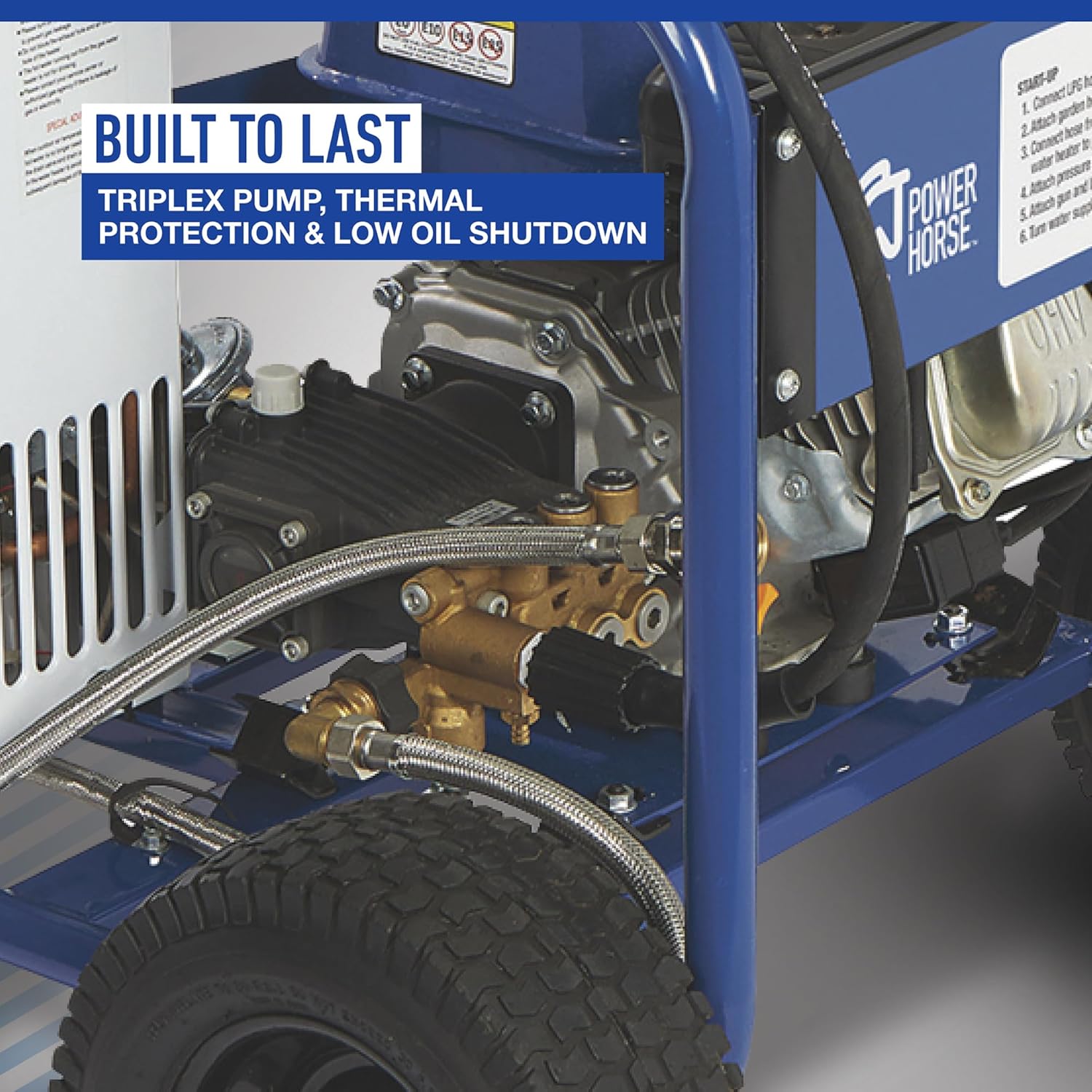
Whakaahua: He taipitopito view of the Powerhorse pressure washer's robust triplex pump and 212cc OHV engine, highlighting components critical for maintenance.
2. Pump Maintenance
After each use, flush the pump with clean water. For extended storage, use a pump protector or antifreeze solution to prevent freezing and corrosion. Inspect the high-pressure hose for kinks, cuts, or abrasions. Clean the nozzle tips regularly to prevent blockages.
3. Rokiroki
Store the pressure washer in a dry, protected area, away from extreme temperatures. If storing for more than 30 days, drain the fuel tank and carburetor, or use a fuel stabilizer. Apply pump protector as described above.
Raparongoā
Ko tenei waahanga e aro ana ki nga take noa ka pa ki a koe.
| Raruraru | Take pea | Rongoā |
|---|---|---|
| E kore e timata te miihini | No fuel; Spark plug issue; Choke not set correctly; Engine switch OFF | Add fuel; Check/replace spark plug; Adjust choke; Turn engine switch ON |
| Karekau he pehanga wai | Ka mutu te tuku wai; Te ngongo ngongo; Puha purua; Te hau i roto i te papu | Turn on water; Straighten hose; Clean nozzle; Purge air from pump |
| Karekau he wai wera | Propane tank empty/closed; Burner ignition failure; Low water flow | Check propane; Inspect ignition system; Ensure adequate water supply |
| Ka rere kino te miihini | Stale fuel; Dirty air filter; Clogged fuel filter | Drain and refill with fresh fuel; Clean/replace air filter; Replace fuel filter |
Mena ka mau tonu nga raru i muri i te whakamatau i enei otinga, tena koa whakapā atu ki te tautoko a te kaihoko.
Whakatakotoranga
| Āhuahira | Whakatakotoranga |
|---|---|
| Waitohu | Te hoiho kaha |
| Tau tauira | 3600 PSI HOT WATER |
| Puna Mana | Gas-powered with Propane Burner |
| Pehenga Morahi | 3600 PSI |
| Rere Rere Morahi | 2.6 GPM |
| Mihini | Powerhorse 212cc OHV Engine |
| Heated Water Temperature | Tae atu ki te 150°F |
| Te roa o te ngongo | 30 Puawai |
| Taumaha Tūemi | 176.5 Pauna |
| Rahi Hua (L x W x H) | 37"L x 23.03"W x 36.22"H |
| UPC | 840321755025 |
Nga korero Whakaputanga
This Powerhorse pressure washer is covered by a manufacturer's warranty. For specific details regarding warranty coverage, terms, and conditions, please refer to the warranty card included with your product or visit the official Powerhorse webpae. Puritia to tohu hoko mo etahi kereme whakamana.
Tautoko Kiritaki
For technical assistance, parts, or service, please contact Powerhorse customer support. Contact information can typically be found on the product packaging, the manufacturer's website, or your purchase documentation. When contacting support, please have your model number and serial number ready.


