Kupu Whakataki
Thank you for choosing the WORKPRO 1/4" Torque Wrench. This manual provides essential information for the safe and effective operation, maintenance, and care of your new tool. Please read this manual thoroughly before use and retain it for future reference.
Ihirangi mōkī:
- 1 x WORKPRO 1/4" Torque Wrench
- 1 x Kawe Kawe
- 1 x Pukapuka Tohutohu (tenei tuhinga)
Nga korero haumaru
Always observe basic safety precautions when using tools to reduce the risk of personal injury. Read and understand all instructions.
- Mauria ngā taputapu tiaki whaiaro (PPE) e tika ana, pērā i ngā mōhiti tiaki.
- Ensure the workpiece is stable and secured before applying torque.
- Kaua e neke ake i te kaha taipana morahi o te wiwi (25 Nm).
- Kaua e whakamahi i te whiri taipana hei pae pakaru.
- Tiakina nga tamariki me te hunga e noho tata ana i a koe e whakahaere ana i te taputapu.
- Whakaorangia te taputapu ki te waahi maroke, haumaru ki te kore e whakamahia.
- Do not attempt to modify or repair the torque wrench yourself. Contact qualified service personnel.
Waehanga
Familiarize yourself with the parts of your WORKPRO 1/4" Torque Wrench.
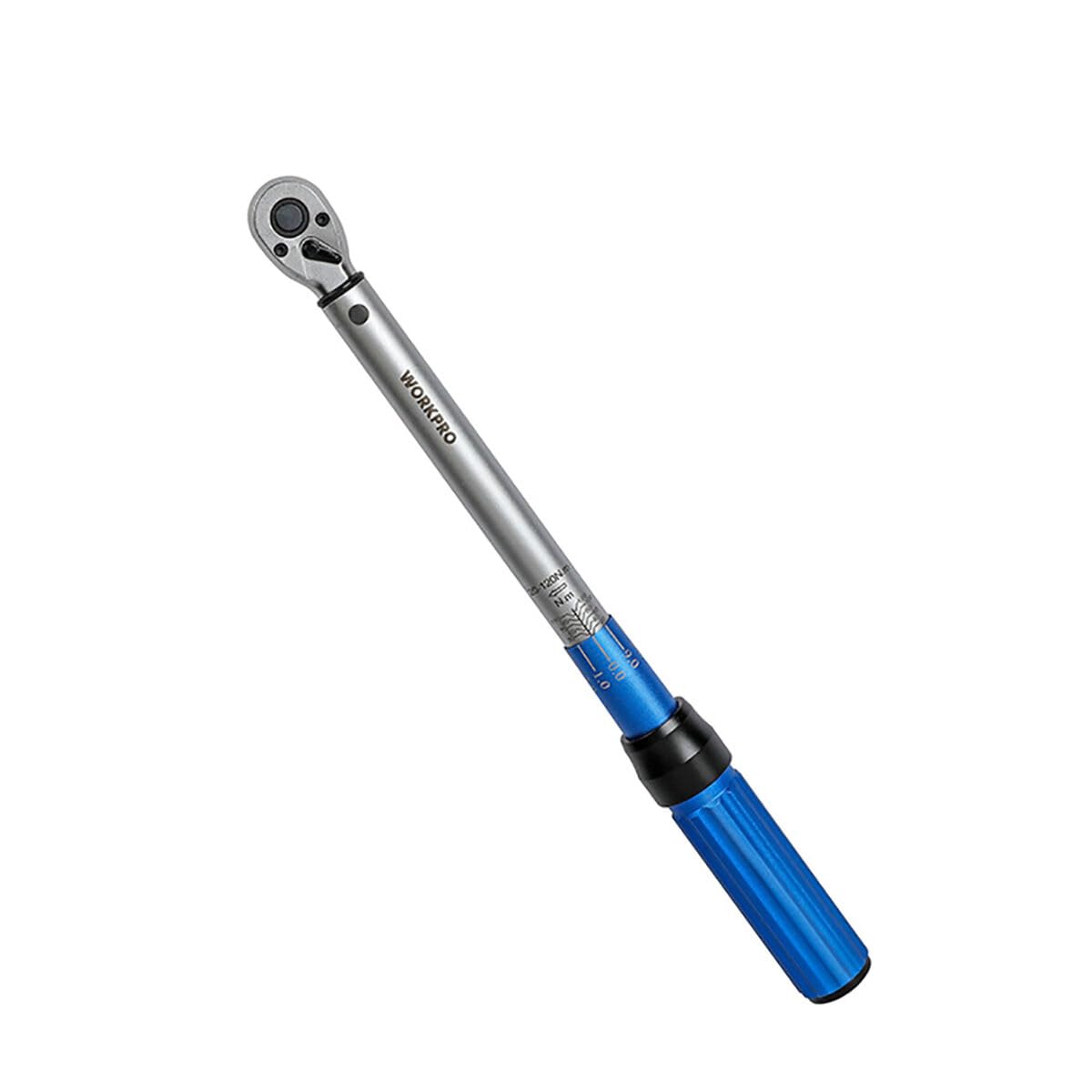
Image: The WORKPRO 1/4" Torque Wrench, typically shown with its protective carrying case. Key components include the drive head, main body with torque scale, adjustment collar, and handle.
Wāhanga Matua:
- Drive Head: 1/4" square drive for sockets.
- Tauine Torque: Markings for setting desired torque values (Nm).
- Adjustment Collar/Knob: Used to set the torque value.
- Tikanga Maukati: Secures the set torque value.
- Kakau: Provides grip during operation.
Tatūnga
1. Wewetewete me te Tirotiro:
Carefully remove the torque wrench from its carrying case. Inspect the tool for any signs of damage that may have occurred during shipping. Do not use the tool if it appears damaged.
2. Setting the Torque Value:
- Unlock the adjustment collar by rotating the locking mechanism (usually a knob at the end of the handle or a collar at the base of the handle).
- Rotate the handle or adjustment collar to align the desired torque value on the main scale with the zero mark on the thimble scale. For example, to set 20 Nm, align the '20' mark on the main scale with the '0' mark on the thimble.
- For finer adjustments, continue rotating the handle until the desired increment on the thimble scale aligns with the main scale line. For example, to set 22 Nm, set to 20 Nm on the main scale, then rotate the thimble until the '2' mark aligns with the main scale line.
- Once the desired torque is set, lock the adjustment collar by rotating the locking mechanism back into its locked position. Ensure it is securely locked to prevent accidental changes during use.
Nga Tohutohu Whakahaere
1. Attaching the Socket:
Select the correct size socket for your fastener and firmly attach it to the 1/4" square drive head of the torque wrench.
2. Applying Torque:
- Place the socket onto the fastener (nut or bolt).
- Hold the torque wrench by the handle and apply steady, increasing pressure in a clockwise direction for right-hand threads.
- Continue applying pressure until you feel and hear a distinct "click" or "break" from the wrench. This indicates that the preset torque value has been reached.
- Immediately stop applying force once the click is felt/heard. Do not continue to tighten the fastener beyond this point.
- Remove the torque wrench from the fastener.
Tuhipoka Nui:
- Always pull the wrench, do not push, to maintain better control and safety.
- Do not use extensions between the drive head and the socket unless specifically designed for torque wrenches, as this can affect accuracy.
- After use, always return the torque wrench to its lowest torque setting (but not below the minimum) before storing to relieve spring tension and maintain calibration accuracy.
Te tiaki
Te horoi:
Wipe the torque wrench clean with a soft, dry cloth after each use. Do not use solvents or harsh chemicals, as these can damage the finish or internal components.
Rokiroki:
Store the torque wrench in its original carrying case in a dry, clean, and temperature-controlled environment. Always set the wrench to its lowest torque setting before storage to preserve the calibration spring.
Whakatikatika:
Torque wrenches are precision instruments and require periodic calibration to ensure accuracy. It is recommended to have your torque wrench calibrated by a qualified service center annually, or more frequently with heavy use.
Raparongoā
Wrench does not click:
- Te take pea: Torque setting is too high for the fastener, or the fastener is already overtightened.
- Rongoā: Recheck the required torque specification. Ensure the wrench is set correctly. Do not force the wrench beyond its capacity.
- Te take pea: Wrench is being used incorrectly (e.g., too fast, not a steady pull).
- Rongoā: Tāpirihia kia pumau, kia piki haereasing pressure. Listen and feel for the click.
Inaccurate torque:
- Te take pea: Kāore te kī i te tika te whakatikatika.
- Rongoā: Me whakarite ngaio te kowiri.
- Te take pea: He he te tautuhinga taipana.
- Rongoā: Double-check the torque setting against the required specification.
Whakatakotoranga
| Āhuahira | Whakatakotoranga |
|---|---|
| Tau tauira | S7923395 |
| Rahi Puku | 1/4 inihi |
| Awhe Torohū | 5-25 Nm |
| Te maha o nga Niho | 72 tpi |
| Rauemi Kakau | Konumohe |
| Ahu (L x W x H) | 7 x 49 x 6.8 cm |
| Taumaha | 729 karamu |
| Nga taputapu kei roto | Te Kawe i te Keehi |
Pūtāhui me te Tautoko
WORKPRO products are manufactured to high-quality standards. For warranty information, technical support, or service inquiries, please refer to the contact information provided with your purchase documentation or visit the official WORKPRO webpae.
Tuhipoka: Specific warranty terms may vary by region and retailer. Please retain your proof of purchase for warranty claims.
For further assistance, please contact WORKPRO customer service via their official webpae: www.workprotools.com


