1. Hua Neke Atuview
The Linshang LS310 water quality tester is a portable, pen-designed instrument engineered for accurate and comprehensive analysis of drinking water. It is capable of measuring six critical water quality parameters simultaneously without the need for reagents, providing an intelligent scoring system to easily interpret water quality levels.

Image: The LS310 Water Quality Tester, a compact, pen-shaped device, held in a user's hand, showcasing tona hoahoa kawe.
2. He aha kei roto i te Pouaka
I te whakatuwheratanga o te kete, ka kitea e koe nga waahanga e whai ake nei:
- Host (LS310 Water Quality Tester Unit)
3. Nga waahanga matua
- Smart Scoring System: Provides water quality scores based on Chinese drinking water standards, categorized into four levels: Fine, Good, Average, and Poor.
- Six-Parameter Measurement: Simultaneously measures COD, TOC, UV275, TDS, EC, and temperature without the need for chemical reagents, offering a comprehensive water quality assessment.
- Residual Chlorine Indication: UV275 measurement indirectly reflects the residual chlorine content in water.
- Hoahoa Kiato me te Kawe: Features a pen-like design for easy handling and portability.
- Nga tirotiro tairongo: Equipped with highly sensitive probes for accurate measurement results.
- IP67 Probe parewai: The probe is waterproof, ensuring durability and reliability in various testing environments.
- Mahi Kotahi-Patene: Simple and intuitive operation for quick measurements.
- TFT Color Screen Display: Utilizes a color screen with blue, green, yellow, and red backlights to visually indicate water quality levels.

Image: A comparison table highlighting the LS310's ability to measure six water quality parameters (TDS, COD, TOC, UV275, EC, Temperature) versus a standard TDS tester.

Image: The LS310 tester in use, showing its display with various water quality parameters and an intelligent score, indicating its multi-functionality.
4. Aratohu Tatūnga
- Wewete ana: Carefully remove the LS310 water quality tester from its packaging.
- Tirohanga Tuatahi: Check the device for any visible damage. Ensure the probe area is clean and free from debris.
- Whakahiko: Press the power button to turn on the device. The TFT color screen should illuminate.
5. Nga Tohutohu Whakahaere
5.1 Te Whanganga
- Whakaritea Sample: Tikina heiample of the water you wish to test (e.g., tap water, filtered water, bottled water).
- Immerse Probe: Gently immerse the probe end of the LS310 tester into the water sample. Ensure the water level reaches at least the 'lowest water mark' indicated on the device.
- Activate Measurement: Press the measurement button (usually indicated by a power/start icon) to initiate the test.
- Panui Hua: The device will display the COD, TOC, UV275, TDS, EC, and temperature readings on the TFT screen. The screen's backlight color will also indicate the overall water quality score.

Image: The LS310 tester being used to check the quality of various water types, including tap water, filtered water, natural sources, bottled water, public drinking water, and well water.
5.2 Interpreting Water Quality Scores
The LS310 provides an intelligent scoring system with four distinct water quality levels, indicated by the screen's backlight color:
- Maama Whakamuri Kahurangi: Excellent Water Quality
- Rama Whakamuri Kakariki: Good Water Quality
- Yellow Backlight: Average Water Quality
- Rama Whakamuri Whero: Kounga Waikore

Image: Visual representation of the LS310's display showing different water quality scores (Excellent, Good, Average, Poor) corresponding to blue, green, yellow, and red backlight colors.
5.3 Water Quality Standards Reference
The following table outlines the water quality standards used by the LS310, based on the "GB 5749-2002 Standards for drinking water quality":

Image: A detailed table presenting the water quality standards for COD, TOC, TDS, corresponding backlight colors, score ranges, and judgment levels (Fine, Good, Average, Poor).
5.4 Advanced Measurement Capabilities
The LS310 offers more comprehensive analysis compared to basic TDS testers, detecting various contaminants:

Image: A visual comparison demonstrating the LS310's ability to detect poor water quality due to E.coli contamination, while a standard TDS tester shows no such detection.
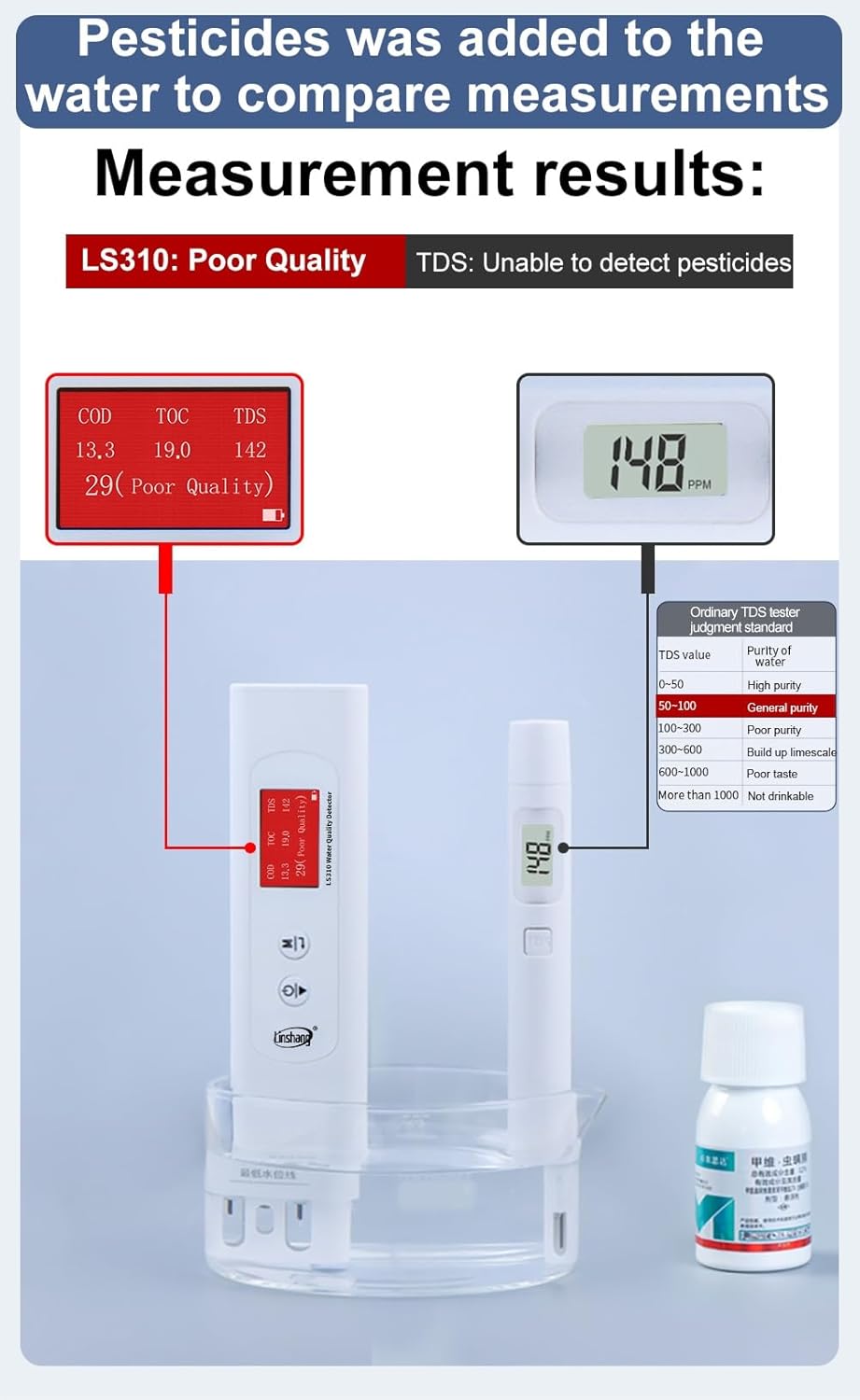
Image: A visual comparison illustrating the LS310's effectiveness in identifying poor water quality due to pesticide contamination, a capability lacking in typical TDS testers.
5.5 Ataata Whakaaturanga Hua
Video: This video demonstrates the compact design, sensitive probe, reagent-free operation, multi-parameter measurement, and waterproof features of the LS310 water quality tester, including its ability to test various water types.
6. Tiaki
- Whakapai i te tirotiro: After each use, rinse the probe thoroughly with clean water to prevent residue buildup. For stubborn deposits, gently wipe with a soft, damp kakahu. Kaua e whakamahi i nga matū abrasive me nga matū kino.
- Rokiroki: Store the LS310 in a cool, dry place away from direct sunlight and extreme temperatures. Ensure the probe is dry before storage.
- Tiaki Pūhiko: If the device uses replaceable batteries, remove them if the device will not be used for an extended period to prevent leakage.
7. Te Raru
- Kaore te Pūrere i te hiko:
- Check if batteries are correctly inserted or if the device needs charging.
- Me tino pehihia te paatene hiko.
- Nga Panui Heke:
- Ensure the probe is clean and free from air bubbles.
- Manatokohia te waiample is sufficient to cover the probe's sensors.
- Perform a calibration if available (refer to specific calibration instructions if provided with the device).
- Whakaatu Take:
- If the screen is dim, check battery levels.
- If the screen is frozen, try restarting the device.
8. Whakatakotoranga
| Āhuahira | Taipitopito |
|---|---|
| Hunga Hua | 10 x 9.98 x 10 inches; 7.05 ounces (approx. 25.4 x 25.35 x 25.4 cm; 0.2 kg) |
| Tauira Tuemi | LS310 |
| Waitohu | Linshang |
| Āhuahira Motuhake | Kawe |
| Whakatauranga parewai | IP67 (Pūtirotiro) |
| Tawhā Ine | COD, TOC, UV275, TDS, EC, Temperature |
| Tikanga Ine | Ultraviolet absorbance (for COD, TOC, UV275), Electrode conductance (for TDS, EC) |
| Momo Whakaatu | TFT Color Screen |
| Whenua Taketake | Haina |
| UPC | 764544737975 |
9. Pūtāhui me te Tautoko
For detailed warranty information and customer support, please refer to the documentation provided with your purchase or contact Linshang directly through their official website or authorized distributors. Specific warranty terms and conditions may vary.


