1. Neke atu i teview me nga ahuatanga
The BRESSER 10x42 Binoculars are designed for clear, high-powered viewing, suitable for various outdoor activities. They incorporate advanced optical technologies to ensure bright, high-contrast images with excellent color fidelity.
Āhuatanga matua:
- 10x42 Top Glass Optics: Provides 10x magnification with a 42mm objective lens diameter, offering a wide field of view (393/1000yds) and clear details over long distances.
- ESP Dielectric Coating & FMC Fully Multi-Layer Coated Lenses: Multi-layer prism coating captures and reflects over 99% of light, ensuring bright, high-contrast images and incredible color fidelity, even in low-light conditions.
- Argon Purging & O-Ring Sealing: Ensures IPX7 waterproofness and thermal stability, preventing fogging and protecting the binoculars from damage in adverse weather.
- Hanga Roa: Features a rubber armored polycarbonate shell for shockproof performance and a non-slip grip.
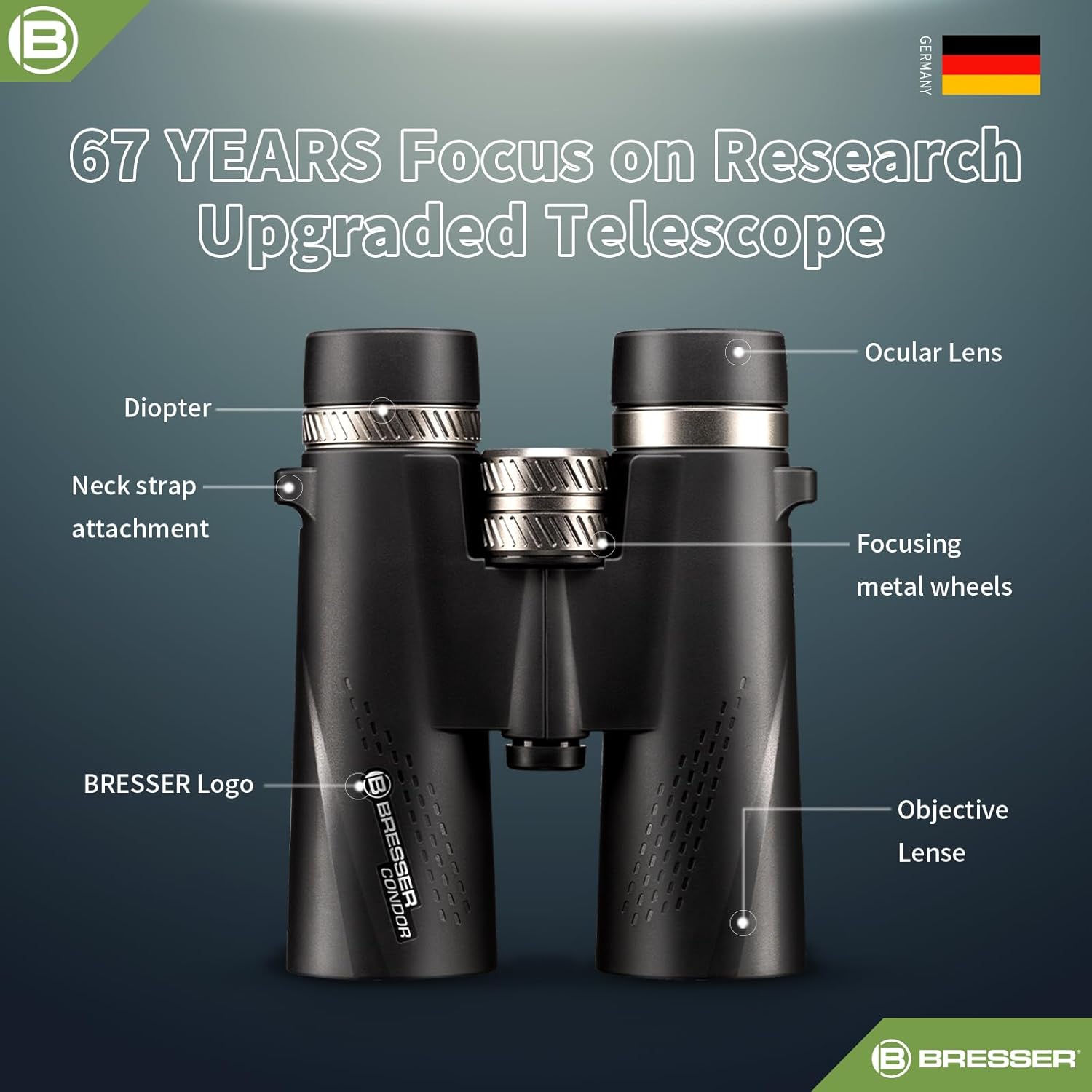
Figure 1: Key components of the BRESSER 10x42 Binoculars, including the ocular lens, diopter, focusing metal wheels, neck strap attachment, BRESSER logo, and objective lens.

Figure 2: The binoculars are designed for extreme weather conditions, featuring Extra Low Dispersion Glass, ESP Dielectric Coating, XPL Coating, and Fully Multi-Coated Lenses for optimal performance.

Figure 3: Detail of the FMC Coated Antireflective Green Film on the 42mm objective lens, ensuring superior light transmission and image clarity compared to ordinary coatings.
2. Ihirangi mokete
Manatokohia ko nga mea katoa kei raro nei kei roto i to kete:
- BRESSER 10x42 Binoculars
- Small Carrying Bag
- Uwhi Arotahi Whainga
- Eyepiece Rain Cover
- Herea kaki
- Karaka horoi horoi
- Pukapuka Tohutohu
- Kaari Raati

Figure 4: The complete package includes the binoculars, carrying bag, lens covers, neck strap, cleaning cloth, and documentation.
3. Tatūnga
3.1 Te Whakapiri i te Whitiki Kaki
- Locate the neck strap attachment points on each side of the binoculars (refer to Figure 1).
- Thread each end of the neck strap through the attachment points and secure them according to the strap's design. Ensure the strap is firmly attached to prevent accidental drops.
3.2 Te Whakatikatika i ngā Kapu Kanohi
The binoculars feature adjustable eyecups for comfortable viewing, especially for eyeglass wearers.
- Mō te hunga kāore e mau ana i ngā mōhiti: Twist the eyecups counter-clockwise to extend them to a comfortable position.
- Mo te hunga mau karu kanohi: Twist the eyecups clockwise to retract them fully. This allows your eyes to be closer to the ocular lenses, providing a full field of view.

Figure 5: Adjustable eyecups can be extended or retracted to suit individual viewing preferences, especially for those wearing eyeglasses.
4. Nga Tohutohu Whakahaere
4.1 Te Whakatikatika i te Tawhiti i waenganui i ngā Pupillary
The interpupillary distance (the distance between the centers of your pupils) varies from person to person. To achieve a single, clear circular field of view:
- Hold the binoculars with both hands and look through them.
- Adjust the distance between the two barrels by moving them closer together or further apart until you see a single, clear circular image.
4.2 Te Arotahi
To focus your binoculars:
- Close your right eye and look through the left eyepiece. Rotate the central focusing wheel until the image is sharp and clear.
- Close your left eye and look through the right eyepiece. Rotate the diopter adjustment ring (usually on the right eyepiece, refer to Figure 1) until the image is sharp and clear.
- Now, with both eyes open, use the central focusing wheel to focus on objects at varying distances. The diopter setting should remain constant for your eyes.

Figure 6: Proper technique for holding and focusing binoculars for optimal viewing during activities like bird watching.
Ataata 1: Kua mutu te huaview video demonstrating the binoculars' features and basic operation. This video provides a visual guide to handling and adjusting the binoculars.
5. Tiaki
5.1 Whakapai Arotahi
To clean the lenses of your binoculars:
- Gently brush off any dust or debris using the included lens cleaning cloth or a soft, lint-free brush.
- If necessary, use a small amount of lens cleaning fluid applied to the cloth (not directly to the lens) to wipe the lenses in a circular motion.
- Avoid using abrasive cloths or harsh chemicals, as these can damage the lens coatings.
5.2 Rokiroki
When not in use, store your binoculars in the provided carrying bag in a cool, dry place to protect them from dust, moisture, and impacts.

Figure 7: Always use lens caps and store binoculars in their protective case to prevent dust and scratches.
6. Te Raru
6.1 Unclear Image
- Ensure the central focusing wheel and diopter adjustment are correctly set for your eyes (refer to Section 4.2).
- Check if the lenses are clean and free from smudges or dust. Clean them as described in Section 5.1.
- Verify that the interpupillary distance is correctly adjusted to achieve a single circular field of view.
6.2 Fogging
- While the binoculars are fogproof due to argon purging, extreme temperature changes can sometimes cause temporary external condensation. Allow the binoculars to accclimate to the ambient temperature.
- Ensure all lens caps are securely in place when not in use to maintain the internal seal.
7. Whakatakotoranga
| Āhuahira | Taipitopito |
|---|---|
| Waitohu | BRESSER |
| Tauira | D.10*42 |
| Te Whakarahi Morahi | 10x |
| Te Diameter Arotahi Whainga | 42 Mirimita |
| Marae o View | 393 ft/1000 iari |
| Āhuahira Motuhake | Fog Proof, Waterproof (IPX7), Shockproof |
| Pūnaha Optical | HD Optical System, FMC Green Film, BAK4 Prism, ESP Dielectric Coating |
| Taumaha Tūemi | 2.42 pauna |
| Ahu mōkihi | 8.27 x 8.26 x 3.54 inihi |
8. Raihana me te Tautoko
BRESSER, a leading German optical brand since 1957, offers a lifetime US warranty for this product. For any inquiries or support, please contact the BRESSER 24-Hour Customer Experience Center.
Your purchase includes BRESSER's lifetime US warranty and customer service.


