1. Hua Neke Atuview
The Intel Wi-Fi 7 BE200.NGWG.NV is an advanced wireless network adapter designed to provide high-speed internet connectivity and Bluetooth capabilities for compatible desktop and laptop systems. Utilizing the latest Wi-Fi 7 (802.11be) standard, this module offers enhanced performance, lower latency, and improved efficiency, making it ideal for demanding applications such as online gaming, 4K/8K video streaming, and large file transfers. It supports dual-band (2.4 GHz, 5 GHz) and tri-band (6 GHz) operation, along with Bluetooth 5.4 for seamless peripheral connectivity.
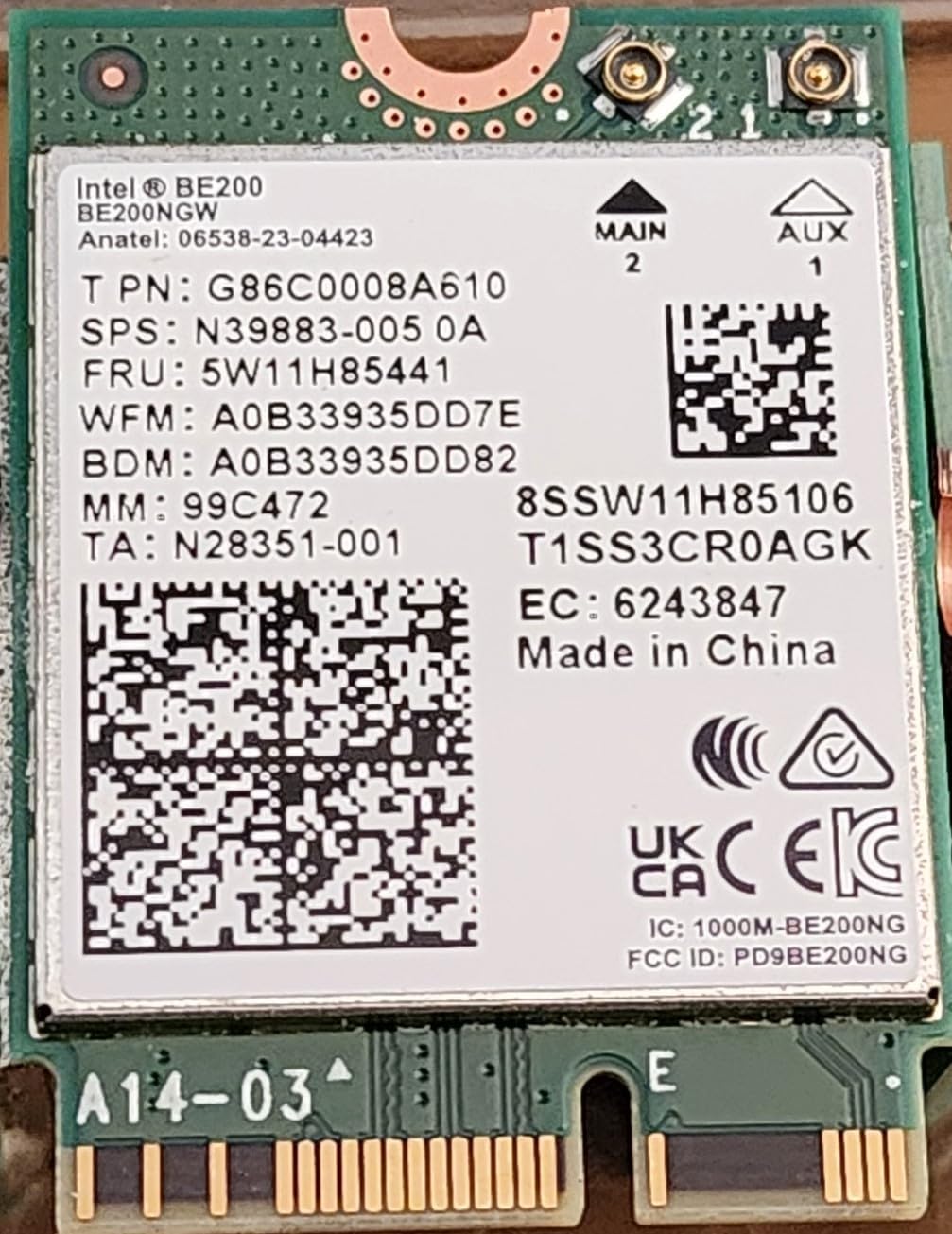
Whakaahua 1.1: Mua view of the Intel Wi-Fi 7 BE200 network card, showing the Intel branding, model number, and various regulatory markings.
2. Nga waahanga matua
- Wi-Fi 7 (802.11be) Standard: Supports the latest Wi-Fi standard for next-generation wireless performance.
- Teitei o te Whakaputa: Achieves a maximum speed of 5.8 Gbps across 2.4, 5, and 6 GHz bands.
- 2x2 TX/RX Streams: Features two transmit and two receive streams for robust and efficient data transfer.
- Whānuitanga o te Hongere 320 MHz: Utilizes wider channels for increased data capacity.
- 4K QAM: Employs higher-order modulation for greater data density per signal.
- Nihokikorangi 5.4: Provides advanced Bluetooth connectivity for peripherals and accessories.
- MU-MIMO (Kaiwhakamahi Maha, Whakauru-maha, Hua-Maha): Enhances network efficiency by allowing the router to communicate with multiple devices simultaneously.
- OFDMA (Uru Urunga Maha-Wehenga Auau-Orthogonal): Improves spectral efficiency and reduces latency in dense environments.
- Awhe Pawera Mahi: Designed to operate reliably from 0°C to 80°C.
- Compact M.2 2230 Form Factor: Suitable for integration into a wide range of compatible devices.

Whakaahua 2.1: Whakatata view of the Intel BE200 network card's label, displaying the model number (BE200NGW), Anatel certification, TPN, SPS, FRU, WFM, BDM, MM, TA, and QR codes.

Figure 2.2: Diagram explaining Intel Wi-Fi 7's Multi-link Operation, showcasing Enhanced Multi-Link Single-Radio (eMLSR) and Multi-Link Multi-Radio (MLMR) for more reliable connections and low latency applications.
3. Tatūnga & Tāuta
3.1. Whakatupato Haumaru
- Always disconnect the power cable and turn off your computer before opening the case.
- Discharge any static electricity by touching a grounded metal object (e.g., the computer chassis) before handling components. Consider using an anti-static wrist strap.
- Handle the network card by its edges to avoid touching the gold connectors or sensitive components.
- Ensure proper ventilation and a clean workspace.
3.2. Whakaritenga Pūnaha
- Available M.2 slot (Key E) on your motherboard or laptop.
- Supported Operating Systems: Windows 11, Windows 10, Linux (specific kernel versions may be required for full functionality).
- Compatible Wi-Fi 7 router/access point for optimal performance.
3.3. Installation Steps (Desktop PC)
- Whakaritehia to Pūnaha: Power off your computer and unplug all cables. Open the computer case.
- Kimihia M.2 Slot: Identify an available M.2 slot on your motherboard. It is typically labeled and may have a pre-installed standoff screw.
- Kōkuhu Kāri: Gently align the Intel BE200 network card with the M.2 slot's keying notch. Insert the card at a slight angle (approximately 30 degrees) into the slot until the gold contacts are fully seated.
- Tiakina te Kaari: Press the card down towards the motherboard. Secure it with the small screw provided with your motherboard or the network card, fastening it to the standoff.
- Connect Antennas (if applicable): If your system uses external antennas, carefully connect the antenna cables to the corresponding connectors on the network card (usually labeled MAIN and AUX).
- Katia te Puhi me te Hia: Katia te pouaka o tō rorohiko, honoa anō ngā taura katoa, ka whakakā i tō pūnaha.

Whakaahua 3.1: Hoki view of the Intel BE200 network card, showing the PCB and additional markings.

Figure 3.2: Multiple Intel BE200 network cards, illustrating their compact M.2 form factor.
4. Nga Tohutohu Whakahaere
4.1. Tāuta Atekōkiri
After physical installation, you will need to install the appropriate drivers for the Intel Wi-Fi 7 BE200 to function correctly. Your operating system may automatically detect and install generic drivers, but for optimal performance and full feature support, it is recommended to install the latest drivers directly from Intel's official webpae.
- Tikiake Atekōkiri: Visit the official Intel Download Center (www.intel.com/downloadcenter). Rapua "Intel Wi-Fi 7 BE200" or navigate to the wireless adapters section. Download the latest Wi-Fi and Bluetooth drivers compatible with your operating system (Windows 11, Windows 10, or Linux).
- Tāuta Atekōkiri: Run the downloaded installer executable. Follow the on-screen prompts to complete the installation. You may need to restart your computer after installation.
- Manatokohia te Tāutatanga: Open Device Manager (Windows) and check under "Network adapters" and "Bluetooth" to ensure the Intel Wi-Fi 7 BE200 and its Bluetooth component are listed and functioning without errors.
4.2. Te hono ki te Whatunga Wi-Fi
Once drivers are installed, your system will be able to detect available Wi-Fi networks.
- Uru Tautuhinga Whatunga: Click on the Wi-Fi icon in your system tray (Windows) or navigate to network settings (Linux).
- Tīpako Whatunga: Kōwhiria te whatunga Wi-Fi e hiahiatia ana e koe mai i te rārangi o ngā whatunga e wātea ana.
- Whakauru Kupuhipa: If prompted, enter the network security key (password) and click "Connect".
- Manatokohia te Hononga: Confirm that your device is connected to the internet.
4.3. Takirua Nihokikorangi
Hei hono i nga taputapu Nihokikorangi:
- Whakahohe Nihokikorangi: Ensure Bluetooth is enabled on your computer and the device you wish to pair.
- Whakauruhia te Aratau takirua: Whakahoutia tō pūrere Nihokikorangi ki te aratau takirua (tirohia te pukapuka ā-ringa o te pūrere).
- Tāpiri Pūrere: On your computer, go to Bluetooth settings (e.g., Settings > Bluetooth & devices on Windows) and click "Add device" or "Pair new device".
- Tīpakohia, ā, Tāruatia: Select your Bluetooth device from the list and follow any on-screen prompts to complete the pairing process.
5. Tiaki
To ensure optimal performance and longevity of your Intel Wi-Fi 7 BE200 network card, consider the following maintenance practices:
- Kia Whakahoutia nga Atekōkiri: Regularly check Intel's official website for the latest Wi-Fi and Bluetooth drivers. Driver updates often include performance improvements, bug fixes, and security enhancements.
- Whakahōu Pūnaha Whakahaere: Ensure your operating system (Windows, Linux) is kept up-to-date. OS updates can include network stack improvements and compatibility fixes that benefit your wireless adapter.
- Kia mau tonu te hau tika: Ensure your computer's cooling system is functioning correctly to prevent overheating, which can affect the performance and lifespan of internal components.
- Te ma: Periodically clean the interior of your computer case to prevent dust buildup, which can impede airflow and lead to overheating. Use compressed air for this purpose.
6. Te Raru
If you encounter issues with your Intel Wi-Fi 7 BE200 network card, try the following troubleshooting steps:
6.1. No Wi-Fi or Bluetooth Connectivity
- Tirohia te Tāutanga ā-Tino: Ensure the card is securely seated in the M.2 slot and any antenna cables are properly connected.
- Manatokohia nga taraiwa: Open Device Manager (Windows) and check if the Intel Wi-Fi 7 BE200 and Bluetooth devices are listed without yellow exclamation marks or red 'X's. If not, reinstall the drivers.
- Enable Wireless/Bluetooth: Ensure Wi-Fi and Bluetooth are enabled in your operating system settings and/or via any physical switches or keyboard shortcuts on your laptop.
- Tautuhinga BIOS/UEFI: Some motherboards have options to enable/disable M.2 slots or integrated wireless. Check your system's BIOS/UEFI settings.
6.2. Slow Wi-Fi Speed or Intermittent Connection
- Whakahōu Atekōkiri: Ensure you have the latest Wi-Fi drivers from Intel's webpae.
- Pouara/Pūwāhi Uru: Verify your router supports Wi-Fi 7 (802.11be) and is configured for optimal performance (e.g., using 6 GHz band if available, appropriate channel width).
- Kaha Waitohu: Check your Wi-Fi signal strength. Move closer to the router or consider using a Wi-Fi extender if the signal is weak.
- pokanoa: Other wireless devices (cordless phones, microwaves, other Wi-Fi networks) can cause interference. Try changing the Wi-Fi channel on your router.
- Tautuhi Whatunga: On Windows, try using the "Network Reset" feature (Settings > Network & Internet > Advanced network settings > Network reset).
6.3. Kāore te Pūrere Nihokikorangi e Honohono
- Aratau Hononga Pūrere: Ensure the Bluetooth device you are trying to pair is in discoverable/pairing mode.
- Tangohia ngā Tāruarua o nāianei: If the device was previously paired with another system, remove that pairing first.
- Restart Bluetooth Service: On Windows, you can restart the Bluetooth Support Service via Services (services.msc).
7. Whakatakotoranga Hangarau
| Āhuahira | Whakaahuatanga |
|---|---|
| Waitohu | Intel |
| Tau tauira | BE200.NGWG.NV |
| Hunga Hua | 1.15 x 0.84 x 0.92 inihi (29.2 x 21.3 x 23.4 mm) |
| Taumaha Tūemi | 0.106 hekere (3 Karamu) |
| Atanga Pūmārō | M.2 (Kī E) |
| Paerewa Ahokore | Wi-Fi 7 (802.11be) |
| Kawa Hononga Raraunga | IEEE 802.11, Bluetooth 5.4 |
| Rere Whakawhiti Raraunga | Tae atu ki te 5.8 Gbps |
| Paihere Auautanga | 2.4 GHz, 5 GHz, 6 GHz |
| Whirihoranga Antenna | 2x2 TX/RX Streams |
| Pūnaha Whakahaere Tautoko | Windows 11, Windows 10, Linux |
| Pūrere Hototahi | Desktop, Laptop, Server (with compatible M.2 slot) |
| Te Waahi Mahi | 0°C ki te 80°C |
| UPC | 735858547307 |
8. Pūtāhui me te Tautoko
8.1. Nga Korero Whakaputanga
Intel products are typically covered by a limited warranty. The specific terms and duration of the warranty for your Intel Wi-Fi 7 BE200 network card may vary based on your region and the retailer from whom you purchased the product. Please retain your proof of purchase for warranty claims.
For detailed warranty information, please refer to Intel's official warranty policy available on their webpae, whakapā atu ranei ki to waahi hoko.
8.2. Tautoko Hangarau
For further technical assistance, driver downloads, or product information, please visit the official Intel Support webpae:
You can also find community forums and knowledge base articles that may help resolve common issues.


