Nau mai haere mai
Thank you for choosing the M-AUDIO Forty Sixty 6.5-inch Studio Monitor Speaker. This manual provides essential information for setting up, operating, and maintaining your new studio monitor. Please read it thoroughly to ensure optimal performance and safe use of your device.
Nga Tohutohu Haumaru Nui
- Haumaru Hiko: Always connect the speaker to a grounded power outlet. Do not expose the unit to rain or moisture.
- Parenga Rongo: This loudspeaker is capable of delivering sound pressure levels of more than 85 dB, which may cause permanent hearing damage. Use caution when adjusting volume levels.
- Whakahau: Kia tika te hauhautanga huri noa i te kaikorero. Kaua e ārai i ngā pūaha hauhautanga.
- Turanga: Place the speaker on a stable, level surface to prevent it from falling.
Ihirangi mokete
Manatokohia ko nga mea katoa kei raro nei kei roto i to kete:
- Wha Tekau Ono Tekau Kai-korero
- Papa Motuhake
- Waea Hiko
- Tohutohu Tere
- Haumarutanga me te pukapuka Whakaputanga
Ka mutu te huaview
The M-AUDIO Forty Sixty 6.5-inch Studio Monitor is a 100W bi-amplified speaker designed for precise audio reproduction. It features a 6.5-inch Kevlar woofer for extended bass response and a 1-inch high-frequency driver with waveguide for clear highs. Advanced DSP processing and Burr-Brown analog-to-digital conversion ensure detailed sound. The speaker also offers Bluetooth 5.3 TWS audio streaming and control via the M-AUDIO Forty Series Control App.

Tatūnga
Turanga-a-tinana
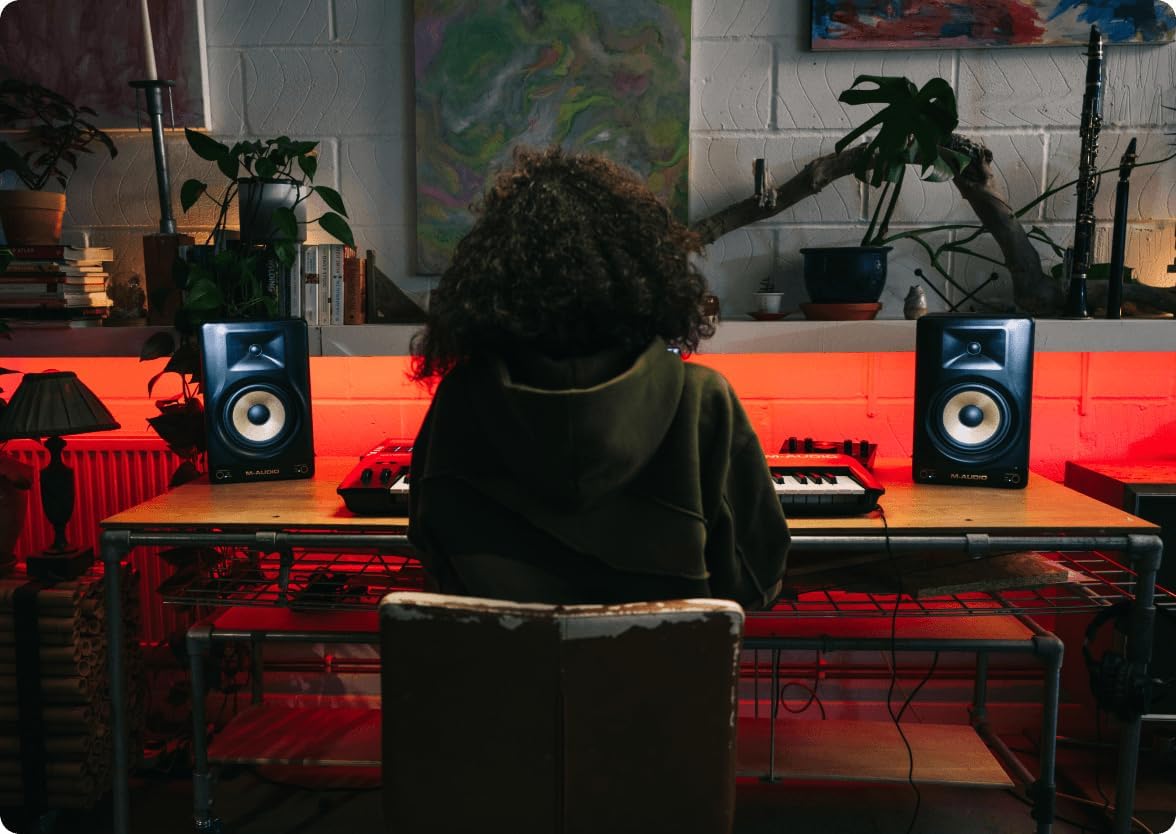
Proper placement of your studio monitors is crucial for accurate sound reproduction. Position the speakers to form an equilateral triangle with your listening position. Ensure the tweeters are at ear level. Use the included isolation pads to minimize unwanted vibrations and improve acoustic performance.
Hononga
The M-AUDIO Forty Sixty offers versatile input options for various audio setups:
- Tāuru XLR: For balanced connections from professional audio interfaces or mixers.
- Tāuru TRS: For balanced or unbalanced connections from audio interfaces, DJ rigs, or other studio equipment.
Connect your audio source to the desired input on the rear panel of the speaker. Ensure the power cable is securely connected to the speaker and a grounded power outlet.


Official Product Video: M-AUDIO FORTY series
An official M-AUDIO video showcasing the features and use cases of the Forty Series studio monitors, including connections and studio environments.
Nga Tohutohu Whakahaere
Te Hiko / Whakaweto
Locate the power switch on the rear panel of the speaker. Flip the switch to the 'ON' position to power on the unit. The power indicator LED on the front will illuminate. To power off, flip the switch to the 'OFF' position.
Mana Rōrahi
Adjust the overall output volume using the 'Volume' knob on the rear panel. Start with a low volume and gradually increase it to your desired listening level.
Aratau Whakarongo
The Forty Sixty features front panel buttons for instant listening modes:
- FLAT Mode: Provides a true, uncolored mix reference for accurate sound.
- HYPE Mode: Simulates how your mix will sound on consumer devices like earbuds or car stereos.
- Aratau ritenga: Allows you to apply personalized EQ settings configured via the M-AUDIO Forty Series Control App.

Hononga Nihokikorangi
The Forty Sixty supports Bluetooth 5.3 True Wireless Stereo (TWS) audio streaming. To pair your device:
- Me mohio kei te kaha te kaikorero.
- Whakahohehia te Nihokikorangi i runga i tō pūrere oro (waea atamai, papa, me ētahi atu).
- Select 'M-AUDIO Forty Sixty' from the list of available Bluetooth devices.
- Once paired, the Bluetooth indicator on the speaker will illuminate. For TWS pairing with a second speaker, refer to the Quickstart Guide.

M-AUDIO Forty Series Control App
Download the M-AUDIO Forty Series Control App to access advanced features, including customizable presets and a 5-band equalizer. The app allows you to fine-tune your speaker's output to match your room's acoustics and personal preferences.

Acoustic Tuning
The Forty Sixty incorporates precision DSP crossover and professional-grade Burr-Brown analog-to-digital conversion to ensure accurate and detailed sound. These technologies work together to deliver a balanced frequency response, crucial for critical listening and mixing.


Te tiaki
- Te horoi: Whakamahia he kakahu ngohengohe, maroke hei horoi i te taha waho o te kaikorero. Kaua e whakamahi i ngā kaihoroi whakakoi, i ngā whakarewa rānei.
- Rokiroki: Ki te kore e whakamahia mo te wa roa, penapena te kaikorero ki te waahi makariri, maroke, kia matara atu i te ra me te wera nui.
- Parenga: Protect the speaker cones from physical damage.
Raparongoā
- Kore Putanga Ororongo:
- Ensure the speaker is powered on and the volume is turned up.
- Verify that the audio source is connected correctly to the appropriate input (XLR or TRS).
- Check the input switch on the rear panel to ensure it matches your connected input type.
- Whakaūtia kei te purei tō pūtake oro, ā, kei te rawaka te rōrahi.
- Unexpected Popping Sound:
- A popping sound may occur if the Bluetooth pairing is lost. Try forgetting the speaker in your device's Bluetooth settings and re-pairing.
- Me whakarite kia mau nga hononga katoa me te kore e pokanoa.
Whakatakotoranga
| Āhuahira | Whakatakotoranga |
|---|---|
| Waitohu | M-AUDIO |
| Ingoa Tauira | FORTYSIXTY |
| Rahi Kaioro | 6.5 Inihi |
| Kaikorero Te Mana Putanga Morahi | 100 Watts |
| Woofer Diamita | 6.5 Inihi |
| Diamita Tweeter | 1 Inihi |
| Hangarau Hononga | Nihokikorangi |
| Putanga Nihokikorangi | 5.3 |
| Tikanga Mana | Taupānga |
| Hunga Hua | 8.6"D x 8.5"W x 13.2"H |
| Taumaha Tūemi | 15.84 pauna (7.2 Kirokaramu) |
| Rauemi | Kirihou |
| Tae | Pango |
| Puna Mana | Hiko Hiko |
| Whakautu auau | 22 KHz (Tepe o runga) |
Pūtāhui me te Tautoko
The M-AUDIO Forty Sixty Studio Monitor comes with a Limited Warranty. Please refer to the included Safety & Warranty Manual for detailed terms and conditions.
For technical support, troubleshooting assistance, or further inquiries, please visit the official M-AUDIO webpaetukutuku, whakapā atu ranei ki ta raatau tari ratonga kaihoko.


