Kupu Whakataki
This manual provides detailed instructions for the installation, operation, and maintenance of your AIDA Single Pole Motion Sensor Light Switch. This device is designed to enhance convenience and energy efficiency by automatically controlling lighting based on occupancy. Please read this manual thoroughly before installation and use to ensure proper function and safety.

Image: The AIDA Single Pole Motion Sensor Light Switch shown alongside its product packaging, highlighting its design and key features.
Nga Korero Haumaru Nui
WARNING: RISK OF ELECTRIC SHOCK. Improper installation can be dangerous or illegal. Always consult a qualified electrician if you are unsure about any part of the installation process.
- Whakawetohia te hiko: Always disconnect power at the circuit breaker or fuse box before installing or servicing the switch.
- Waea kupapa e hiahiatia ana: This device requires a neutral wire for proper operation. If your electrical box does not have a neutral wire, this switch is not compatible.
- Single Pole Only: This switch is designed for single-pole control only and is not suitable for 3-way or multiple-way circuits.
- UL/CUL Certified: The switch is UL and CUL listed, ensuring compliance with safety standards.
- Mahinga Mahi Voltage: Ensure your electrical system operates at 120 Volts (AC).
Ihirangi mokete
Manatokona kei te noho nga waahanga katoa i mua i te tiimata o te whakaurunga:
- AIDA Single Pole Occupancy Motion Sensor Light Switch
- Pereti Taiepa Korekau
- Wire Nuts (Terminal caps)
- Whakaeke Tiu
- Pukapuka Tohutohu (tenei tuhinga)
Whakatakotoranga Hua
| Āhuahira | Taipitopito |
|---|---|
| Whakatauranga Whakauru | 120/277V~50/60Hz |
| Applicable Load Types | 200W LED/CFL, 500W MLV, 500W INC/HAL, 5A Ballast (120V), 1/6HP Fan (4.4A 120V) |
| Momo Whakawhiti | pou kotahi |
| Mata Gauge | #14 - #12 AWG |
| Momo Waea | potae tauranga |
| Te Waahi Mahi | 32°F ki te 104°F (0°C ki te 40°C) |
| Rahi Hua | 4.17"x1.73"x1.77" (106x44x45mm) |
| Rauemi | Parahi, Parahi (Rauemi Whakapā) |
| Tikanga Mana | Sensor, Touch |

Image: A visual representation of the product dimensions and a detailed table of specifications for the AIDA motion sensor switch.

Image: A chart illustrating the universal compatibility of the AIDA motion sensor switch with various load types including LED/CFL, MLV, INV/HAL, Ballast, and Fan.
Tatūnga me te Tāuta
I mua i to tiimata:
- Whakawetohia te hiko: Locate your circuit breaker panel and turn off the power to the switch box you will be working on. Verify power is off using a voltage Kaiwhakamatautau.
- Tautuhi Waea: Carefully remove the existing wall plate and switch. Identify the following wires:
- Line Wire (Black): Ka haria te hiko mai i te pūwhakawhiti ara iahiko.
- Load Wire (Black): Ka haria te hiko ki te rama.
- Waea Kūpapa (Mā): Required for this switch.
- Waea Whenua (Parahi Kakariki, Parahi Tahanga rānei): For safety.
- Confirm Neutral Wire: This switch requires a neutral wire. If you do not have a neutral wire (typically white) in your electrical box, this switch is not compatible.
Tohutohu Waea:
Follow the wiring diagram carefully. Use the provided wire nuts to secure connections.
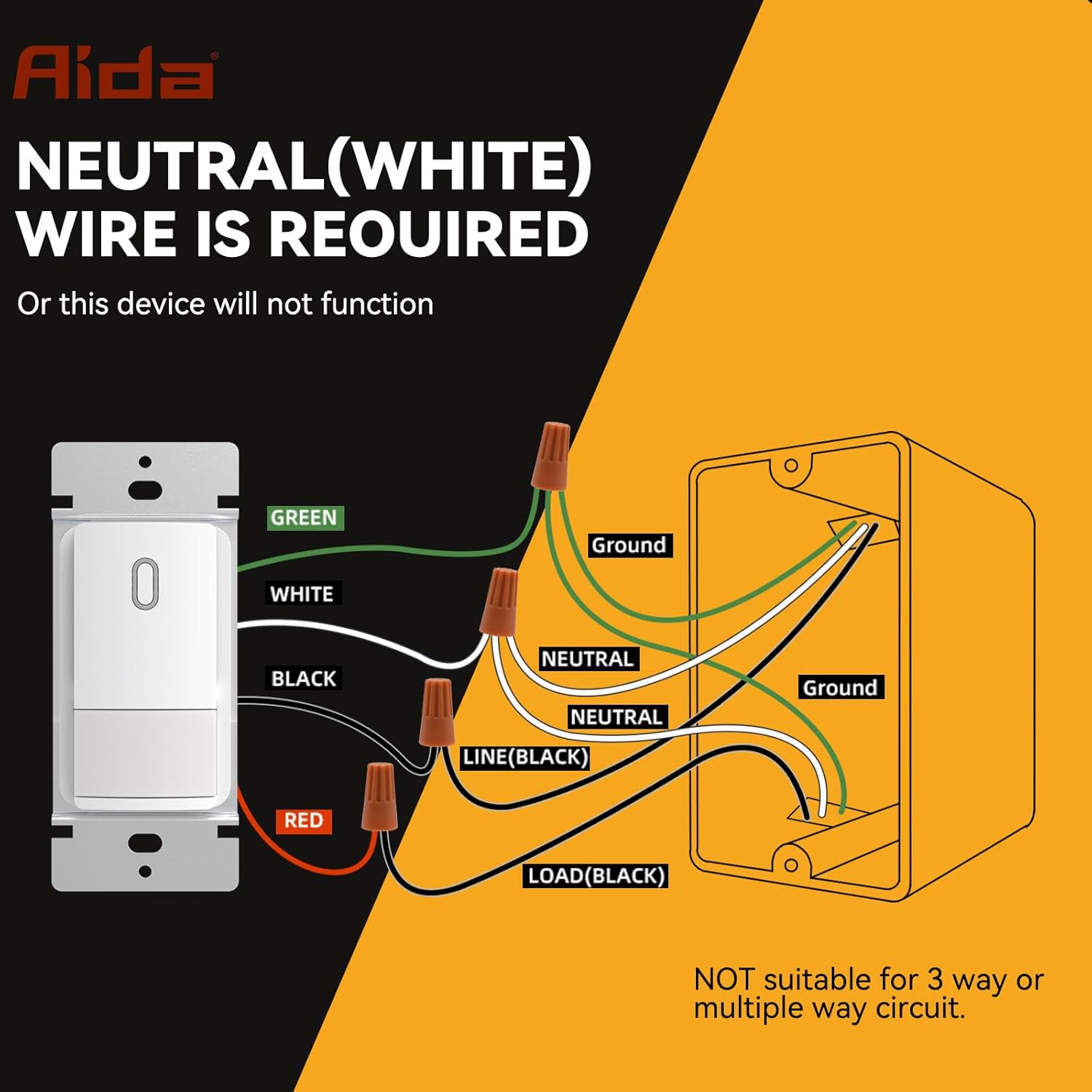
Image: A detailed wiring diagram showing connections for the AIDA motion sensor light switch, including Line, Load, Neutral, and Ground wires. It explicitly states that a neutral wire is required and the switch is not suitable for 3-way or multiple-way circuits.
- Honoa te KAKAKAKA wire from the switch to your house's WHENUA waea.
- Honoa te WHITE wire from the switch to your house's KORERO waea.
- Honoa te Pango wire from the switch to your house's RINA (wera) waea.
- Honoa te Whero wire from the switch to your house's UTANGA wire (to the light fixture).
Important: Ensure all connections are secure and insulated with wire nuts. This switch is for single-pole applications only. Do not use in 3-way or multi-way circuits.
Whakapiki i te Whakawhiti:
- Carefully fold the wires and push the switch into the electrical box.
- Secure the switch to the electrical box using the provided screws.
- Attach the screwless wall plate.
- Whakahokia te hiko i te kaaiti iahiko.

Image: A diagram showing the precise dimensions of the AIDA motion sensor light switch, its mounting bracket, and the screwless wall plate for easy installation.
Operating Instructions and Customization
The AIDA motion sensor switch offers various modes and adjustable settings to suit your needs.
Aratau Mahi:
- Occupancy Mode (Auto-On/Auto-Off): Lights automatically turn ON when motion is detected and OFF after a set delay when no motion is detected. Ideal for high-traffic areas like bathrooms, laundry rooms, and kitchens.
- Vacancy Mode (Manual-On/Auto-Off): Lights must be manually turned ON, but will automatically turn OFF after a set delay when no motion is detected. Suitable for bedrooms or TV rooms where you prefer manual control for turning on lights.
Tautuhinga Whakaritea:
The switch features internal dip switches for customizing settings. Carefully remove the faceplate to access these controls.

Whakaahua: He tata view of the AIDA motion sensor switch's internal settings, showing dip switches for Adjustable Light Level (Timeout), PIR Sensitivity, and Ambient Light Sensor Mode.
- Adjustable Light Level (Timeout): This setting determines how long the light stays on after the last detected motion. Options typically include 30 seconds, 1 minute, 5 minutes, 15 minutes, or 30 minutes. Refer to the switch's internal labels for specific settings.
- PIR mataata: Adjusts the sensitivity of the Passive Infrared (PIR) sensor to detect motion. Settings range from Low (L) to High (H). A higher sensitivity detects smaller movements or movements at a greater distance.
- Ambient Light Sensor Mode: Controls how the switch reacts to ambient light.
- Iti/Teitei: The switch will only turn on lights if the ambient light level is below a certain threshold (e.g., only turn on at night).
- Weto: The ambient light sensor is disabled, and the switch will turn on lights regardless of ambient light.
- Ritenga: Allows for more specific ambient light level adjustments.
Note: After adjusting any internal settings, reattach the faceplate securely.

Whakaahua: He taipitopito view of the AIDA motion sensor switch with its cover removed, showing the dip switches for adjusting timeout, PIR sensitivity, and ambient light sensor mode.
Te tiaki
The AIDA Motion Sensor Light Switch is designed for long-lasting, maintenance-free operation. To ensure optimal performance:
- Te horoi: Periodically wipe the switch and wall plate with a soft, damp kakahu. Kaua e whakamahia nga kai horoi, nga whakarewa ranei, na te mea ka taea e enei te pakaru te whakaoti me nga waahanga o roto.
- Ārai: Ensure the sensor lens is not obstructed by furniture, decorations, or other objects, as this can impair motion detection.
- Kaore he waahanga e taea ana e te Kaiwhakamahi: There are no user-serviceable parts inside the switch. Do not attempt to open or repair the unit beyond adjusting the dip switches.
Raparongoā
| Raruraru | Take pea | Rongoā |
|---|---|---|
| Light does not turn ON with motion. |
|
|
| Light stays ON constantly. |
|
|
| Light turns OFF too quickly or too slowly. |
|
|
| Switch makes a clicking noise. |
|
|
Pūtāhui me te Tautoko Kiritaki
AIDA products are manufactured to high-quality standards and are backed by a limited warranty. For specific warranty details, please refer to the warranty card included with your purchase or visit the official AIDA webpae.
If you encounter any issues or have questions regarding your AIDA Single Pole Motion Sensor Light Switch, please contact our customer support team:
- Webpae: Visit the AIDA Store on Amazon (mo nga korero hua whanui)
- Īmēra: Tirohia ki te kohinga hua, whai mana ranei webpae mo te imeera whakapā.
- Waea: Tirohia ki te kohinga hua, whai mana ranei webpae mo te nama waea whakapā.
Please have your model number (B0DM4SGNBQ) and purchase date ready when contacting support.


