1. Nga korero haumaru
Before using the ZIBOO 15B PRO Digital Multimeter, please read and understand all safety instructions. Failure to follow these instructions may result in electric shock, fire, or personal injury.
1.1 Nga Aratohu Haumaru Whanui
- Me whakarite kia tika te mahi me te awhe o te mita maha i mua i te inenga.
- Do not use the multimeter if it appears damaged or if the test leads are compromised.
- Observe all safety precautions for working with electricity, including wearing appropriate personal protective equipment (PPE).
- Never exceed the maximum input values for any function.
- The device is rated CAT III 600V and CAT II 1000V. Adhere to these ratings for safe operation.
- The multimeter features double fuse protection to prevent damage from overload.
2. Hua Neke Atuview
The ZIBOO 15B PRO True RMS Digital Multimeter is a compact and reliable tool designed for a wide range of electrical testing applications. It offers accurate measurements for AC/DC voltage, AC/DC current, resistance, continuity, diode, capacitance, and duty cycle. Its True RMS capability ensures precise readings for non-sinusoidal waveforms.
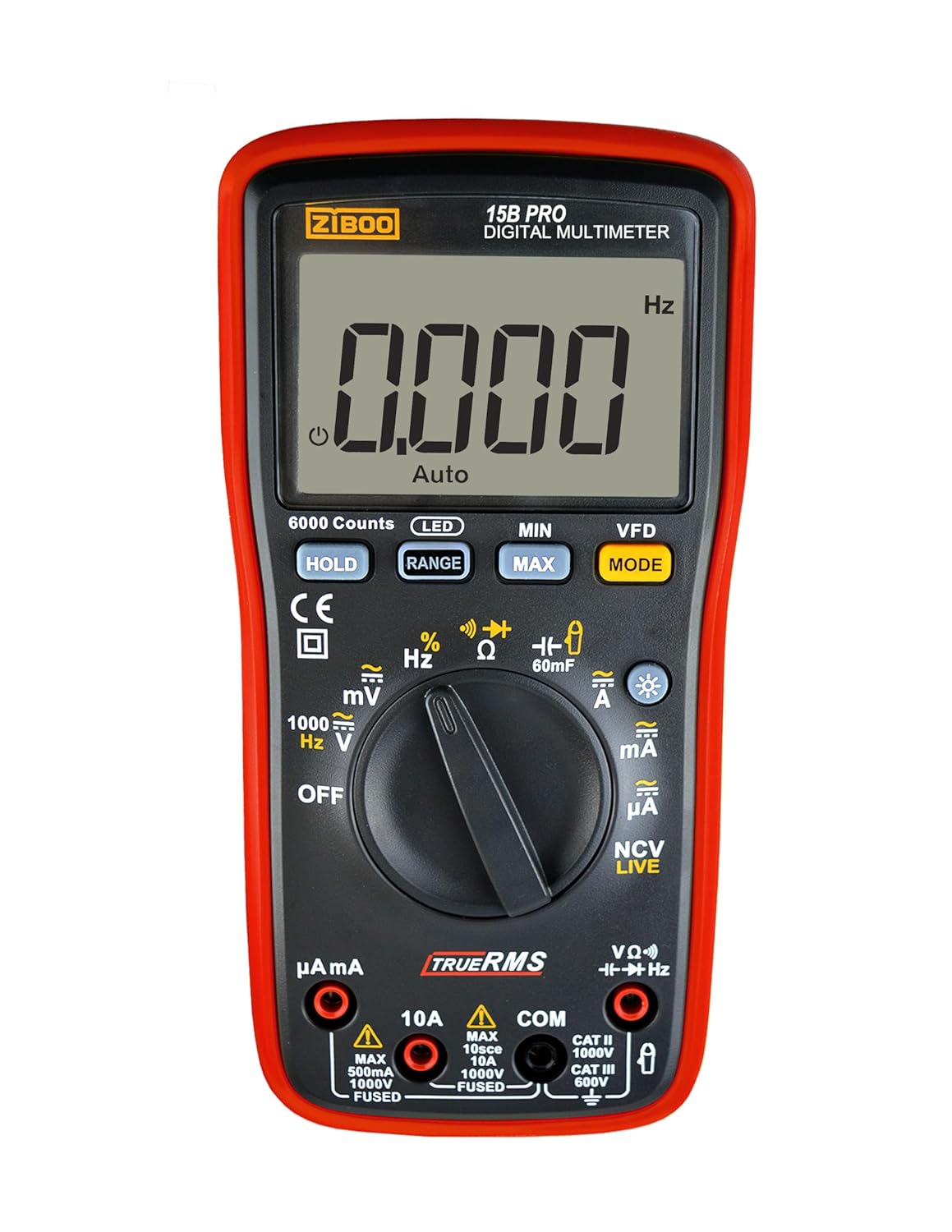
Whakaahua 1: Mua view of the ZIBOO 15B PRO Digital Multimeter, showing the display, rotary dial, and function buttons.
2.1 Nga waahanga matua
- RMS Pono: Provides accurate measurements for both sinusoidal and non-sinusoidal AC waveforms.
- 6000 Kaute Whakaatu: High-resolution display for precise readings.
- AC / DC Voltage: Measures up to 1000V.
- AC/DC Nāianei: Measures up to 10A (optional current clamp for up to 600A).
- Resistance, Continuity, Diode, Capacitance, Duty Cycle: Essential functions for comprehensive electrical troubleshooting.
- VFD AC 600V: Variable Frequency Drive measurement capability.
- NCV/ORA: Kore-Whakapā Voltage and Live Wire Detection with Red LED Flash.
- Pupuri Raraunga: Freezes the displayed reading for easier recording.
- Maama Whakamuri: Bright white backlight for clear visibility in various lighting conditions.
- Parenga Casing: Durable outer casing mo te whakamarumaru ake.

Figure 2: Visual representation of the various measurement functions available on the multimeter.
2.2 He aha kei roto i te Pouaka
- ZIBOO 15B PRO Digital Multimeter
- Multimeter Test Leads (Red and Black)
- Protective Caps for Test Leads
- Pukapuka Kaiwhakamahi
Note: AC pliers are an optional accessory and are not included with the standard package.
3. Tatūnga
3.1 Tāuta Pūhiko
- Me mohio kua weto te mita maha.
- Kimihia te wahanga pākahiko kei muri o te taputapu.
- Unscrew the single Phillips #1 screw to open the compartment.
- Insert three AA 1.5V batteries, observing correct polarity.
- Whakakapia te uhi o te wahanga pākahiko ka mau ki te huri.
3.2 Te hono i nga kaiarahi Whakamātautau
- Insert the black test lead into the 'COM' (Common) jack.
- Mo te nuinga o nga inenga (voltage, resistance, continuity, diode, capacitance, frequency, duty cycle), insert the red test lead into the 'VΩHz' jack.
- For current measurements up to 10A, insert the red test lead into the '10A' jack.
- Mō te mirionaampere (mA) moroiti rāneiampere (µA) measurements, insert the red test lead into the 'µAmA' jack.

Figure 3: The ZIBOO 15B PRO Multimeter with its test leads, showing the connection points.
4. Nga Tohutohu Whakahaere
4.1 Hiko / Whakaweto me te Whakaatu
Turn the rotary dial from 'OFF' to any desired function to power on the multimeter. To power off, turn the dial back to 'OFF'. The device features an automatic power-off function to conserve battery life. Press the LED button to activate or deactivate the display backlight for improved visibility.
4.2 Nga Mahi Ine
Rotate the dial to select the desired measurement function. Use the MODE button to toggle between different sub-functions within a dial position (e.g., AC/DC voltage, NCV/LIVE).
- Voltage Inenga (AC/DC):
Set the dial to 'V~' for AC voltage or 'V=' for DC voltage. Connect the test leads in parallel to the circuit or component being measured. The display will show the voltage te panui. - Inenga o nāianei (AC/DC):
Set the dial to 'A~' for AC current or 'A=' for DC current. Ensure the red test lead is in the appropriate current jack (10A or µAmA). Connect the multimeter in series with the circuit. - Ine Ātete (Ω):
Set the dial to 'Ω'. Connect the test leads across the component. Ensure the circuit is de-energized before measuring resistance. - Whakamātautau Tonu ():
Set the dial to 'Ω' and press MODE until the continuity icon appears. A buzzer will sound and a green LED will flash if continuity is detected (low resistance). - Whakamatau Diode ():
Set the dial to 'Ω' and press MODE until the diode icon appears. Connect the test leads across the diode. - Capacitance Measurement (F):
Set the dial to 'F'. Connect the test leads across the capacitor. Ensure the capacitor is discharged before measurement. - NCV (Kore-Whakapā Voltage) / LIVE (Live Wire Detection):
Set the dial to 'NCV LIVE'. The multimeter will detect AC voltage without direct contact. 'L' indicates a live wire with voltage, accompanied by a red LED flash and buzzer. 'EF' indicates non-contact detection.

Figure 4: The multimeter's NCV function detecting voltage near an electrical outlet, indicated by 'EF' on the display.
Video 1: This video demonstrates the difference between the NCV (Non-Contact Voltage) and LIVE (Live Wire Detection) functions on the ZIBOO 15B PRO/17B PRO multimeters. It shows how to toggle between these modes and their respective indications when detecting live electrical circuits.
4.3 Nga Mahi Motuhake
- Tohu: Pehia te KAUPAPA pātene hei whakatio i te pānui o nāianei kei te mata. Pēhia anō hei tuku.
- MIN / MAX: Pehia te MIN / MAX button to record the minimum and maximum values during a measurement session. Press again to cycle through MIN, MAX, and current readings.
- RANGE: Pehia te PANUI button to switch between auto-ranging and manual ranging.
5. Tiaki
5.1 Te horoi
Horoia te mita maha casing me te panuiamp kakahu me te hopi horoi ngawari. Kaua e whakamahi i ngā horoi whakakoi, i ngā whakarewa rānei. Me whakarite kia maroke rawa te taputapu i mua i te whakamahinga.
5.2 Whakakapinga Pūhiko
When the battery indicator appears on the display, replace the batteries as described in Section 3.1. Always use three new AA 1.5V batteries.
5.3 Whakakapinga Puka
The multimeter is equipped with internal fuses for protection. If a current measurement function stops working, the fuse may need replacement. To access the fuses, open the battery compartment (Section 3.1). The fuses are located inside. Replace with fuses of the correct type and rating (e.g., 10A/1000V and 500mA/1000V).
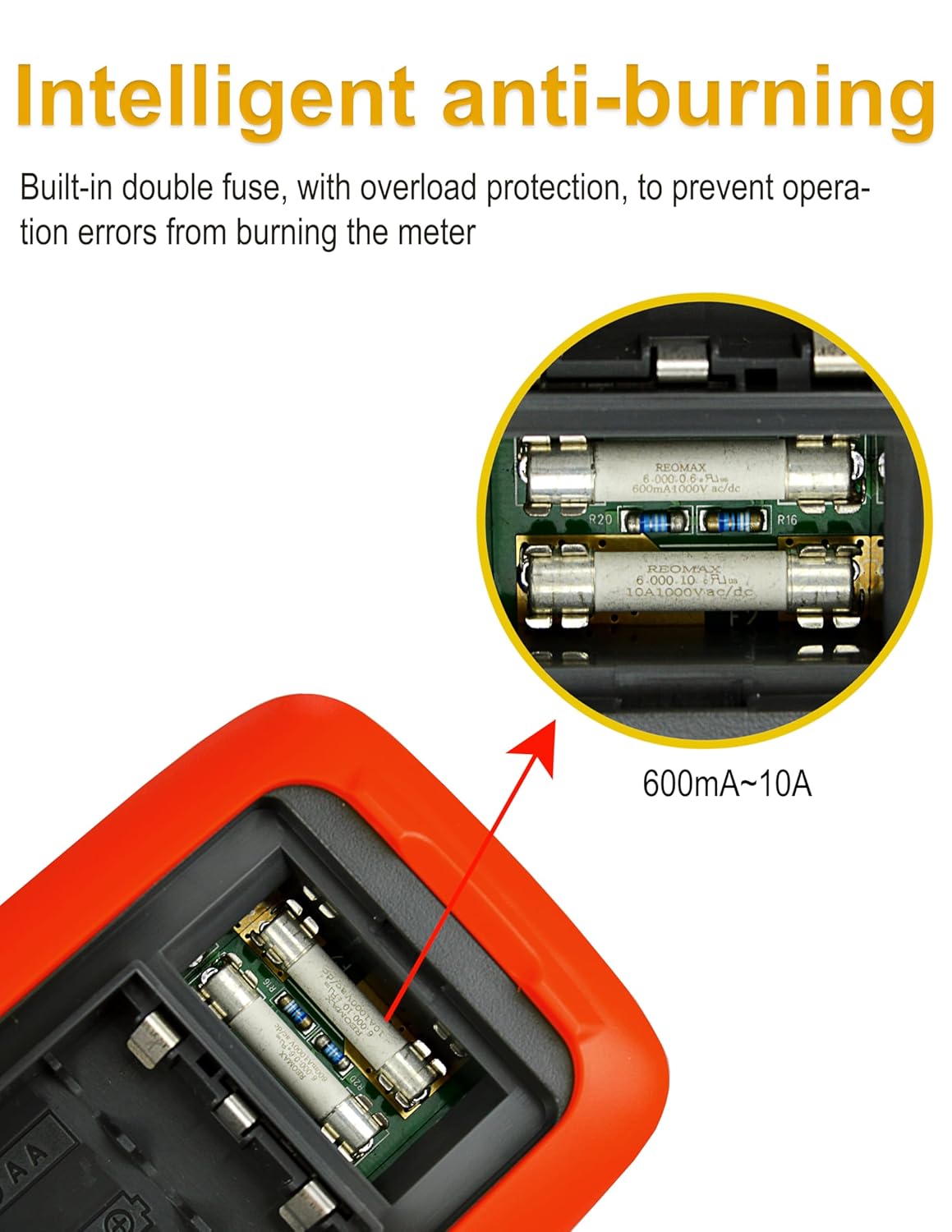
Whakaahua 5: Roto view highlighting the double fuse protection for safety and durability.
5.4 Te Manaaki i te Arataki Whakamātautau
The test leads come with protective caps. Use these caps to protect the sharp tips when not in use or when measuring in situations where only a short tip is required. This helps prevent damage to the probes and ensures safety.
6. Te Raru
If you encounter issues with your ZIBOO 15B PRO Digital Multimeter, refer to the following common troubleshooting steps:
- Kāore he Whakaaturanga/Whakaaturanga Mārō: Check battery levels and replace if necessary. Ensure the multimeter is powered on.
- Pānui hē: Verify the test leads are correctly inserted into the appropriate jacks for the selected function. Ensure the rotary dial is set to the correct measurement type and range. Check for damaged test leads.
- Current Function Not Working: The internal fuse for current measurement may have blown due to an overload. Replace the fuse as described in Section 5.3.
- Continuity Buzzer Not Sounding: Ensure the multimeter is in continuity mode. Check for open circuits or high resistance.
For persistent issues, consult the manufacturer's support resources.
7. Whakatakotoranga
| Āhuahira | Whakatakotoranga |
|---|---|
| Whakaatu | 6000 Tatau, RMS Pono |
| DC Voltage (V) | 6V/60V/600V/1000V (±(0.5%+3)) |
| AC Voltage (V) | 6V/60V/600V/1000V (±(0.8%+5)) |
| VFD AC Voltage (V) | 600V (±(0.8%+5)) |
| DC Naianei (A) | 600µA/6mA/60mA/600mA/6A/10A (±(0.8%+5) to ±(1.5%+5)) |
| AC o nāianei (A) | 600µA/6mA/60mA/600mA/6A/10A (±(1.0%+5) to ±(1.8%+5)) |
| Ātete (Ω) | 600Ω/6KΩ/60KΩ/600KΩ/6MΩ/60MΩ (±(0.8%+5) to ±(2.5%+5)) |
| Te kaha (F) | 60nF-60mF (±(3%+5) to ±(5%+5)) |
| Auautanga (Hz) | 10Hz-20MHz (±(0.1%+5)) |
| Huringa Mahi | 10%-90% (±(2%+5)) |
| Whakatauranga Haumaru | CAT III 600V, CAT II 1000V |
| Puna Mana | 3 x Pūhiko AA 1.5V |
| Hunga Hua | 3.58 x 1.77 x 7.2 inihi |
| Taumaha Hua | 1.19 Pauna (402g) |
Note: Accuracy specifications are typical values and may vary slightly.

Figure 6: A detailed table outlining the technical specifications for the ZIBOO 15B PRO multimeter.
8. Pūtāhui me te Tautoko
For warranty information and customer support, please refer to the official ZIBOO website or contact the seller directly through the platform where the product was purchased. Standard return policies typically apply (e.g., 30-day return window).