1. Kupu Whakataki
This manual provides detailed instructions for the installation, operation, and maintenance of your Cenmate 5-Bay Hybrid Hard Drive Enclosure. This enclosure is designed to expand your storage capacity by combining 2.5/3.5 inch SATA HDDs/SSDs and M.2 NVMe SSDs, offering versatile storage solutions with high-speed data transfer.

Image 1.1: Cenmate 5-Bay Hybrid Enclosure
2. Nga Hua o te Hua
- Hybrid Storage Design: Supports 2 x 2.5/3.5 inch SATA HDDs/SSDs and 3 x M.2 NVMe SSDs (2230/42/60/80/110).
- Raukaha Teitei: Maximum total capacity of 68TB (2x22TB HDDs + 3x8TB M.2 SSDs).
- Ngā Aratau RAID: Supports RAID 0, RAID 1, JBOD, and Normal modes for SATA drives. Tuhipoka: RAID configuration may result in data loss. Always back up data before configuring RAID.
- Hononga Tere-Teitei: USB 3.2 Gen 2 interface provides data transfer rates up to 10Gbps.
- Te whakamahana pai: Built-in aluminum alloy housing and a 2.7-inch silent fan ensure optimal heat dissipation.
- Utauta-Kore he Tāuta: Features a tool-free hard drive tray design for easy installation and removal of 3.5-inch SATA drives.
- Hototahi Whānui: Compatible with Windows 7 and above, Mac OS 9.1 and above, and Linux. USB Type-C interface supports USB 3.0, USB 3.1, USB 3.2, Thunderbolt 3, and Thunderbolt 4.

Image 2.1: Product Features Overview
3. Ihirangi mokete
Tena koa tirohia kei roto nga taonga katoa kei roto i te kete:
- Cenmate Hybrid Hard Drive RAID Enclosure
- USB A/C 3.2 Cable
- Pūurutau Hiko
- Pukapuka Kaiwhakamahi (tenei tuhinga)
4. Tatūnga me te Tāuta
4.1 M.2 SSD Tāutatanga
- Insert the M.2 SSD into the slot until it clicks into place.
- Hopukia te mono rapa ki te haurua porohita whakarewa o te M.2 SSD.
- Press the rubber plug with the M.2 SSD down into the bayonet until it is secure.

Image 4.1: M.2 SSD Installation Steps
4.2 3.5 inch HDD Installation
- Pull up the blue clasps on both sides of the bracket.
- Put the hard drive gently into the tray, then snap the carabiner pins into the 3.5 inch HDD side screw holes.

Image 4.2: 3.5 inch HDD Installation Steps
4.3 2.5 inch HDD/SSD Installation
- Tangohia te maru puru i te taha ma te whakamahi i te huriwiri.
- Use screws to secure the 2.5 inch HDD/SSD in the corresponding holes on the tray.

Image 4.3: 2.5 inch HDD/SSD Installation Steps
5. Whirihoranga RAID
The Cenmate enclosure supports four RAID modes for SATA drives: Normal, RAID 1, RAID 0, and JBOD. M.2 NVMe SSDs are always treated as independent drives.
Important Note: Press and hold the "Reset" button for 5 seconds after resetting the RAID array. Designing or changing RAID modes may result in data loss. Always back up your data before performing RAID configuration.

Image 5.1: RAID Mode Configuration
- Pūnoa: Each drive operates independently. (Switch 1 & 2 are down)
- RAID 1 (Whakaata): Data is duplicated across two drives for redundancy. Requires two drives. Capacity equals the smallest drive. (Switch 1 & 2 are up)
- RAID 0 (Whakatakotoranga): Data is split across two drives for increased speed. Requires two drives. Total capacity is the sum of both drives. (Switch 1 up & Switch 2 down)
- JBOD (He Puranga Kōpae Noa): Drives are concatenated to form a single large volume. Requires two drives. Total capacity is the sum of both drives. (Switch 1 down & Switch 2 up)
6. Nga Tohutohu Whakahaere
After installing your drives and configuring RAID (if desired), connect the enclosure to your computer using the provided USB A/C 3.2 Gen 2 cable and power adapter. Power on the device using the switch on the rear panel. Your operating system should detect the drives. For new drives, you may need to initialize and format them through Disk Management (Windows) or Disk Utility (macOS) before use.
6.1 Whakawhiti Raraunga
The enclosure supports up to 10Gbps data transfer speeds. Actual speeds may vary based on your drives, computer's USB port, and operating system.
Ataata 6.1: Ka mutuview of the Cenmate Hybrid Storage Enclosure and its features.
7. Tohu LED
The enclosure features LED indicators for each drive bay to provide status information:

Image 7.1: LED Indicator Guide
- M.2-1 (Purple LED): Always blue when connected, flashes when reading/writing.
- M.2-2 (Red LED): Always red when connected, flashes when reading/writing.
- M.2-3 (Red LED): Always red when connected, flashes when reading/writing.
- HDD1 (Blue LED): Always blue when connected. If incompatibility or damage occurs, the blue light will show red. Flashes red when reading/writing.
- HDD2 (Blue LED): Always blue when connected. If incompatibility or damage occurs, the blue light will show red. Flashes red when reading/writing.
8. Hototahi
The Cenmate 5-Bay Hybrid Enclosure offers broad compatibility with various operating systems and devices.
8.1 Supported M.2 NVMe SSDs
The enclosure supports M.2 NVMe SSDs with M Key and M&B Key (NVMe/PCIe) in sizes 2230, 2242, 2260, 2280, and 22110.

Image 8.1: M.2 NVMe SSD Compatibility
8.2 Supported Operating Systems and Devices
The enclosure is compatible with:
- Pūnaha Whakahaere: Windows 7 and above, macOS 9.1 and above, Linux, Chrome OS.
- Pūrere: Desktops, Laptops.
- Atanga USB: USB 3.0, USB 3.1, USB 3.2, Thunderbolt 3, Thunderbolt 4.

Image 8.2: System and Device Compatibility
9. Te Raru
Tirohia nga take noa e whai ake nei me o raatau otinga:
9.1 Hard Drive Not Found / RAW Format

Image 9.1: Troubleshooting Q1 & Q2
- Q1: After connecting a new hard drive, why can't I find it or see its disc letter?
A1: New hard drives must be formatted before use. Right-click 'Computer' (or 'This PC'), then 'Manage', open 'Disk Management'. Find the new hard drive, right-click 'Initialize Disk' (select 'MBR' for drives ≤ 2TB, 'GPT' for drives > 2TB). Then, 'New Simple Volume' and follow the prompts to format the partition. - Q2: Ka puta te puku mārō ki te whakatakotoranga RAW i te Whakahaere Kōpae nā te hē o te tangohanga, te kore hiko ranei. Me aha ahau?
A2: You can attempt recovery using thechkdskcommand. Run Command Prompt as administrator, then inputchkdsk D:/f(replace 'D' with the actual drive letter). Scanning and repair will complete, and a reboot may be required.
9.2 Ētahi atu Take Noa
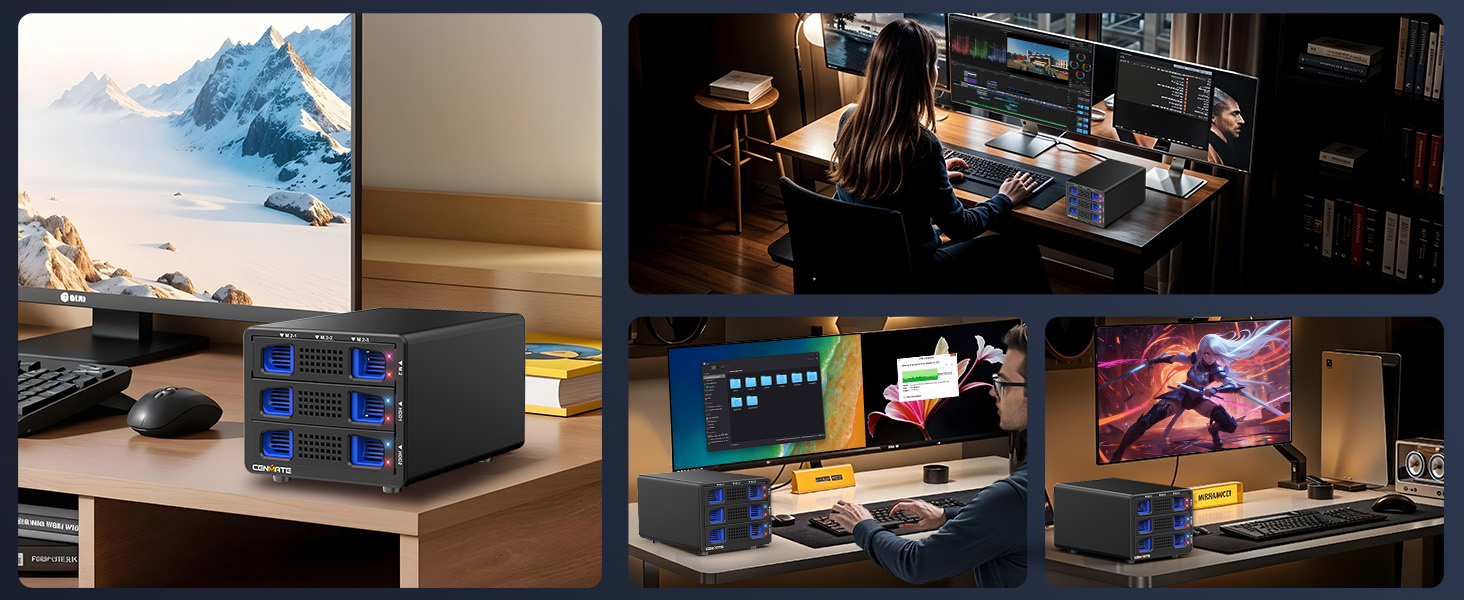
Image 9.2: Troubleshooting Q3-Q5
- Q3: The hard drive is dynamically invalid in Disk Management because it was previously removed from an old computer.
A3: This is a system-related issue. Reinstall the hard drive into the original computer motherboard and back up the data. If the old computer is unavailable, you can use dynamic disk conversion software to convert it to a basic disk. - Q4: Hard drive shows up but has no disc letter.
A4: In Disk Management, right-click on the Disk Partition section and select 'Change Drive Letter and Paths' to add a drive letter for use. - Q5: The enclosure automatically disconnects during transmission and then reconnects after a while.
A5: This could indicate issues with the computer's USB interface, the USB cable, computer USB drivers, the hard drive itself, or the hard drive enclosure. Contact technical support for assistance in diagnosing the problem.
10. Whakatakotoranga
| Whakatakotoranga | Taipitopito |
|---|---|
| Waitohu | hoa |
| Tau tauira | 5 Pei |
| Taumaha Tūemi | 2.49 pauna (1.13 Kirokaramu) |
| Hunga Hua | 7.95 x 5.2 x 4.41 inihi |
| Te Rokiroki Mahara | 68 TB (Maximum) |
| Pūrere Hototahi | Papamahi, Pona |
| Tauwehe Puka Kopae Maama | 2.5 Inihi, 3.5 Inihi |
| Tau Max o nga Pūrere Tautoko | 5 (2 SATA, 3 M.2 NVMe) |
| Rere Whakawhiti Raraunga | 10 Kikabit ia Hekona (USB 3.2 Gen 2) |
| Atanga Pūmārō | USB 3.2 Gen 2 |
| Pūmārō Pūmārō | Windows, MAC, Linux |
| Rauemi | Konumohe |
11. Pūtāhui me te Tautoko
Cenmate provides lifetime technical support for this product. If you have any questions or encounter issues, please do not hesitate to contact us. We aim to reply and resolve your problem within 24 hours.


