1. Kupu Whakataki
This manual provides essential information for the safe and efficient use of your Dyness 12V 100Ah Mini LiFePO4 Battery. This deep cycle lithium battery is designed for various applications including RVs, boats, trolling motors, solar off-grid systems, and golf carts. It features a compact and lightweight design, premium A+ grade LiFePO4 cells, advanced BMS protection, and low-temperature protection.
2. Nga korero haumaru
WARNING: RISK OF FIRE, EXPLOSION, OR BURN
- DO NOT short circuit the (+) and (-) terminals with any metals.
- DO NOT immerse, throw, and wet battery in water.
- DO NOT heat above 60°C or throw battery into fire.
- DO NOT disassemble, crush, or modify the battery.
- DO NOT reverse the (+) and (-) terminals.
- Stopping using the battery under the conditions: abnormal heat, odor, deformation.
- Elevation no more than 4000m.
The battery is equipped with a built-in Battery Management System (BMS) that protects against overcharging, over-discharging, over-current, overheating, and short circuits. It also includes an upgraded low-temperature power-off function to ensure safe use in cold environments.
3. He aha kei roto i te Pouaka
I te whakatuwheratanga o te kete, ka kitea e koe:
- 1 x Dyness 12V 100Ah Mini LiFePO4 Battery (Model: AR1.2-MINI TM)
- 1 x Pukapuka Kaiwhakamahi
- 2 x M8*16mm Terminal Bolts
Whakaahuatanga Ataata: This video demonstrates the unboxing of the Dyness 12V 100Ah Mini LiFePO4 Battery. It shows the battery being removed from its packaging, highlighting the included user manual and M8 terminals. The video also showcases the battery's compact size and integrated handles for easy portability.
4. Tatūnga me te Tāuta
The Dyness 12V 100Ah Mini LiFePO4 Battery is designed for easy installation. It features standard M8 terminals for secure connections. Always ensure proper polarity when connecting the battery to your system.
4.1 Connecting Terminals
- Me mohio kua momotuhia nga puna hiko katoa i mua i te whakaurunga.
- Connect the positive (+) cable to the positive terminal of the battery.
- Connect the negative (-) cable to the negative terminal of the battery.
- Securely tighten the M8 terminal bolts.
The battery's compact Group 24 size (L10.2*W6.6*H8.2 inches) offers a smaller footprint, making it easier to install in various applications like RVs and boats.

Whakaahuatanga Whakaahua: A Dyness 12V 100Ah Mini LiFePO4 Battery is shown installed in a compact RV storage compartment, demonstrating its space-saving design. The image highlights its suitability for recreational vehicles.
4.2 Hononga Rangatū me te Whakarara
The Dyness 12V 100Ah LiFePO4 battery supports series and parallel connections for increased voltage or capacity, up to 4P4S configurations. This allows for flexible power solutions for various needs.

Whakaahuatanga Whakaahua: A diagram illustrates various series and parallel connection configurations for Dyness 12.8V 100Ah batteries, including 4P4S for 51.2V 400Ah (20.48kWh), 4P for 12.8V 400Ah (5120Wh), and 4S for 51.2V 100Ah (5120Wh).
5. Nga Tohutohu Whakahaere
5.1 Aroturuki Nihokikorangi
The integrated Bluetooth module allows for wireless monitoring of your battery's status via the Dyness app. Connect instantly to monitor real-time voltage, current, state of charge, temperature, and capacity directly from your smartphone.
Whakaahuatanga Ataata: This video demonstrates the Bluetooth connectivity feature of the Dyness 12V 100Ah Mini LiFePO4 Battery. It shows a user connecting their smartphone to the battery via the Dyness app to monitor various parameters like voltage, current, state of charge, and temperature in real-time.
5.2 Whakamahinga Whanui
This battery is versatile and ideal for a wide range of applications:
- Ngā Motuka Whakatere: Provides reliable and long-lasting power for marine applications.
- RV me Poti: Offers a compact and lightweight power solution for recreational vehicles and watercraft.
- Te Pupuri Pūngao Kāinga: Suitable for backup power or solar off-grid systems.
- Golf Carts: Delivers efficient power for extended use.
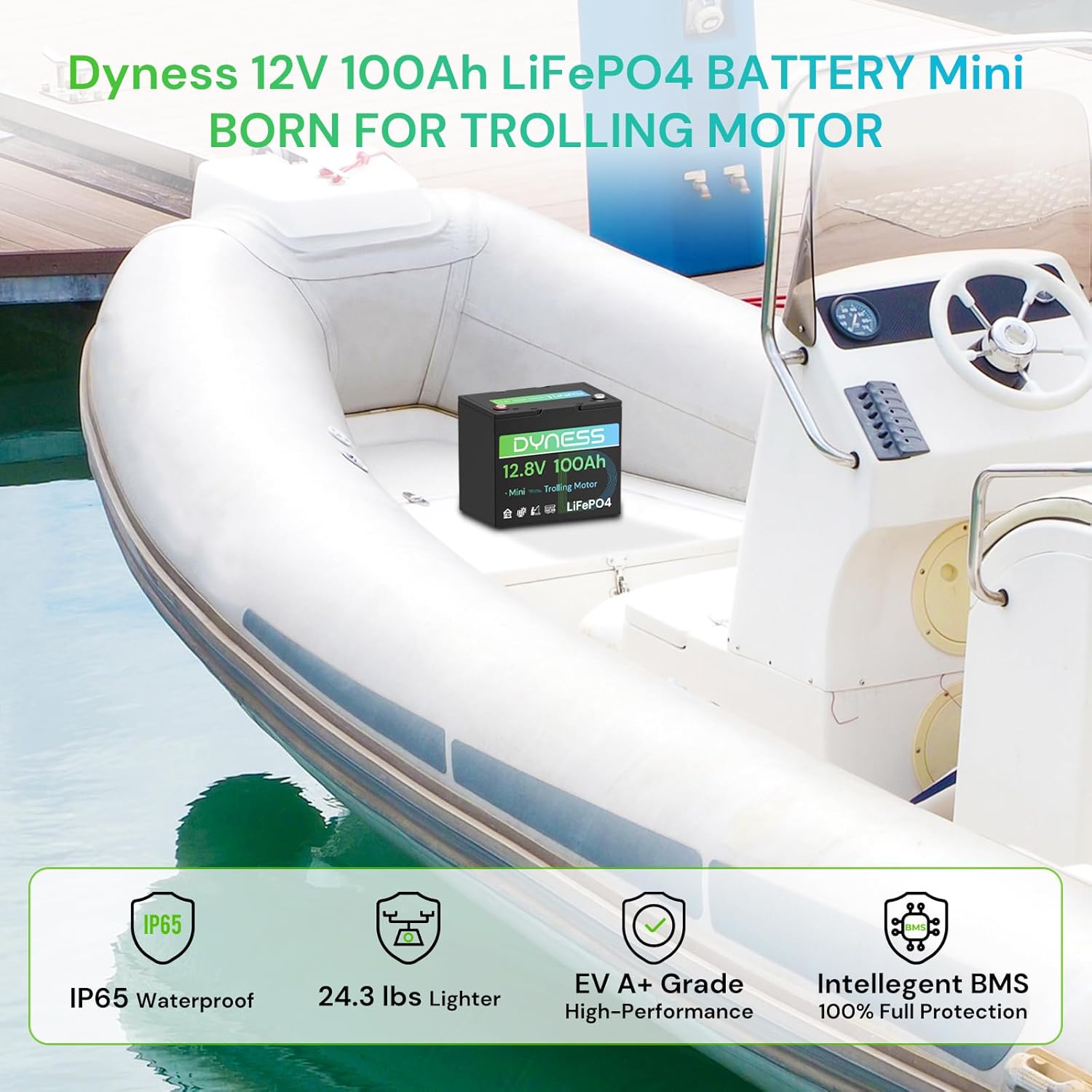
Whakaahuatanga Whakaahua: A Dyness 12V 100Ah Mini LiFePO4 Battery is shown powering a trolling motor on a small boat, illustrating its application in marine environments.
6. Tiaki
To ensure the longevity and optimal performance of your Dyness LiFePO4 battery, follow these maintenance guidelines:
- Regularly check terminal connections for tightness and corrosion.
- Kia ma, kia maroke te pākahiko.
- Avoid exposing the battery to extreme temperatures outside its operating range.
- Penapenahia te pākahiko ki te wāhi hauhautanga, maroke mēnā kāore e whakamahia ana mō te wā roa.
6.1 Low-Temperature Protection
The battery features automatic low-temperature protection:
- Charging automatically disconnects when the cell temperature drops below 32°F (0°C).
- Discharging cut-off temperature is -4°F (-20°C).
- Charging resumes at 41°F (5°C).

Whakaahuatanga Whakaahua: An illustration of the Dyness 12V 100Ah Mini LiFePO4 Battery in a snowy environment, detailing its low-temperature protection features: discharging off below -4°F (-20°C), charging off below 32°F (0°C), and charging recovery above 41°F (5°C).
7. Te Raru
The advanced BMS provides comprehensive protection. If you experience any issues, check the following:
- Kore Putanga Hiko: Check terminal connections, ensure the battery is charged, and verify no short circuits are present. The BMS may have activated a protection mode.
- Nga take utu: Ensure the charger is compatible with LiFePO4 batteries and operating within the specified voltage and current ranges (Charge Voltage: 14.2V-14.6V, Charge Current: 5A-50A). Check battery temperature for low-temperature cut-off.
- Te wera nui: Ensure adequate ventilation around the battery. The BMS will shut down if temperatures exceed safe limits.
For persistent issues, refer to the user manual or contact Dyness customer support.

Whakaahuatanga Whakaahua: A visual representation of the advanced Battery Management System (BMS) within the Dyness LiFePO4 Battery, highlighting its 100% full protections against overcharge, over-discharge, over-current, and short circuit.
8. Whakatakotoranga
| Huanga | Uara |
|---|---|
| Tauira | AR1.2-MINI TM |
| Nomine Voltage | 12.8 Volts |
| Raukaha Ingoa | 100Ah |
| Pūngao Ingoa | 1280Wh |
| Hanganga Pūtau Pūhiko | Lithium Iron Phosphate (LiFePO4) |
| Max Tukunga o Naianei | 100A |
| Te Utu Nui o Naianei | 50A |
| Akene Voltage Awhe | 14.2V-14.6V |
| Te Wehenga Tapahanga Voltage | 10V |
| Low-Temp Charge Cut-off | 32°F (0°C) |
| Low-Temp Discharge Cut-off | -4°F (-20°C) |
| Porohita Ora | 4000+ Cycles @ 100% DOD, 6000+ @ 80% DoD |
| Te ora | Tae atu ki te 10 tau |
| Taumaha Tūemi | 21.3 pauna |
| Hunga Hua | 10.23 x 6.61 x 8.22 inihi |
| Whakatauranga parewai | IP65 |
9. Pūtāhui me te Tautoko
Dyness provides professional technical support and online customer service with a fast response within 24 hours. If you have any product-related issues or questions, do not hesitate to contact the Dyness support team directly.

Whakaahuatanga Whakaahua: A customer support team is depicted, symbolizing Dyness's commitment to reassuring after-sales guarantee, including local warehouses, service hotlines, high quality, and responses within 24 hours.


