1. Hua Neke Atuview
This manual provides instructions for the OLIGHT Oclip Pro and Oclip Ultra Everyday Carry (EDC) Flashlight Clip-on Light Bundle. These compact and versatile lighting tools are designed for various daily tasks and outdoor activities.

Image 1: The OLIGHT Oclip Pro (top, with American flag design) and Oclip Ultra (bottom, olive green) clip-on flashlights.
Oclip Pro Features:
- Three lighting solutions: 500 lumen floodlight, 120-meter spotlight, and 40/4 lumen red light.
- User-friendly interface with a selector switch for mode changes.
- Integrated battery level indicator.
- Compact and lightweight design (1.87 oz / 53 g, 2.24 in / 57 mm length).
Oclip Ultra Features:
- Three-in-one functionality: 530 lumen floodlight, 130-meter spotlight, and 800 mW UV light.
- Constructed from O-aluminum for enhanced durability and wear resistance.
- Compact and lightweight design (1.05 oz / 30 g, 1.90 in / 48.5 mm length).
2. Tatūnga
2.1 Whakataki Tuatahi
Before first use, fully charge your Oclip Pro and Oclip Ultra flashlights. Both models feature a USB-C charging port.
- Locate the USB-C charging port on the side of the flashlight.
- Connect a USB-C cable to the flashlight and the other end to a compatible USB power source (e.g., computer, wall adapter).
- The battery indicator will show charging status. Refer to the operating section for indicator details.
- Kia oti te utu, momotuhia te taura.

Image 2: The OLIGHT Oclip Pro, illustrating its compact size, clip mechanism, and the USB-C charging port.
2.2 Attaching the Clip
Both Oclip Pro and Oclip Ultra are designed with an integrated clip for easy attachment to various items.
- Identify the desired attachment point (e.g., pocket, backpack strap, hat brim).
- Gently open the clip by pressing the top part away from the body.
- Slide the clip onto the material until it is securely fastened.
- Ensure the flashlight is stable and will not easily detach during use.

Image 3: A hand demonstrating the robust clip mechanism of the OLIGHT Oclip Pro, highlighting its secure attachment capability.
3. Nga Tohutohu Whakahaere
3.1 Hiko / Whakaweto
To turn the flashlight on or off, press and hold the main power button located on the side of the device.
3.2 Mode Switching (Oclip Pro)
The Oclip Pro features a selector switch for cycling through its various lighting modes:
- He Maamaa: Provides a wide beam for general area illumination (up to 500 lumens).
- Maama: Offers a focused beam for long-range visibility (up to 120 meters).
- Maama Whero: Preserves night vision and is suitable for low-light situations (40/4 lumens).
To switch modes, toggle the selector switch. The flashlight will cycle through the available modes in a predetermined order.

Whakaahua 4: Visual examples of the OLIGHT Oclip Pro's floodlight for daily routines, spotlight for focused tasks, and red light for preserving night vision.
3.3 Mode Switching (Oclip Ultra)
The Oclip Ultra combines three distinct lighting functions:
- He Maamaa: Delivers wide-area illumination (up to 530 lumens).
- Maama: Provides a concentrated beam for extended reach (up to 130 meters).
- Rama UV: An 800 mW pure 365nm UV light for specialized inspections (e.g., currency verification, stain detection).
To switch modes, toggle the selector switch. The flashlight will cycle through the available modes.

Image 5: The OLIGHT Oclip Ultra showcasing its floodlight for wide-area illumination, spotlight for long-range visibility, and UV light for specialized inspections.
3.4 Tohu Pohiko
Both models feature a battery indicator, typically located in the center of the switch, to display the current battery level. Consult the product packaging or official OLIGHT website for specific indicator light meanings (e.g., green for high, yellow for medium, red for low).
4. Tiaki
4.1 Te horoi
Hei pupuri i te mahi tino pai me te ahua:
- Horoia te tinana o te rama ki te ngohengohe, damp kakahu.
- A ape i te whakamahi i nga kai horoi, i nga whakarewa ranei, na te mea ka pakaru te mutunga.
- Keep the lens clean for clear light output. Use a lens cloth if necessary.
4.2 Te utu
Regular charging is essential to ensure your flashlight is ready when needed. Charge the device when the battery indicator shows a low level.
- Use the provided USB-C cable or a compatible high-quality USB-C cable.
- Avoid over-discharging the battery, as this can reduce its lifespan.
- Store the flashlight with a partial charge if it will not be used for an extended period.
4.3 Material Durability (Oclip Ultra)
The Oclip Ultra is constructed with O-aluminum, an exclusive OLIGHT aluminum alloy. This material offers superior hardness and wear resistance compared to standard 6061 aluminum, ensuring long-term durability even with daily use and accidental drops.
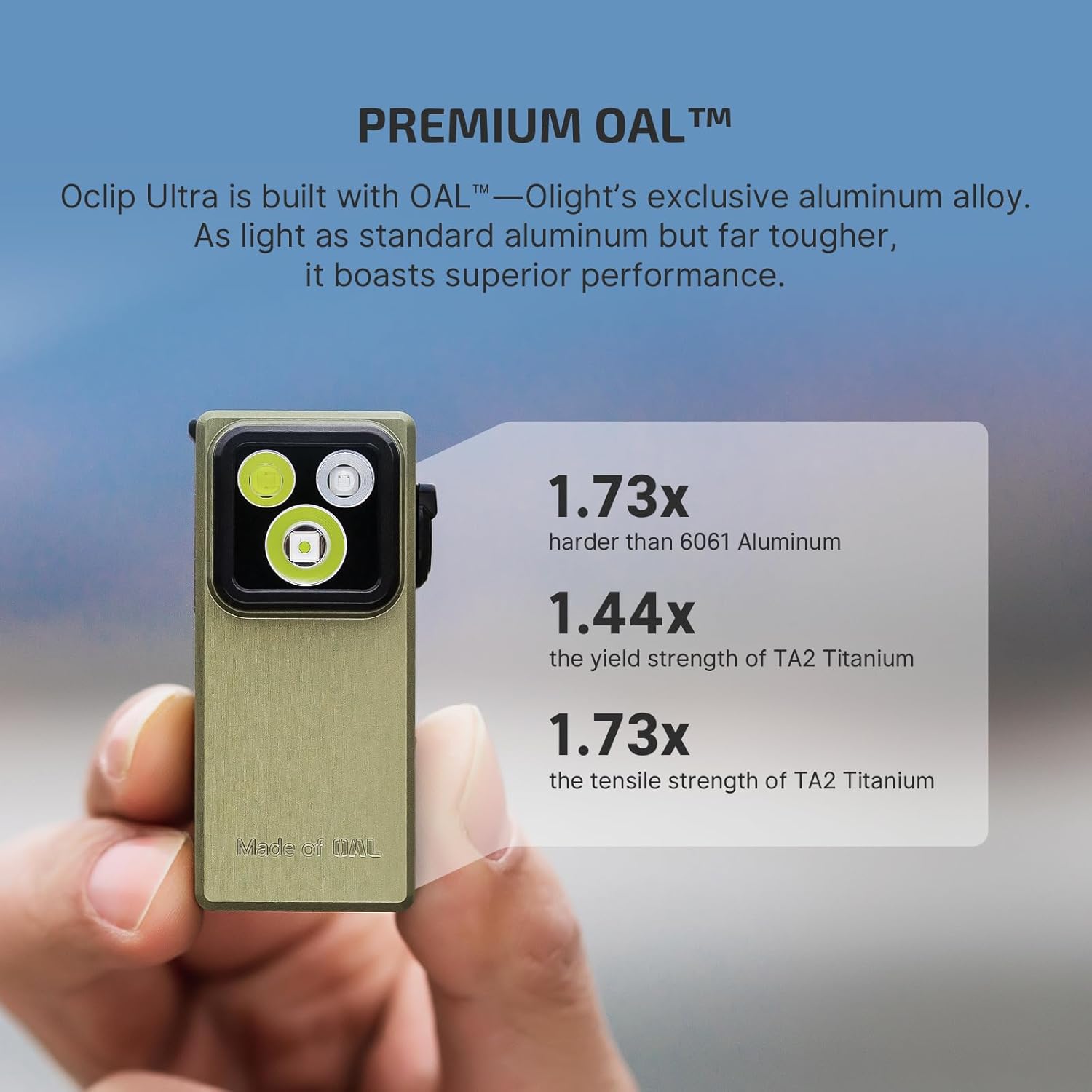
Image 6: The OLIGHT Oclip Ultra, emphasizing its construction from O-aluminum, which is significantly harder and stronger than standard aluminum alloys.
5. Te Raru
If you encounter issues with your OLIGHT Oclip flashlight, refer to the following common troubleshooting steps:
5.1 Flashlight Not Turning On
- Tirohia te Taumata Pūhiko: Ensure the flashlight is sufficiently charged. Connect it to a power source and observe the battery indicator.
- Taura/Whakauru Utu: Verify that the USB-C cable and power adapter are functioning correctly. Try a different cable or adapter.
- Mahi Pātene: Ensure you are pressing and holding the power button correctly.
5.2 Light Output is Dim or Flickering
- Whakahiko Pūhiko: Low battery can cause dimming or flickering. Fully recharge the device.
- Arotahi Ma: A dirty lens can obstruct light. Clean the lens gently with a soft cloth.
- Ngā Āhua Taiao: Extreme cold can temporarily affect battery performance. Allow the flashlight to warm up if used in very cold conditions.
5.3 Clip Not Holding Securely
- Matotoru Rauemi: Ensure the material you are clipping to is within the appropriate thickness range for the clip.
- Clip Condition: Inspect the clip for any signs of damage or deformation.
Ki te kore enei mahi e whakatau i te take, tena koa whakapā atu ki te tautoko a te kaihoko OLIGHT mo etahi atu awhina.
6. Whakatakotoranga
Below are the detailed specifications for the OLIGHT Oclip Pro and Oclip Ultra flashlights:

Image 7: A visual comparison detailing the dimensions, weight, and key features of the OLIGHT Oclip Pro and Oclip Ultra.
Oclip Pro Specifications:
| Āhuahira | Taipitopito |
|---|---|
| Max Output (Floodlight) | 500 rama |
| Max Throw (Spotlight) | 120 mita |
| Putanga Rama Whero | 40/4 rama |
| Taumaha | 1.87 oz / 53 g |
| Te roa | 2.24 ki / 57 mm |
| Whānui | 1.10 ki / 28.05 mm |
| Kōwhiringa Rama | Floodlight, Spotlight, Red Light |
Oclip Ultra Specifications:
| Āhuahira | Taipitopito |
|---|---|
| Max Output (Floodlight) | 530 rama |
| Max Throw (Spotlight) | 130 mita |
| Putanga Maama UV | 800 mW (365nm) |
| Taumaha | 1.05 oz / 30 g |
| Te roa | 1.90 ki / 48.5 mm |
| Whānui | 0.82 ki / 21 mm |
| Rauemi | O-konumohe |
| Kōwhiringa Rama | Floodlight, Spotlight, UV Light |

Image 8: The OLIGHT Oclip Ultra securely clipped to a backpack strap, demonstrating its practical application and light output.
7. Pūtāhui me te Tautoko
For warranty information and customer support, please refer to the official OLIGHT webpaetukutuku, whakapā atu ranei ki ta raatau ratonga kaihoko. Puritia to riirii hoko hei tohu mo te hoko mo nga kereme whakamana.
OLIGHT Official Webpae: www.olightstore.com


