1. Kupu Whakataki
This manual provides comprehensive instructions for the installation, operation, and maintenance of your RAINPOINT 149 Drip Irrigation System. Designed for efficient and automatic plant watering, this system features a solar panel for power and programmable settings to ensure your plants receive optimal hydration. Please read this manual thoroughly before use to ensure proper function and longevity of your device.
2. Ihirangi mokete
Manatokona kei roto katoa nga waahanga kei roto i to kete:
- RAINPOINT 149 Controller with integrated solar panel
- Tātari urunga wai
- Waea anti-siphon
- Drip tubing (main line and distribution lines)
- Drip emitters
- Tubing connectors and stakes
- USB utu taura
- Pukapuka Kaiwhakamahi
3. Hua Neke Atuview
The RAINPOINT 149 system is designed for ease of use and reliability. Key features include:
- Programmable Watering: Set frequency and duration with intuitive dials.
- Whakahikohia te Ra: Integrated solar panel charges the internal lithium-ion battery.
- Kōwhiringa Hiko Takirua: Can be powered by solar or USB.
- Hangarau maramara atamai: Provides short-circuit protection, over-charge protection, and ultra-low power consumption.
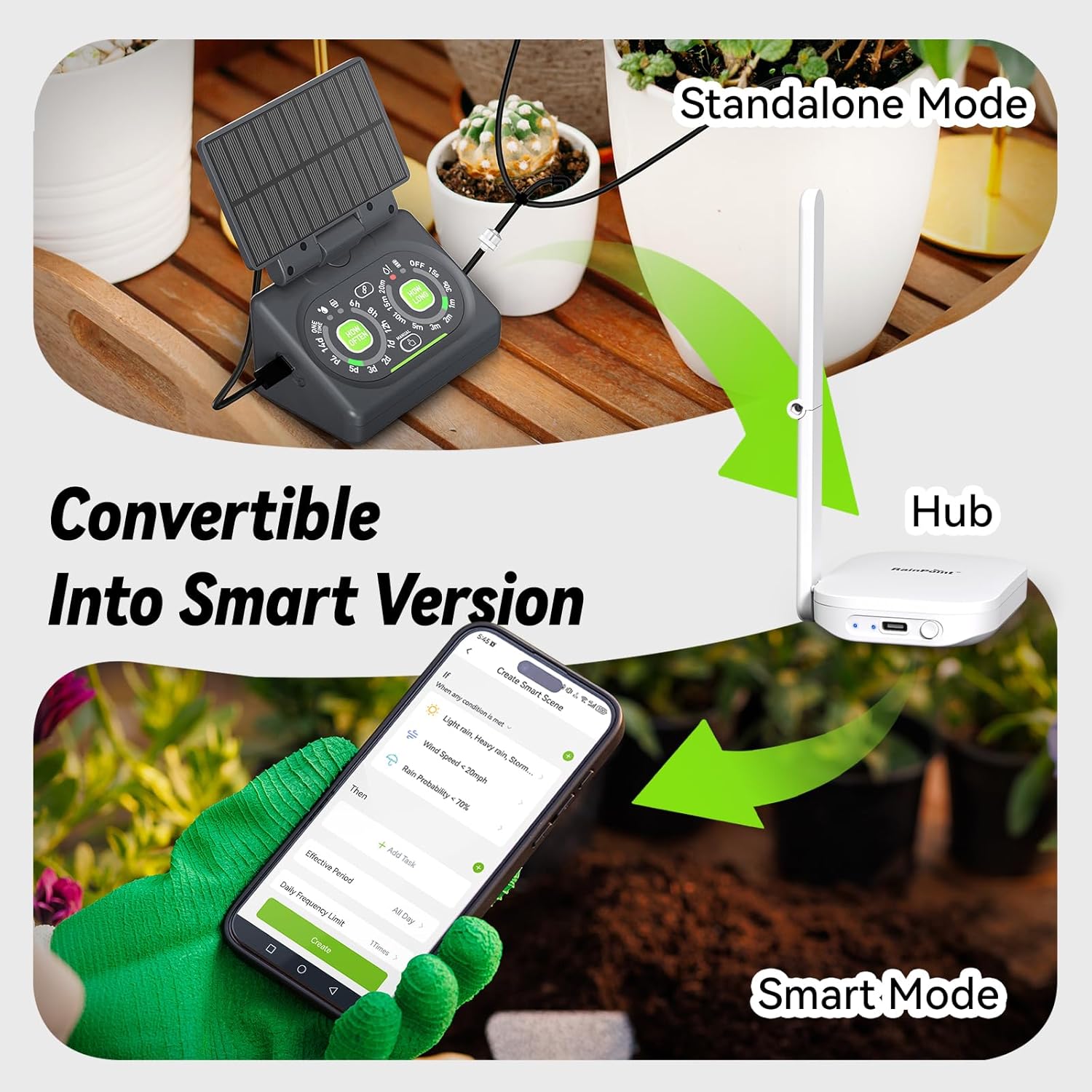
- Ka taea te whakaroha: Convertible to a smart version with a separate hub for app control.
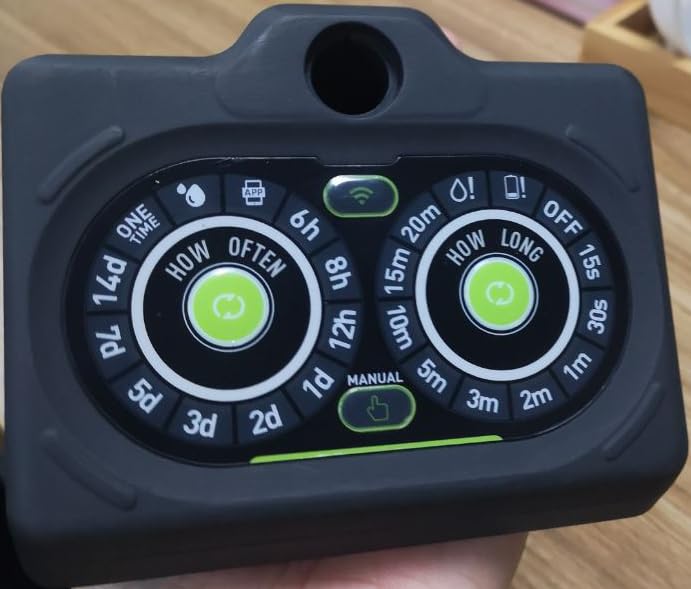
Whakaahua 3.1: Mua view of the RAINPOINT 149 controller, showing the 'How Often' and 'How Long' setting dials, along with indicators for app connectivity and manual mode.

Whakaahua 3.2: The adjustable solar panel integrated into the RAINPOINT 149 controller, designed for optimal sun exposure and charging efficiency. The image illustrates its flexible positioning.
Whakaahua 3.3: Illustration of the two power options for the RAINPOINT 149 controller: solar power via the integrated panel and USB power for charging or continuous operation indoors.

Whakaahua 3.4: The RAINPOINT 149 controller operating with solar power, highlighting its rechargeable battery backup feature for uninterrupted watering even without direct sunlight.

Whakaahua 3.5: The RAINPOINT 149 controller's capability to convert from a standalone unit to a smart version when connected to a compatible hub, enabling app-based control and advanced scheduling.

Whakaahua 3.6: Visual representation of the smart chip technology within the RAINPOINT 149 controller, emphasizing its protective features like short-circuit and over-charge protection, and ultra-low power consumption.
4. Tatūnga
Follow these steps to set up your drip irrigation system:
- Charge the Controller: Before first use, fully charge the controller using the provided USB cable. The charging indicator will show status.
- Tautuhi i te Kaiwhakahaere: Mount the controller in a location where the solar panel receives direct sunlight for several hours daily. Ensure it is close to your water source (e.g., a water reservoir).
- Hononga Wai Putanga: Attach the water inlet filter to the controller's inlet port. Place the filtered end into your water reservoir.
- Install Anti-Siphon Valve: Connect the anti-siphon valve to the controller's outlet port. This prevents water from flowing back into the reservoir.
- Lay Out Tubing: Connect the main drip tubing to the anti-siphon valve. Route the tubing to your plants, securing it with stakes as needed.
- Tāuta Kaituku: Cut the main tubing at desired points and insert T-connectors or directly attach distribution lines. Place drip emitters near the base of each plant. Ensure all connections are secure to prevent leaks.
- Pūnaha Whakamātautau: Once assembled, perform a manual watering cycle to check for proper water flow and any leaks. Adjust emitters as necessary for even distribution.

Whakaahua 4.1: Taipitopito view of the water flow components, including the anti-siphon valve and filter, ensuring clean and controlled water delivery to plants.

Whakaahua 4.2: A diagram illustrating the stable water pressure and even water distribution achieved by the RAINPOINT system compared to other irrigation methods, ensuring consistent watering for multiple plants.
5. Nga Tohutohu Whakahaere
The RAINPOINT 149 controller offers simple dial-based programming.
5.1 Setting Watering Frequency ('How Often')
Rotate the left dial labeled 'HOW OFTEN' to select the desired watering interval. Options typically include:
- Every 6 hours (6h)
- Every 8 hours (8h)
- Every 12 hours (12h)
- Every 1 day (1d)
- Every 2 days (2d)
- Every 3 days (3d)
- Every 5 days (5d)
- Every 7 days (7d)
- Every 14 days (14d)
- One Time (for a single watering event)
5.2 Setting Watering Duration ('How Long')
Rotate the right dial labeled 'HOW LONG' to select the desired watering duration. Options typically include:
- 15 seconds (15s)
- 30 seconds (30s)
- 1 minute (1m)
- 2 minutes (2m)
- 3 minutes (3m)
- 5 minutes (5m)
- 10 minutes (10m)
- 15 minutes (15m)
- 20 minutes (20m)
- OFF (to disable watering)
5.3 Whakamakuku a-ringa
To initiate a manual watering cycle, press the 'MANUAL' button located between the two dials. The system will water for the duration currently set on the 'HOW LONG' dial. Press again to stop.

Whakaahua 5.1: A hand demonstrating the adjustment of the 'How Long' and 'How Often' dials on the RAINPOINT 149 controller for setting watering schedules.
5.4 Smart Mode (Optional)
If you have purchased the compatible RAINPOINT hub, you can convert your system to 'Smart Mode'. Follow the hub's instructions to connect the controller to the app. This allows for advanced scheduling, remote control, and integration with smart home features.
6. Tiaki
Regular maintenance ensures optimal performance and extends the life of your irrigation system.
- Tātari Ma: Tirohia me te horoi i te tātari wai e tomo ana i ia wā, i ia wā, kia kore ai e purua, kia pai ai hoki te rere o te wai.
- Tirohia mo nga turuturu: Inspect all tubing and emitter connections regularly for any leaks. Tighten or replace components as needed.
- Whakapai Paewhiri Solar: Keep the solar panel clean from dust and debris to maximize charging efficiency.
- Tiaki Pūhiko: Ensure the controller receives adequate sunlight for charging. If storing for extended periods, fully charge the battery and store in a cool, dry place. Recharge every 3-6 months to maintain battery health.
- Te takurua: In freezing climates, disconnect the system, drain all water from tubing and components, and store the controller indoors to prevent frost damage.
7. Te Raru
Mena ka raru koe, tirohia nga raru me nga otinga e whai ake nei:
| Raruraru | Take pea | Rongoā |
|---|---|---|
| Kaore he rere wai | Clogged filter, kinked tubing, empty water reservoir, low battery. | Clean filter, straighten tubing, refill reservoir, charge battery. |
| System not watering at scheduled times | Incorrect dial settings, low battery, 'OFF' selected on 'How Long' dial. | Verify dial settings, charge battery, ensure 'How Long' is not set to 'OFF'. |
| Uneven water distribution | Clogged emitters, improper emitter placement, insufficient water pressure. | Clean or replace emitters, adjust placement, ensure reservoir is adequately filled. |
| Karekau te panui solar e utu ana | Panel is dirty, insufficient sunlight, panel obstructed. | Clean solar panel, reposition for direct sunlight, remove obstructions. |
8. Whakatakotoranga
| Āhuahira | Taipitopito |
|---|---|
| Tau tauira | HTP149FRF |
| Waitohu | TE WANANGA |
| Puna Mana | Solar Panel, USB (Rechargeable Lithium Ion Battery included) |
| Nga waahanga motuhake | Automatic Watering, Leak Resistant, Programmable |
| Taumaha Tūemi | 739 g |
9. Pūtāhui me te Tautoko
RAINPOINT products are manufactured to high-quality standards. For warranty information or technical support, please refer to the contact details provided on the product packaging or the official RAINPOINT webpae. Puritia to riiki hoko hei tohu mo te hoko.


